May 19, 2024
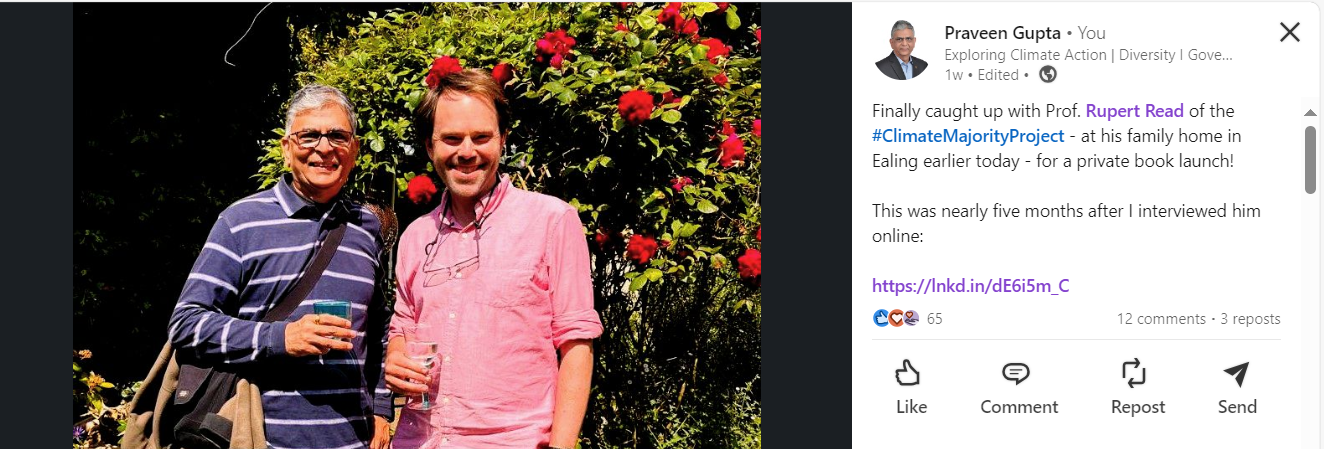
https://www.linkedin.com/feed/update/urn:li:activity:7198051019358900224/
And here you can hear Prof. Rupert Read and I having a spontaneous conversation:
https://www.youtube.com/watch?v=lru2x4GDCq0 many months ago.

Wolfgang Kuhn is an independent consultant advising on sustainability-related matters in a financial market context. Previously, he was Director of Financial Sector Strategies at London-based research and campaigning group ShareAction. Before joining the civil society sector, Wolfgang spent 20 years analysing and investing in corporate and government bonds.
Wolfgang holds a German master’s degree in business administration from Technical University of Berlin, is a GARP Financial Risk Manager (FRM), a Certified EFFAS Financial Analyst (CEFA), and used to be a CFA charterholder.
Praveen Gupta: Much of Climate breakdown discussion centres around Carbon. Biodiversity is not on the radar?
Wolfgang Kuhn: Well, I think it has arrived on the radar, looking at The Taskforce on Nature-related Financial Disclosures (TNFD), Partnership for Biodiversity Accounting Financials (PBAF) and other initiatives. But is much more difficult to deal with, as location is a crucial element, which isn’t the case for carbon. Also, you can’t use the I-wish-we-had-a-carbon-price excuse to inaction because pricing biodiversity is impossible. Not that people aren’t trying, but I think it is the wrong approach.
PG: Is the financial sector absolving itself by pushing the buck back to governments?
WK: A resounding yes. Of course and without doubt, governments have the major role here. But we won’t get very far if we go with the entrenched view that it is for business to profit-maximize and governments to set the rules. Corporations now make decisions too systemically relevant and far reaching to allow them to push all responsibility towards governments.
PG: Is Too-Big-To-Fail (TBTF) making big finance complacent. They know central banks will bail them out? Did Alan Greenspan set a bad trend?
WK: Not TBTF of individual large financial institutions, but TBTF of the whole financial market. Central bank policy over the past quarter of a century (Greenspan put, Bernanke put, QE, asset purchase program this, asset purchase program that) has prioritized the stabilization of the financial system over anything else. Asset price inflation is outside of the mandate when stock prices are going up, but when stock prices are going down, deflationary pressures are cited to justify accommodating policy. I would argue that central bank policy is the single biggest reason why sustainability risks are neither priced nor taken seriously.
Everyone knows full well that the financial system has been allowed to become so over-levered that central banks can’t tolerate any half-significant asset price drop without risking the dominos to start falling. So why worry about stranded assets? Systemic issues are irrelevant because they are taken care of. By the time central banks can’t help any more, you will have left too much money on the table if you didn’t invest in systemic risks. Maybe this is also a reason for the ESG-push-back: it isn’t obvious why the systemic risks we are facing are danger to people’s portfolios.
“The standard argument is that business should be allowed to make profits at all costs, and that it is for the state to set the rules.”
PG: Public companies have become very big and assertive. And PE companies are free for all modes at private companies. Isn’t this corporate capture in play?
WK: Yes. The standard argument is that business should be allowed to make profits at all costs, and that it is for the state to set the rules. But then business helps setting the rules through outsized influence. Honi soit qui mal y pense (“shame on anyone who thinks evil of it”).
PG: Would you agree stewardship is in crisis?
WK: Looking just at how executive remuneration has developed, I am minded to argue that stewardship has never worked. And it appears the system is built against shareholders exerting their will. Of course, investors can tell management individually, but are bound to be ignored. Or they could do so in coordinated fashion, but inevitably, someone will say that is against the law.
That is why collaborative engagement platforms are ineffective: they cite the risk of being seen acting in concert, or anti-competitively as reason for not really coordinating their actions. So everyone is on their own. It is a convenient argument, but also one that is very difficult to disprove.
If groups of shareholders aren’t permitted to form a view together, than we are in a similar situation to those of autocratic political systems: people might still get a vote, but if they are not permitted to co-ordinate and form parties, voting results become what those in charge of matters want. Autocrat governments always get the votes. (Ok, maybe comparing CEOs to autocratic leaders goes a bit far).
Now, that may just work fine for companies and their shareholders on a day-to-day basis: Why care how much shareholders leave on the table. But when we come to systemic issues, CEOs ignorant of systemic threats (the persistent academic argument that management knows best is highly questionable) need direction. But directing is not possible, because shareholders are not permitted to express a common view. At least that is what we are told, and everyone is happy to play along. So who is controlling corporations if shareholders aren’t able to? Corporations control themselves. Go figure.
PG: Not only is climate risk becoming more immediate, but it is also systemic and likely to manifest as #polycrisis?
“If you do care about the world, you don’t bother with figuring out how much of the ‘carbon budget’ is yours.”
WK: People are going on and on about whether portfolios are aligned with this or that scenario. A pretty irrelevant exercise, in my view, mostly used to justify the status quo. If you only care about financials, then you focus on the immediate future, and discount anything beyond 10 years in the future. No scenarios needed. If you do care about the world, you don’t bother with figuring out how much of the ‘carbon budget’ is yours. You accept that ANY further warming is going to have terrible effects, and you try to cut your negative impact as fast as possible. No scenarios needed.
PG: Has sustainable finance lost its way?
WK: Sustainable Finance is busy convincing everyone that it is all about financing ‘solutions’, about financing ‘impact’. All about financing green. Greening finance is discounted as something unscientific. Worrying about financing pollution is un-scientific. Not investing in fossil fuels has no effect on the world. Refraining from investing in economic activity that involves child labour is ‘value-based’, but not impact-generating. So they say.
PG: Isn’t ESG getting boxed in the disclosure space?
WK: No. That seems to become common sense, but it isn’t true. Of course, everyone knows what should be done without any more disclosure. Unfortunately, though, no-one will do anything without more disclosure.
If you have a problem with disclosure, why is that? If box ticking is your answer, than tell me: do you think that pilots should do box-ticking before they fly, or do you prefer they follow their gut instinct?
Of course, disclosure is not sufficient to get action. But I would argue that it is pretty much a necessary condition.
PG: Many thanks Wolfgang for your trademark crisp and candid insights!
Illuminem
April 27, 2024
https://illuminem.com/illuminemvoices/boeing-is-it-really-about-supply-chain

Re-published by The Insurance Times
May 2024

Illuminem
May 9, 2024

https://www.linkedin.com/feed/update/urn:li:activity:7194144897501655040/
Walter Murphy charts an unfolding drama that lies ahead for #insurers and #reinsurers #underwriting and #investing in #fossilfuel – in his interview with me.
The average window between billion-dollar climate disasters in the United States has drastically reduced to a mere 20 days.
Interestingly, despite the rising frequency and severity of losses, some of the biggest reinsurers operating in the US market have made record profits. Perhaps a part answer lies in the fact that climate risk prone areas are rapidly becoming #uninsurable.
Walter explains: “U.S. insurers currently have approximately $582 billion invested in fossil fuels, including nearly $90 billion in coal alone.”
“The insurance and reinsurance sectors continue to underwrite fossil fuel projects and continue to invest premiums in fossil fuel companies, thereby exacerbating the #climaterisks (hurricanes, flooding, wildfires, etc.) that directly affect their business. They have and continue to contribute to climate change.”
“As the world accelerates its #energytransition pace to move from a fossil fuel-based to one run by #renewableenergy, Walter tells me, all those fossil fuel assets that the insurance and reinsurance sector continue to hold and finance become highly vulnerable to becoming #strandedassets.”
US Treasury Secretary, Janet Yellen, has expressed alarm at the growing #protectiongap for Americans seeking insurance against property losses. Increasingly the federal government is the one becoming insurer of last resort.
Given this stark reality, can ‘astute’ underwriters, and the rest of ecosystem continue gaming what to and what not to patronize?
Illuminem
May 2, 2024

https://www.linkedin.com/feed/update/urn:li:activity:7191619935645659136/
While the corporate world generally struggles with adoption of #stewardship, Susana Gago at Unakti shares how she is making some brilliant headway. “We cultivate a more participatory and responsible form of #governance that aligns with our commitment to #regeneration and #resilience at every level of our organization”, she explains.
Drawn to India in 2003, she shook off the corporate association at a young age. “It has been a transformative journey of personal, professional, and spiritual growth that has deeply influenced my worldview”, says Susana. Her ambition: “to create a positive impact on a planetary bioregional scale starting from India”.
Unakti is, what she calls, a movement dedicated to ecosystem and biodiversity regeneration. Committed to empowering #women from the #grassroots level, providing them with the tools and opportunities to uplift their communities. It fosters #community-based resilience, ensuring that local populations can thrive in harmony with their natural environments. A regenerative, holistic, and inclusive model of business that respects both the planet and its people.
As Susana and her team endeavour to create a just and equitable global order – they are rediscovering the ancient best practices, right here!
Beyond the world of #patriarchy.

As Founder and Lead Steward at Unakti, Susana drives a female-led ecosystem focused on restoring human and planetary health. The mission centers around replicable agroforestry projects for biodiversity restoration, and taking the lead on detoxifying the cosmetics industry.
Working closely with local women farmers and communities, Susana’s team cultivates valuable medicinal and aromatic plants. These botanical gifts form the basis of pure and potent raw materials, are used in cosmetics, health & wellness, and their own regenerative skincare line.
Unakti, under Susana’s leadership prioritizes impactful outcomes, ensuring financial gains align with their core values. They harness business as a catalyst for positive change, integrating regenerative design and social responsibility at the core of their operations.
Praveen Gupta: You quit the financial markets to nurture an alternative form of governance for a new system of doing business?
Susana Gago: Indeed, I left the corporate world in 2000 to reorganize my inner architecture at the age of 32, opening up space for more inspiring and purposeful possibilities in my life ahead. It has been a transformative journey of personal, professional, and spiritual growth that has deeply influenced my worldview. I was drawn to India, captivated by the profound insights I gained from several yoga books, most notably “Autobiography of a Yogi” by Paramahansa Yogananda. This incredible science not only introduced me to new spiritual dimensions but also ignited a passion for exploring deeper, more meaningful ways of living and working.
Since that pivotal shift, I ventured into the realm of sustainability with a slow fashion brand, nurturing it for 17 years. This experience was extremely challenging but fulfilling, focusing on ethical practices and sustainable growth. However, as my journey evolved, so did my vision. Today, I am at the helm of a more ambitious project, Unakti, which aims to create a positive impact on a planetary bioregional scale starting from India.
Unakti is not just a brand; it’s a movement dedicated to ecosystem and biodiversity regeneration. We are committed to empowering women from the grassroots level, providing them with the tools and opportunities to uplift their communities. Furthermore, our initiatives are designed to foster community-based resilience, ensuring that local populations can thrive in harmony with their natural environments.
This new chapter is about taking everything I have learned and applying it to create a regenerative, holistic, and inclusive model of business that respects both the planet and its people.
PG: There are no directors only stewards?
SG: At Unakti, we pioneer a governance model rooted in stewardship, moving away from traditional hierarchical structures, which seem outdated and somewhat immature to me. Recognizing that all team members are capable adults with enormous potential, we empower our team of co-stewards to step up into their own leadership roles. This approach is not only about empowering but also nurturing and sustaining.
“Our model emphasizes accountability and long-term caretaking over short-term gains, ensuring that every decision made is in the best interest of the community and the environment.”
Our model emphasizes accountability and long-term caretaking over short-term gains, ensuring that every decision made is in the best interest of the community and the environment. It’s about creating an environment where leadership involves guidance, empowerment, and oversight. This holistic approach helps ensure that our practices are ethical and collaborative, reflecting our core values of sustainability and inclusivity.
By focusing on stewardship, we cultivate a more participatory and responsible form of governance that aligns with our commitment to regeneration and resilience at every level of our organization. This transformation in leadership is not just a policy but a practice that permeates our entire operation.
PG: How are you leveraging self-help groups (SHGs) to nurture agroforestry in the Himalayan region?
SG: Currently, we are in the early stages of establishing our operations in the Himalayas, with our efforts focused on securing appropriate land. While our on-the-ground activities have not yet begun, our strategy includes empowering local self-help groups to implement sustainable agroforestry practices that are beneficial for both the environment and the communities.
A crucial component of our approach is the educational side of our project, which aims to enhance skill sets and build capacity among local women farmers’ groups. By introducing them to the latest AgriTech innovations and providing training in regenerative farming practices, we are committed to supporting these groups not only with the knowledge but also with the tools necessary for regenerative farming.
Moreover, our project is designed to bring all seven forms of capital to these communities, including financial, natural, social, human, intellectual, cultural, and spiritual capital. This holistic approach ensures that the interventions are robust and sustainable, enabling the women farmers to optimize their efforts, manage their resources more effectively, and ultimately lead their communities towards greater economic resilience and environmental stewardship.
Our partnership with these self-help groups will be instrumental in fostering a model of agriculture that is not only ecologically sound but also economically viable, creating a blueprint for sustainable development in the Himalayan region.
“Only men insecure of themselves feel uncomfortable with the idea of a Matriarch or Feminine leadership (which is genderless).”
PG: You have always been candid about the downside of Patriarchy. What’s your concept of Matriarchy? How does that align with Nature?
SG: Indeed, my reflections on patriarchy have always been forthright, and are based on proof-of-concept, highlighting its many limitations as a system characterized by violence, extraction, devastation, and exploitation. Over the last 7,000 years, patriarchal structures have significantly endangered life on our planet, with clear evidence all around us. If such a system, based on ego and ignorance, were a startup, it would have failed within just a few years. The acquisition of power through brute force is no match for the more effective powers of subtle and comprehensive intellect.
In contrast, my concept of matriarchy is deeply rooted in the historical success of such systems, which thrived for over 200,000 years. In a matriarchal system, gender does not dictate roles; instead, the focus is on balance and the equitable distribution of power and resources. This approach is intertwined with the feminine energy that exists in all of us, regardless of gender, promoting a system that values nurturing, cooperation, and sustainable growth. Only men insecure of themselves feel uncomfortable with the idea of a Matriarch or Feminine leadership (which is genderless).
These principles are inherently aligned with nature, embodying the way natural ecosystems operate through interdependence and balance. Matriarchy, in this sense, champions inclusive leadership and collective well-being. It draws upon the nurturing aspects traditionally associated with feminine energy, aiming to create a society that is balanced and equitable. Such a system not only supports social cohesion but also ensures that growth and development are sustainable and beneficial to all members of the community.
Additionally, there is compelling data and statistics that support the notion that women are particularly well-suited for leadership roles. Women’s collaborative, compassionate, and empathetic qualities have been shown to not only enhance team dynamics but also deliver better business outcomes. This evidence further bolsters the case for a matriarchal approach, highlighting the effectiveness of leadership that is attuned to these inherently feminine traits.
“There is compelling data and statistics that support the notion that women are particularly well-suited for leadership roles.”
While we operate within a matriarchal ecosystem at Unakti, it is crucial to emphasize that men in our team are deeply valued and respected. They are integral to our community, and there is a mutual appreciation that enhances our collaborative environment. Indeed, the men on our team are very happy -though for an authentic insight of their sentiments, one would need to ask them directly! This balance and mutual respect underpin our success and contribute to a thriving workplace.
PG: Much of the cultivation is dependent on women farmers?
SG: Yes, women farmers are indeed the backbone of smallholders farming. Their invaluable knowledge and skills in farming are critical not just for sustaining their families but also for enriching the biodiversity of the region. By focusing on empowering women, we ensure food security and enhance community well-being, thereby driving progress from the ground up. This empowerment is central to our approach, recognizing the vital role these women play in both agriculture and community development.
Furthermore, we firmly believe in the enormous untapped potential of women at the grassroots in exploited, robbed and abused countries worldwide. They are our first investment priority, especially those in marginalized communities who have endured exploitation for generations. Despite these challenges, these women remain the backbone of their families and communities. By investing in and empowering them, we aim to catalyze sustainable development and regeneration in these regions.
Additionally, it is historically proven that top-down approaches to development are often inefficient and prone to failure. These methods lack holistic problem-solving capabilities and a human-centered approach to addressing planetary issues. Our focus is on fostering bottom-up initiatives that empower individuals and communities from within, ensuring that solutions are sustainable, culturally relevant, and directly address the needs and challenges faced by those on the ground. This method not only promotes long-term success but also aligns with our commitment to respecting and uplifting human dignity in every aspect of our work.
PG: You are beholden to the concept of Gurukul and Vedic lifestyle?
SG: Absolutely, the Gurukul and Vedic lifestyle are foundational to our mission, deeply influencing our practices and ethos. These ancient systems emphasize wisdom, respect for nature, and a holistic approach to living, which align perfectly with our goals of sustainability and community empowerment.
The Gurukul system, traditionally a residential schooling system that teaches not only academics but also life skills and high spiritual knowledge, inspires our approach to learning and personal development. It fosters a close-knit community environment where knowledge is passed down through experiential learning, much like the mentorship and hands-on approach we advocate.
Moreover, the principles of the Vedic lifestyle, which prioritize balance and harmony with nature, guide us in creating regenerative practices that respect and replenish our natural resources. This approach to living is more crucial today than ever as we face global environmental challenges that require not only modern technological solutions but also a return to more balanced, conscious ways of living that can be sustained across generations.
“Moreover, the principles of the Vedic lifestyle, which prioritize balance and harmony with nature, guide us in creating sustainable practices that respect and replenish our natural resources.”
In my view, without any shade of a doubt, the most elevated, evolved, and flourishing civilization that has ever walked the face of the Earth is the Vedic civilization. Their profound contributions to language, science, astrology, geometry, binary mathematics, arts, and spirituality not only unveil the intricacies of the cosmos and universal powers but also qualify them as an immensely advanced culture. Therefore, we acknowledge this culture as the most valuable asset that Bharat has to offer. We are committed to preserving and spreading this valuable heritage globally, ensuring that the wisdom of the Vedic civilization continues to enrich and inform modern society.
By integrating these ancient wisdom into our modern practices, we aim to create a life-affirming model that nurtures the environment while also fostering personal and community growth. This holistic approach ensures that our initiatives are not only effective in the short term but also contribute to a regenerative and thriving future for all.

With the school kids in Nepal, gurukul style, talking to them about climate collapse, female leadership and regenerative farming.
PG: Your skincare venture aims to be regenerative? Even the packaging will be made from mycelium?
SG: Yes, Unakti is deeply committed to regenerative practices, extending beyond the products themselves to include every aspect of our packaging. In our relentless pursuit of planetary stewardship, we’ve chosen to move away from conventional, toxic plastic packaging options. We are pioneering eco-viable solutions by utilizing bio composite-based jars, which significantly reduce the use of plastics. Additionally, we’ve adopted mycelium-based secondary packaging, a material that naturally biodegrades and ultimately nourishes the earth rather than polluting it.
Moreover, each product is wrapped in a hand-made, seeded paper sleeve. This unique packaging choice not only reduces waste but also invites our customers to actively participate in the regenerative process. By planting the seeded paper, they can watch it grow and flourish, becoming a part of the cycle of life themselves. This holistic approach underscores our commitment to regenerative design and our belief in the power of community involvement in fostering environmental well-being.
PG: How do you wish to minimize the wealth gap between your grassroots workers and those of you at the very top?
SG: To minimize the wealth gap between our grassroots workers and those at the very top, we are actively implementing policies that bridge this disparity through a more equitable salary structure and through a steward-ownership model in which all the members of the team working actively and bringing value to the project, are having access to shares. We are consciously reducing the traditionally high salaries associated with top-level management and C-suite positions, and simultaneously increasing wages at the grassroots level. We find the current wealth gap not just disproportionate but frankly unacceptable, and are committed to rectifying this through our ecosystem policies.
Our approach is grounded in the belief that dedication, commitment and contribution should drive compensation, not just titles or roles. We consider all jobs within our organization as fundamentally important, adhering to the principle that no one is above anyone else based on their role or different birth opportunities. In fact, given that clean water, food, and air are essential to survival, we believe that the roles of farmers and other foundational workers should be especially recognized, supported, and compensated appropriately.
We find the current wealth gap not just disproportionate but frankly unacceptable, and are committed to rectifying this through our ecosystem policies.
This shift towards a more equitable distribution of wealth within our company is part of our broader commitment to a just and sustainable business model, one that respects and uplifts every member of our community. By taking these active steps, we aim to not only address the financial inequities but also foster a culture of respect and mutual appreciation across all levels of our organization.
PG: How successful are your crowdfunding campaigns to raise necessary capital?
SG: Our upcoming crowdfunding campaigns are poised to play a crucial role in raising the necessary capital to advance our mission. In June, we are scheduled to initiate a pre-seed equity crowdfunding campaign, by invitation only. This selective approach is designed to build a community of aligned individuals who recognize the urgent need to move away from outdated, profit-centric, short-term investment models to a smarter system where the planet and people are priorities, and profit is merely a byproduct.
The anticipation for our model is palpable, as we reached the funding target months before launching the campaign. This reflects a strong desire for change towards nature-based, female-led business models and governance structures. The interest generated so far indicates a clear appetite for innovative, regenerative approaches that challenge traditional paradigms.
In addition to our equity campaign, we plan to launch a rewards-based crowdfunding campaign. This campaign will open up opportunities for our fans and broader supporter base, allowing them to contribute to various capacities. Participants will have the chance to pre-order our first product at a discounted rate, further engaging with our mission and becoming active members of our ecosystem.
These strategic crowdfunding efforts are aimed not just at financial backing but at cultivating a robust, engaged community. This community will be deeply involved in our ecosystem, joining us on this inspiring journey towards a higher purpose. By fostering this connection with our stakeholders, we aim to collectively pursue sustainable and equitable development, making significant strides in transforming our industry and the world.
PG: What draws you to the Himalayas?
SG: The Himalayas hold a profound allure for me, driven by a combination of their majestic natural beauty and the deeper values they embody. This region is home to some of the most forgotten and vulnerable communities, whose resilience and wisdom are a continuous source of inspiration. Their rich indigenous culture offers invaluable insights into sustainable living and a deep connection with nature, principles that are core to our mission at Unakti.
Additionally, the Himalayas are a treasure trove of high-value potent medicinal and aromatic plants, which serve as vital raw ingredients for our products. The ecosystem here is not only rich but also critical for biodiversity conservation. These plants not only contribute to the efficacy of our products but also support the local economies and traditional practices that are centered around sustainable harvesting and use of natural resources.
“The Himalayas are in urgent need of protection. These areas play a crucial role in the global climate system and water supply, underlining the need for environmental stewardship…”
Moreover, the region’s environmental significance cannot be overstated. The receding glaciers and the critical landscapes of the Himalayas are in urgent need of protection. These areas play a crucial role in the global climate system and water supply, underlining the need for environmental stewardship, a responsibility we take seriously in our operations.
Lastly, the spiritual aspect of the Himalayas, often referred to as the abode of the gods, adds a profound dimension to our work. This spiritual heritage inspires our approach, infusing our efforts with a sense of purpose and dedication to preserving and celebrating this sacred landscape.
Together, these elements draw me to the Himalayas, compelling our commitment to work in harmony with the local communities, protect and leverage the natural wealth responsibly, and uphold the cultural and spiritual legacies of this magnificent region.
PG: This is amazing stuff, Susana. All good wishes in your endeavour towards creating a just and equitable order by rediscovering the ancient best practices.

Walter Murphy began his career in the U.S. political world serving a member of Congress before transitioning to the insurance industry. He spent almost twenty years in the property & casualty market, working for ISO, AIG and QBE in a product development and compliance role. He currently is an Environment, Societal & Governance (ESG) Risk Associate at BMO Capital Markets where he helps manage ESG risk for the bank’s first line of defense (1LOD).
Praveen Gupta: You recently mentioned that the Florida state fund is now bigger than the private sector as more and more insurers refuse to provide homeowner insurance in the state?
Walter Murphy: That’s correct. Florida’s state-run insurance program, which is supposed to be an insurer of last resort, has instead become the largest insurer in the state. Since more and more private carriers have become insolvent or have withdrawn from Florida, Florida Citizens Property Insurance Corp. has become the largest property insurer in the state. Citizens has grown to provide nearly 20 percent of Florida’s property insurance. Insurance costs have risen tremendously due to the intensity and frequency of hurricanes battering the state, resulting in more carriers to exit the state rather than deal with rising costs. If the state-run program does not have enough funds to cover insurance claims because of hurricanes, then Florida taxpayers will need to cover the balance.
PG: Given the growing hurricane activity on the Florida coast, the climate risk exposure is only bound to rise?
WM: Indeed. The Atlantic hurricane season is starting earlier and ending later due to the warming of the oceans in the Atlantic Ocean as well as the Gulf of Mexico. As you know, it’s this warming of the oceans which increases the intensity of the storms and dumps more rain than ever before. Another climate risk exposure that is particular to Florida is, of course, the issue of rising seas. Not only are properties that are situated on Florida’s coasts vulnerable, but because Florida is mostly lowland and just above sea-level there is now the threat that as oceans rise seawater will now begin permeating the geology and begin mixing with and polluting the groundwater.
“A recent report by First Street Foundation, a non-profit focusing on climate risk research, found 23.9 million properties in the US are at risk from damaging winds, 4.4 million properties at risk from wildfire, and a further 12 million properties have a significant risk of flooding.”
PG: It does not stop with Florida?
WM: It’s not just in Florida. You will see this in other parts of the country as well. California (wildfires), Louisiana (hurricanes/flooding), Texas (wildfires/hurricanes) are all feeling the stress of climate change and seeing large insurance carriers either dramatically raising rates or have abandoned the marketspace entirely. And it will not be relegated to coastal states. The Midwest is seeing more intense weather events – flooding, tornados, wind, hail – which are impacting insurance prices. In fact, a recent report by First Street Foundation, a non-profit focusing on climate risk research, found 23.9 million properties in the US are at risk from damaging winds, 4.4 million properties at risk from wildfire, and a further 12 million properties have a significant risk of flooding.
PG: How much of this is about politics? One impression emerging is that the state regulators do not wish to see the insurance rates going up too fast. And that these rates are not profitable enough for the insurers to stay in the game?
WM: Politics certainly does play its part in all of this. Insurance is regulated at the state level, so there is an insurance regulator in each state whose main role is to ensure that insurance rates and premiums remain affordable and that there is adequate coverage in its state. Climate change is and will continue to make regulators’ jobs harder and harder. As more frequent and costlier weather events occur, it puts more and more strain on private carriers. And it’s not just the small and medium sized enterprises. The major carriers also are struggling and rethinking where they want to off coverage.
Take California for example. In 2023, State Farm, one of the US’ biggest insurance providers, announced it too would stop selling new home insurance policies in California due to historic increases in construction costs outpacing inflation, rapidly growing catastrophe exposure, and a challenging reinsurance market. This was due to the devastating wildfires and floods in recent years, and the ever-looming threat of a major earthquake. For years, the California Department of Insurance would not allow carriers to price climate risk into their rates. The Department finally had to acquiesce because it could not afford to lose any more carriers to flee the state and allowed insurance companies to consider climate change when setting their prices which, of course, raised homeowners rates even higher.
“U.S. insurers currently have approximately $582 billion invested in fossil fuels, including nearly $90 billion in coal alone.”
PG: But then insurers are aiding and abetting climate breakdown by investing in and insuring the fossil fuel business?
WM: Unfortunately, that is still the case. In the United States, the insurance industry continues to support existing and expanded fossil fuel projects with few restrictions in place limiting – or excluding – either. U.S. insurers continue to underwrite polluting projects while making investments in an industry whose continued expansion poses multiple serious dangers to overall economic stability and to insurance services in particular. Many U.S. insurance companies are beginning to limit the scope of coverage they will provide – or pull out of markets entirely – due to their assessments of the likelihood of coming “catastrophic risk” caused by climate change. At the same time, and despite evidence that new and expanded oil, coal, and gas development is incompatible with global climate goals and long-term economic stability, the U.S. insurance industry is continuing to support fossil fuel expansion: U.S. insurers currently have approximately $582 billion invested in fossil fuels, including nearly $90 billion in coal alone.
PG: Not only does the insurance sector need to divest from fossil fuel, but also rethink its operating model – as climate change clearly has disrupted the old way of doing business?
WM: The insurance and reinsurance sectors are facing what many other financial and industrial sectors are facing and that is the concept of “double materiality”. Double materiality considers both the effects an organization has on the climate and environment and the potential impact of these factors on its financial performance. A double materiality approach recognizes that organizations contribute to, and are affected by, climate change.
The insurance and reinsurance sectors continue to underwrite fossil fuel projects and continue to invest premiums in fossil fuel companies, thereby exacerbating the climate risks (hurricanes, flooding, wildfires, etc.) that directly affect their business. They have and continue to contribute to climate change. In double materiality, the insurance sector is also highly vulnerable to transition risk. As the world accelerates its energy transition pace to move from a fossil fuel-based economy to one run by renewable energy, all those fossil fuel assets that the insurance and reinsurance sector continue to hold and finance become highly vulnerable to becoming stranded assets. Any energy sector asset, including coal, oil, gas reserves, and fossil fuel power generators, are considered the most potential climate stranded assets.
PG: Why aren’t the likes of pollution and biodiversity loss factored as externalities when pricing risks?
WM: I think you are beginning to see more traction when it comes to the plight of biodiversity loss and what it not only means for the insurance sector but for humanity in general. Deforestation, land-use change, overfishing, pollution, climate change and the introduction of invasive alien species have resulted in biodiversity losses. One million known species could go extinct within decades. At the same time, more than half of the world’s economic output depends either highly or moderately on nature and its benefits, such as fertile soils, food supply, clean water, climate control, erosion prevention and flood control.
“The potential economic loss from the biodiversity crisis is driving a need for insurers to better assess related risks.”
The Taskforce on Nature-related Financial Disclosures (TNFD) has really tried to bring more attention to the biodiversity crisis and how the insurance sector can price biodiversity into its risk models. The success of insurance underwriting always lies in the proper pricing of risk. The potential economic loss from the biodiversity crisis is driving a need for insurers to better assess related risks.
PG: This is an election year in the US. How would the political outcome influence the way insurers behave?
WM: Biden good, Trump bad. At the federal and international level, the presidential election will have tremendous bearing on the future of U.S. climate policy. As I indicated earlier, since insurance is regulated at the state level, it’s the down ballot elections that matter more – insurance commissioner, state legislature, governor. But I am not sure politics is really the main influencer when it comes to financial institutions and insurance companies turning away from fossil fuels.
Policy and regulations certainly do have an effect, but I think change is being driven more by economics and by choices being demanded by society. More people than ever believe that humans have affected the climate and are buying products and investing more of their money into green and sustainable products and services. Most renewable energy is now cheaper than or on par with fossil fuels and is getting cheaper every year. Economics and society are accelerating the transition. Pro-environment governments and their aggressive climate policies certainly would be welcome.
PG: ESG does not get even lip service. Any prospects for moving the needle there?
WM: Well, in America, ESG was all the rage until Republicans heard about it. Then ESG became a dirty three letter word as a symbol for being “woke” and it has become Republicans’ bogeyman. As you know, there has been a considerable amount of anti-ESG legislation that has been introduced throughout the country and some of it has been signed into law in “red states”. We’ve also seen the abuse of the term – products and financial services listed as “green” or “ESG-friendly” which has led to a considerable rise in claims of greenwashing.
Ultimately, I think the principles of ESG will continue to be touted and incorporated in financial institutions and the insurance industry simply because they are values that are proven to increase financial, societal, and environmental impact as well as ensure long-term competitiveness. In fact, I think ESG considerations are becoming more – not less – important in companies’ decision making simply because more of society is insisting upon these values and insisting that they be incorporated in companies’ that they work for and interact with in their daily lives.
PG: Many thanks Walter for these fantastic insights. It is really critical that the U.S. sets its house in order on the Climate and Bio-diversity front. I quite agree with you that your insurers cannot continue underwriting polluting projects and making investments in an industry whose continued expansion poses multiple serious dangers to overall economic stability and to insurance services in particular.
Illuminem.com
April 11, 2024


A tiger in the crosshairs image from an early campaign of ‘Project Tiger’ has stayed with me forever. The initiative ensured that the tiger stays on and continues to roar & rule our jungles.
Bittu Sahgal represents a rare breed that has relentlessly worked to ensure this success. “Project Tiger turned out to be the world’s first, to scale, rewilding project and it continues to be a metaphor for the resurrection of wild nature across the world”, he tells me in this fascinating conversation.
“Fragmentation of tiger habitats, which is ongoing in India will result in a loss of genetic diversity, not only of Panthera tigris, but of uncounted species that occupy the diverse habitats”, warns Bittu.
Moreover, the choices we now make will be very critical: “It all depends on whether India believes that its own future in an era of a galloping #climatecrisis is dependent more upon the resurrection of natural infrastructures, or on the iffy technology on which Homo sapiens seems to be placing all its bets today”.
Can we really afford to ignore his wise counsel?
 The Diversity Blog