
Doctors living longer is a growing breed. Longer living doctors serving generations of patients longer and longer are on the rise, too. However, those of them with a pedigree and a genius to effortlessly navigate way outside the box – remain a rarity. I have had the privilege of knowing one such.
The reason for writing this blog coincides with the publication of ‘To Talk Of Many Things‘. It is much more than a biographical account of nonagenarian Dr. Lalit Kothari’s glorious journey before, during and beyond the medical profession. While he had a brief stint as a student of liberal arts – growing up in a family of distinguished scientists, science was bound to draw him in. He chose medicine. Human Physiology has ever since been a lifetime passion as he endeavours to refine the art of medicine as a science of happiness.
The latest book echoes of an earlier title by him: ‘Man, Medicine And Morality‘ – a bouquet of withered flowers, with a subtle fragrance – as he calls it. Given his penchant for literature and history, he dips the readers into four key themes, in a unique style. Evolutionary history of medicine; ethical and cultural aspects of health, and healthcare; health beyond medicine; medical education, and the exciting life of medical students and doctors. All with a trademark sense of humour. For anyone wishing to explore Dr. Kothari’s written works – must draw the nuggets from these two books in conjunction.
Medicine: The Art
Modern medicine is science, but its use on individual patients – men and women, young and old, rich and poor, the confident and the skeptics – is almost an art.
The good physician humanizes the science of medicine. He adds human understanding, sympathy and hope to his science, drawing from the rich traditions of his noble art.
Following Descartes, we may consider man as a sophisticated machine but, unfortunately, the Celestial Manufacturer provides no handbook or operating manual to tell us how it should be handled and serviced!
Following Descartes, we may consider man as a sophisticated machine but, unfortunately, the Celestial Manufacturer provides no handbook or operating manual to tell us how it should be handled and serviced! That makes the work of a physician very difficult and challenging, and mistakes occur. With each patient different from all others (except in the case of identical twins, or clones of the future) because of the unique and infinite randomization of our genes, the doctor has the scope of an artist to do his work.
When medical science can no longer help the patient, the wise doctor carefully uses all his experience and skill to keep alive the patient’s hope and will to live. This is the Art of medicine.
Fault lines
Can health care be purely an industry? Doctors are entrapped on all sides by relentless pressure from pharmaceutical industry. Like a mysterious force-field emanating from a network of medical representatives, it is modulating every aspect of the medical profession, from treating patients to conferencing in Honolulu.
Take for instance an area where medicine and morality are sometimes at conflict, he points out, relates to the use of drugs. In India, more than 70,000 drugs or drug formulations are being sold in the market. Despite the World Health Organisation (WHO) having declared that this number is ridiculous and only 250 or so are normally needed.
In India, more than 70,000 drugs or drug formulations are being sold in the market. Despite the World Health Organisation (WHO) having declared that this number is ridiculous and only 250 or so are normally needed.
Medical education, he laments, provides only a surfeit of ‘mental experience’, some little ‘manual experience’ but no ‘moral experience’ at all. Just when the concern for morality in medicine is gaining momentum. The teaching of medicine is unique in the sense that half of it is on a blackboard and half around living patients in the hospital. This requires great sensitivity and experience. Traditional old hospitals will have to be reborn to function as a medical college hospital. It must be fully prepared to perform its 3 vital functions: Patient-Care, Teaching, Research. Only then will the hospital perform its full purpose.
From the beginning, I was constantly searching for ways to make physiology more and more interesting and clinically useful for students, he says. Teachers should also respect and admire their students; normally we expect only the students to respect their teachers.
Individual masters of healing art as the very embodiment of the highest human values? Dr. Kothari’s top picks being Charak, Sushruta, Hippocrates and Galen. And he reminds us of Sir William Osler’s famous words: “One of the duties of a doctor is to educate the community not to take medicines”.
Moral commitment of a health care establishment cannot be better stated, he illustrates, than this engravement on the gate of renowned medical missionary late Dr. Albert Schweitzer’s jungle hospital in Lambarene, Gabon (Africa): “Here, at whatever hour you come, you will find LIGHT and HELP and human KINDNESS”.

“Particularly, I was interested in the lives of three scientists – Dr DS Kothari, Dr Homi J Bhabha and Dr. Vikram Sarabhai“: Late Dr. A.P.J. Abdul Kalam.
Talking of many things
That doctors rarely see any books beyond their text-books never got into the way of his vast explorations. The Time has now come to talk of many things. But is anyone listening? He draws from ‘Of cabbages and kings’ – Alice in Wonderland.
If only had Queen Mumtaz Mahal not died during her fourteenth delivery, in 1631, Emperor Shahjahan might not have thought of the Taj Mahal. Likewise, have you ever wondered what an important role diseases have played in shaping the course of history? From Alexander the Great, Napoleon, Franklin D. Roosevelt, George Washington!
Then he takes you through – Mahabharat; relaxing in the modern world; yoga; power of thinking; spirituality; superstition; Charles Sherrington to Alexis Carrel to Aldous Huxley; Charles Dickens; Wordsworth; medical progress in the 20th century; health and culture; nonviolence. TS Eliot, The Time Machine, Descartes, Tantra, Rasputin, doctor patient relationship; The Monkey Who Peeped through the Key-hole; George Bernard Shaw & His Tailor; Paulo Coelho.
We have discovered the science of life, but not the Science of living. Will medicine rediscover the soul?
Healthcare beyond medicine has been his constant pursuit. We have discovered the science of life, but not the Science of living. Will medicine rediscover the soul? Strangely the word ‘soul’ which has completely disappeared from all modern textbooks of medicine, he laments. Incidentally, it occurs frequently in Alexis Carrel’s book.
In search of happiness
Where have I gathered all these anecdotes and historical stories? I really don’t know, he quips! For the polymath in him, perhaps this is his way to stay happy. While Dr. Kothari wraps up the book ahead of the onset of the pandemic, his deep concerns touch upon the many fault lines we have seen manifest as vaccine apartheid and profits before people. He yearns for the soul to return to medicine, however, it is eventually the quest for happiness that he believes is the most fundamental pursuit.
Happiness can be both elusive and evasive! He quotes Somerset Maugham from ‘The Summing Up‘. “I saw in the wards what hope looked like; and fear and relief. I saw the dark lines that despair drew on a face. I saw courage and steadfastness. I saw the gallantry that made a man greet death with an ironic smile because he was too proud to let those near him see the terror in his soul.” All the more reason as to why it is worth seeking.
In his impressive list of influencers two that stand out the most are – his late father Padma Vibhushan Dr. Daulat Singh Kothari, an eminent scientist, and Mahatma Gandhi – both a rare embodiment of austerity and self-effacement. With a moral compass such as this, our good doctor’s Rx should not be any surprise: “Seeking Happiness? Count Your Blessings and Be Happy”.
“My formula is easy and it has a use for every human”, he tells me.

Vibhuti’s work includes providing decarbonization pathways, including its impact on environment, air pollution, jobs; promoting clean energy solutions for the agriculture sector by adopting water-energy-food nexus approach; enhancing national and international understanding of India’s progress; and helping inform governments and financial institutions globally about the pace and opportunities of reforms in India.
Praveen Gupta: Analysis of country-level data shows that the greater the proportion of a country’s population that has access to electricity, the greater its gender equality?
Vibhuti Garg: Absolutely, with greater access to electricity, more women are able to free their time from general household chores and divert their time on income generating opportunities, which make them more empowered. They have a voice in pushing for their child education especially girls, use more sustainable energy choices, energy efficient appliances etc. which in turn has a positive impact on their income and productivity.
For example, many women in small towns are now selling solar lamps and solar house systems which enhance energy access but also create opportunities for them to become entrepreneurs.
With greater access to electricity, more women are able to free their time from general household chores and divert their time on income generating opportunities, which make them more empowered. They have a voice in pushing for their child education especially girls…
Also, it allows more girls to undertake education and be part of the formal workforce. Women feel more protected with improved street lighting in their areas. Further, in some households shifting to electric cooking will also save them the time and hard work of collecting biomass, cow dung, wood pellets for cooking. It will also have positive impact on their health as they will not be exposed to indoor pollution using traditional fuels which are polluting.
PG: What are the challenges for women to participate in the active workforce?
VG: It needs to be noted that women participation is ~20% of the workforce. Most of the micro enterprises set up by the women are self-financed, which makes them more vulnerable. A lot more supportive ecosystem needs to be created for them to thrive and have better livelihood opportunities.
There are limitations for women to relocate in search of livelihood. They do not have finance for upfront payment to start business. Lack of awareness and required skillsets impact their confidence to engage in income generating opportunities.
By imparting them education, required skills, providing energy access, and more importantly financial inclusion – the biggest challenges would get addressed.
PG: Women and girls are often disproportionately responsible for household duties – particularly in rural settings – where they spend considerable time on collecting firewood for basic cooking, heating, and lighting needs?
VG: Women account for just 22-25% of total employees in the power sector, and a low proportion work in science, technology, engineering and mathematics (STEM) roles. It has been demonstrated that a lack of gender equality in the energy sector puts utilities at a disadvantage, boards with at least 30% women have higher profit margins than those that do not. It has also been suggested that energy sector organisations that improved gender equality can boost innovation.
Energy access would allow reduced time burden for women on activities like cooking, heating etc. A better use of their time and skills will allow them to be part of earning members of the family.
Women in rural India are now getting opportunities in high earning jobs, because of improved energy access they will have more options. Solar Sahelis in Rajasthan is a classic example of how women have turned entrepreneurs. They rope in more women to their network, demonstrate improved sales and after sales services. By participating in income generating activities, their welfare and both physical as well as mental wellbeing has improved.
Solar Sahelis in Rajasthan is a classic example of how women have turned entrepreneurs. They rope in more women to their network, demonstrate improved sales and after sales services. By participating in income generating activities, their welfare and both physical as well as mental wellbeing has improved.
PG: Studies demonstrate that improved access to electricity improves baseline living conditions for women?
VG: Studies evidence positive correlation between energy access and women’s economic empowerment. However, this is still not considered as one of the big levers for women’s economic empowerment and thus has not got the due which it should be given.
As highlighted above women can use their time more productively and in income generating activities. Young women can invest their income to education and skill development. They will be financially more independent and able to raise their voice and put their demands forward.
In order to empower women from low-income communities, an initiative called Project Vahini, which involved promoting female ownership of e-rickshaws by addressing the challenges around access to affordable finance, infrastructure, awareness etc. This project can be scaled up as it provided lot of job opportunities for women by creating women micro-entrepreneurs in last mile transportation. We also have big taxi aggregators like OLA with ‘By Women, For Women’ taxi service.
PG: Firewood as a dominant source of energy – triggers deforestation?
VG: It is criminal to cut trees to use as a fuel for energy demands. Climate risk is one of the biggest risk impacting mankind. Efforts should be directed towards afforestation and use of clean energy to meet cooking and electricity needs.
There is a large renewable energy potential in our country which should be exploited. The health costs of burning fossil fuels or using firewood is much higher than using renewable energy. These fossil fuels are subsidized or come at no cost to people. However, the indoor and outdoor air pollution they cause is a big price in terms of high mortality and morbidity rates. A comparison of the health costs vs renewable energy costs, renewable energy wins big.
It is criminal to cut trees to use as a fuel for energy demands. Climate risk is one of the biggest risk impacting mankind. Efforts should be directed towards afforestation and use of clean energy to meet cooking and electricity needs.
PG: Volatility of gas pricing makes the dependent population vulnerable? Is solar the long-term answer?
VG: India relies heavily on gas imports. Price volatility of gas has exposed the vulnerability of nations relying on such expensive fuels. In recent times, gas prices have been extremely volatile, reaching unprecedented lows in 2020 and all-time highs in 2021. Japan Korea Marker (JKM), considered a benchmark for spot Asian LNG prices, went from US$2 in April 2020 to US$30 in September 2021 due to the onset of Covid-19 and post-lockdown economic recovery, respectively.
Volatile fuel prices can raise the operating costs of downstream projects in the industrial, power and CGD sectors – harming product competitiveness, utilisation rates and returns on investment.
The government should reduce reliance on gas and increasingly start replacing it with renewable energy. In urban areas where the electricity load is relatively stable, there should be increased effort to switch to electricity. India would eventually have to move to electric cooking and mobility to achieve the target of 450 gigawatts (GW) of renewable energy by 2030, so leapfrogging now would be a more pragmatic long-term strategy.
PG: Do you see opportunities to directly employ women in the electricity sector along the entire value chain?
VG: Yes, women after acquiring the required skill sets can do lot of jobs including billing, collection, also for decentralized renewable energy generation. They can be entrepreneurs as well responsible for sales, revenues and providing after sales services.
An initiative called Promotion of Women in Energy Related Enterprises for Development (POWERED), a first if its kind accelerator programme supporting female led ventures across the energy value chain, has led to creation of 3,700 jobs for women, 260 women supported to set up micro enterprises and 22 women-led energy startups.
Women can also promote solar pumps in farming. This will help in enhancing income and improved productivity but also at the same time improve water conservation and prevent use of harmful diesel for meeting their irrigation requirements.
PG: Many thanks Vibhuti for sharing these insights. Best wishes in all your ongoing endeavours at such a critical juncture.
My Op-Ed: Illuminem
https://illuminem.com/energyvoices/d6476570-88fa-4221-93f7-164412a03745
With much of tokenism relating to #IWD to be soon behind us, securing energy for millions of women and girls particularly in the developing countries cannot be lost sight of.
Ukrainian scientist Svitlana Krakovska, at the final sign off of the recent #IPCC report said: “Let me assure you that this human-induced climate change and war against Ukraine have direct connections and the same roots. They are fossil fuels and humanity’s dependence on them”.
This battle is also about renewable versus non-renewable sources of energy. However, as the unfortunate drama escalates, #fossilfuel pricing keeps scaling new highs. Some optimists believe this is a tipping point for the #renewables.
In the meantime, as the #extractive industry merrily continues to destroy the green cover, how do we sensitise the billions about #biodiversity and #ecologicalservices that we take for granted? I cite the works of celebrated author Amitav Ghosh and renowned ethnobotanist Mark Plotkin.

Thanks to a friendly intervention and this invitation, I had an opportunity to revisit the ‘Climate Change Exclusion’ clause and read it between the lines. Happy to note that anthropogenic gets attributed directly or indirectly to human activity. Having said that, there is a problem with our siloed thinking. Even though issued for the liability teams, the fiduciary responsibility could very well make this omni applicable to any other class/es of business.
If an insurer or a reinsurer were not to hold a subject matter covered (redline) against Climate Change – should it be investing (as an investor) in any such business? If it still does, would it not be oxymoronic? And if it stops doing so, that would be a truly benign influence of this clause!
Key messages
As Climate Change nudges insurers out of their comfort zone; Institute of Public Policy Research warns us of new emerging risks; Financial Protection Forum (World Bank Group) reminds of assessing financial risks from physical climate shocks; ESMA classifies Climate Risk as a new distinct risk category; Patrick Flynn of Salesforce shows the way forward as climate pledges crumble under scrutiny; there are many a slip between the cup and the lip – whilst dealing with Science Based Targets initiative (SBTi)!
Strategy is no longer bounded by shareholder value, reinforces Alison Taylor. And insurers must quickly change too. Textile consumption, for instance, has the fourth biggest impact on the environment and climate change – after food, housing and mobility! Ah, the magic of marketing. Insurers – watchout for greenwashing! Embedding sustainability is work in progress. But we do not have time.
“Engagement with customers on Climate Risks, not exclusion, the best way forward!”
– Zaneta Sedilekova, Climate Change Lawyer
Transition to low carbon economy has its opportunities and threats. Can the insurance industry support this critical transition? There is a price to be paid for fundamental changes in the business models. Insurers must assert as stewards. How can we forget pricing nature in insurance? Remember both TCFD and TNFD will hold insurer boards responsible for aiding and abetting biodiversity loss.
Carbon removal remains unproven, thus net-zero could be a mirage. Fossil fuel must go. Without action, WHO and The Lancet tell us, both excess morbidity and mortality can be expected. Climate litigation is here and insurers are bound to get enmeshed. Australia has shown how tort is good enough pending ecocide codification. Reputation and existential risks as a quid pro quo for procrastinating? A rather heavy price…

OpEd in Illuminem: February 17,2002

https://illuminem.com/energyvoices/52d115ee-a021-49d5-93f9-9c2b39c08475
Climate Change is nudging insurers out of their comfort zone. As a handmaiden of the industry, insurers have been ensconced at the point of sale for too long. It is time for an urgent course correction and willingly head towards the moment of truth. What can be a bigger truth than the climate emergency – an outcome of anthropocentric activity hastened by the industrial revolution. Whether it calls for mitigation, adaptation or resilience would depend on how quickly the reality dawns upon them. The signals are writ large and a lip service, as it turns out today, would be catastrophic not only to USD 6 trillion-plus global insurance business but can cause a far bigger damage arising from the investments of its float. Here I pick signals from the Geneva Association, Institute of Public Policy Research, Swiss Re and The Guardian.

Praveen Gupta: What constitutes a genuine Environmental, Social & Governance (ESG) fund and why is it not so easy to identify one?
Harald Walkate: People don’t agree on what they expect from ESG funds, so it’s also unlikely we will end up agreeing on the definition of a ‘genuine ESG fund’. To me, an ESG fund is genuine when the investment team has some sort of investment conviction that is related to ESG, and they can clearly articulate this conviction, but also explain what that means for the investment process and for expected outcomes. I call this the “Conviction & Narrative” approach. But other people believe, for example, that oil is “not ESG”, so any fund that invests in oil companies can not be genuine, even if the point of the investment team is to work with that oil company to reduce emissions or develop renewable technologies. Genuineness is in the eye of the beholder.
PG: What are the key ESG considerations that ought to be incorporated in an investment strategy? How easy or difficult is this process?
HW: I think investors should focus on ESG considerations that are ‘material’; i.e. considerations that influence your investment decision: you would make the investment decision differently if you did not have access to this information. But that means that it depends what kind of investing you’re doing and which sector or businesses you’re investing in, which ESG considerations you look at. One of the things we’ve learned after about 15 years of doing ESG integration is that materiality is ‘situational’. And I think people are making this out to be much more difficult than it actually is; in my experience in working with portfolio managers and analysts it is relatively straightforward to work out which issues are material.
PG: How crucial is the role of an ESG team and what should ideally be the most critical skillsets?
HW: Here also, it depends. I’ve worked with asset management firms who have no ESG team, or a very small one, and who are better at understanding ESG issues than many asset managers with very large teams. I think the critical skillset is: (1) have true expertise in certain ESG issues, recognizing that today almost everyone calls themselves an “ESG expert”. ESG is also very broad so you can’t be an expert in all of these things. (2) understand financial markets and investments. ESG is a wonderful thing but you have to recognize that you work in an investment organization. If you don’t know what that entails, or understand who you’re investing for and what preferences and restrictions that comes with, you will not be very effective. (3) be a teamplayer. You need to be able to work with investment, research, compliance, legal, communications people, and perhaps also with other experts in other organizations. If you’re not a self-starter or reach out to people easily then you’ll likely not have much impact.
I’ve argued that we should take a much more qualitative approach to attribution. Also, when talking about impact investment, we have to recognize that most outcomes cannot be attributed directly to any one specific company, project, or investor.
PG: What is attribution assessment? How important is it?
HW: It is assessing, or measuring, what the outcomes are of your ESG approach. It is quite important, because you want to know if your approach is working, if your theory of change is correct. At the same time, attribution is usually very hard to measure precisely – i.e. quantitatively – and I’ve argued that we should take a much more qualitative approach to attribution. Also, when talking about impact investment, we have to recognize that most outcomes cannot be attributed directly to any one specific company, project, or investor.
PG: Regulatory guidance could vary from a regulator to regulator. Do you see emergence of a common standard?
HW: Not really. Roughly speaking you see regulators who expect a lot from disclosure, with the idea that once we have transparency on ESG things that companies and investors will do something about them – something I’m rather skeptical about. And then there are regulators who try to directly change, incentivize or ban specific activities, which makes more sense to me. There does appear to be a common standard emerging in how regulators are looking at ESG funds, in many countries (eg. UK, Switzerland, Denmark, US) guidance has been issued that – boiled down to the bare essence – tells investors to “say what you do, and do what you say”. This is very similar to my Conviction & Narrative approach.
PG: What is the significance of a fund label? Can it trigger greenwashing? Constituents of ESG fund sometime look no different from any other fund?
HW: The significance of labels is extremely limited. There are many labels out there, with different standards, which is confusing to the customer. Also most labels are pretty easy to get, as long as you pay. And then there are new ‘labels’ in the form of Sustainable Finance Disclosure Regulation (SFDR) classifications article 8 and 9 – those are actually free (even though you have to disclose a lot of information on those funds but that’s doable for most large asset management firms) and the requirements for when you can opt for art. 8 or 9 are relatively light. In other words, yes, there are a lot of funds out there that have some ESG label or indicator on it, but the asset manager will have a hard time showing “what’s ESG” about the fund, and indeed many of these funds will be basically undistinguishable from conventional funds.
PG: Would there be some businesses (Oil & Gas in particular) that you would not expect to see at all?
HW: No, not really. As said above, ESG means different things to different people. Some look to ESG funds for values-alignment, others for outperformance, and yet others for ‘impact’. So it depends what you want to achieve to say what should and should not be in your fund. The main challenge for us should be to educate consumers about what you can and cannot achieve to address ESG issues through investments, not so much trying to have objective rules on what should or should not be considered “green’” or “sustainable”.
Presumably the investment industry would consider it ‘allowed’ to have ESG funds that invest in gas & nuclear. But at the same time…there would be asset managers who see a market opportunity for funds without gas and nuclear, and would call them “true sustainable” funds…
PG: Wells Fargo, Citi, Morgan Stanley received a boost in their green credentials from MSCI Inc. even after providing $74 billion to polluting companies?
HW: I’m not familiar with these cases but usually whether or not large banks provide funding to polluting companies makes extremely little difference to the problem of pollution or climate change. Instead of wasting time pointing fingers at polluting companies or their banks, people could be much more effective by trying to change the bigger system, e.g. engaging in the political process, calling for the needed taxes or subsidies, or working out ways to stimulate the development of new technologies.
PG: If Nuclear energy and Gas were to be classified as green in the European taxonomy, how would ESG funds treat them?
HW: Presumably the investment industry would consider it ‘allowed’ to have ESG funds that invest in gas & nuclear. But at the same time, presumably there would be asset managers who see a market opportunity for funds without gas and nuclear, and would call them “true sustainable” funds, or whatever. All of this is not going to make much difference at all to the problem of climate change – what’s decisive is how the EU and other governments will use industrial policy, taxes and subsidies to transform our economy and how much they will rely on nuclear and gas in these activities. Right now it doesn’t look like the Taxonomy is going to play a very big role in that decision-making.
PG: Many thanks Harald for demystifying some of the concepts relating to ESG. Looks like I still need to better my understanding as to how ESG investing can direct the money pipeline towards addressing the Climate Emergency.

Praveen Gupta: Do you see any disconnects between our coal addiction, net zero commitments, ongoing efforts to raise the coal production and the urgency in raising the share of RE?
Kashish Shah: India is the world’s third largest and one of the fastest growing electricity markets. We will continue to need additional power capacity to serve electricity demand growth of 5-6% annually for this decade.
I think we have not been able to build renewables capacity fast enough. To reach the target of 450GW by 2030, we need an annual build rate of ~35GW from the build rate of 10-15GW last 5 years. Furthermore, we would require substantial energy storage capacity for grid-balancing.
This would allow India to phase out its coal-fired power fleet and transform its electricity system to be cheaper, cleaner and more reliable.
India is the world’s third largest and one of the fastest growing electricity markets. We will continue to need additional power capacity to serve electricity demand growth of 5-6% annually for this decade.
PG: There is a big gap between the gross capacity of thermal energy and the actual capacity utilization?
KS: Yes, India’s coal-fired power fleet has been operating an unsustainably low utilisation factor of ~55% for the last several years.
PG: Are the discoms favourably inclined towards aligning with RE sources?
KS: The discoms continue to be in bad financial shape. However, government-owned entities such as Solar Energy Corporation of India (SECI) and NTPC are playing a key role in underwriting renewable energy contracts and reducing the counterparty risk.
PG: Do you see challenges coming from the land supply, water shortages, disposal of solar panel wastes as a spoilsport?
KS: Solar power operations use a fraction of water compared to thermal power plants. Now developers are employing water-free technology for cleaning the panels.
PG: Where are we on the battery supply side? How soon can that front be ramped up?
KS: In our view, recent market and regulatory developments indicate India’s battery storage market could boom in no time. Continuing a decade-long deflation in costs, solar plus batteries are cost competitive with new coal-fired plants in markets such as the U.S. and Australia, where battery storage development is burgeoning.
In India, there is a similar prospect for a surge in uptake of battery storage as the learning-by-doing experience deepens as new projects, backed by tenders from government-owned entities such as NTPC and Solar Energy Corporation of India (SECI), are executed.
ReNew Power, one of the biggest renewable energy developers in India, and Fluence Energy, a leading battery technology provider, have announced a joint venture to develop a 150MWh storage facility in Karnataka. ReNew Power has won numerous RE plus storage tenders and the battery project will play a key role in delivering firmed RE capacity.
The cost of batteries could reduce further with local manufacture.
The Government of India is striving to support the localisation of batteries’ value-chain with a Production Linked Incentive (PLI) scheme worth Rs18,100 crore (US$2.47Bn) for 50GWh of battery storage for electric vehicles (EVs) and stationary battery storage. The tender has been oversubscribed 2.6 times with bids received for 130GWh of battery manufacturing capacity. The interested parties are Reliance New Energy Solar, Hyundai Global Motors, Ola Electric Mobility, Lucas-TVS, Mahindra & Mahindra, Amara Raja Batteries, Exide Industries, Rajesh Exports, Larsen & Toubro, and India Power Corporation.
They have a track record of delivering dramatic cost reduction in the sectors it has ventured into and it would not be a surprise if they manage to do the same in the clean energy space.
Reliance’s entry into the market could change the landscape dramatically. Reliance is looking to acquire world-leading technology and to further scale it up in the Indian market. They have a track record of delivering dramatic cost reduction in the sectors it has ventured into and it would not be a surprise if they manage to do the same in the clean energy space.
PG: How do you see dealing with rare minerals like lithium and its unique sensitive supply chain issues?
KS: Yes, that is going to be a challenge. The recent supply shortages in lithium have put a halt to the decade long deflation in lithium-ion battery storage. This is where diversification of storage technology will come into the picture. There are other battery technology alternatives such as storage, Sodium Sulphur, zinc-air, liquid metal and storage systems based on gravity and compressed air. The recent global supply shortage in lithium is mainly induced due to the pandemic driven supply-chain bottlenecks. This would probably ease out as the pandemic subsides.
PG: How do you see the equation change as private operators play an increasingly larger role in the overall pie?
KS: In my opinion, the transition should be market-driven for it to be sustainable.
PG: What is the rationale for gas?
KS: Gas has never been viable for India in the absence of local availability of the fuel. We should look to leapfrog to green hydrogen. That is the future!
PG: Do you expect any budgetary sops to further boost solar and wind generation?
KS: Rationalisation of GST on solar equipment will provide a much-needed clarity for the industry. I think we could expect that in this year’s budget. Additionally, I hope to see some budgetary allocation for the research and development of the green hydrogen industry. For example in Australia, Australian Renewable Energy Agency (ARENA) has funded roughly 10-12 test projects for green hydrogen development.
PG: Many thanks for these quick & succinct insights, Kashish. I appreciate your general sense of optimism.
Illuminem: January 24, 2022
“The US is the world’s largest historic greenhouse gas emitter. Now, standing on the verge of running out of carbon budget, US insurers need to abandon their fossil-fuel fixation.”
In today’s article, Praveen Gupta explains why climate change is driving major changes to insurance supervision and regulation in the US.
Read the full article on illuminem: https://lnkd.in/eCHvQsaT

Praveen Gupta: Do businesses fully realise that climate is both a systemic and existential risk? Why are they trying to game it rather than address the bubble? What do you think they ought to be doing?
Jerome Tagger: A growing number are coming to realize that the climate crisis could have existential consequences. At the same time, the status quo appears comfortable, cognitive dissonance is strong, the unknowns (e.g., tipping points) are confusing (as well as an excuse for inaction) and the perceived trade-offs are too high. Executives are rarely incentivized in terms of reward, to drive this sort of transformation, few seem to have the courage needed to stand out and lead, and economic systems (from investors to consumers) pressure in a different direction.
This type of societal transformation is chaotic and anarchic – there is no one at the helm, so no one will dictate transformation. What leaders should do: set their organizations on a path to rapid transformation, advocate tirelessly with their constituents, support level setting legislation (e.g., carbon pricing), strengthen rather than weaken governance and political institutions, and constantly raise the bar of their ambitions. What civil society should do: exert constant pressure for them to do so and call out insufficiencies.
PG: Suddenly everything about capitalism seems fragile? Unlike other forms of ‘isms’, can this be capitalism’s ‘antifragile’ moment?
JT: It’s too early to tell. What is capitalism anyway? Seen from Berlin, Beijing, New York or Lagos, you might come to different conclusions. Is it shareholder primacy? That’s likely to stay strong in countries with large liquid markets and matching ideologies like the US. Is it just in time global supply chains? Covid is showing the limits of that, and companies are to some degree reacting, but there are limitations, for example with natural resources where supply diversification is a challenge. Is it the increasingly concentrated economies, with 4-5 companies controlling key global sectors?
One of our advisors estimates the risk of Severe Global Disruption this century at 25% (corresponding to roughly a 25% loss in global output). Who is prepared for that? Who is doing proper risk management?
One of our advisors estimates the risk of Severe Global Disruption this century at 25% (corresponding to roughly a 25% loss in global output). Who is prepared for that? Who is doing proper risk management? You tell me. It’s relatively new that societies actually have the ability to make this sort of macro long term projection thanks to a boom in science, so it should be no surprise that we all are learning what to make with that information. What we learn from this exercise, and how humans and societies withstand and react to the pressures of the current disruption will tell how history looks back on turn of the century capitalism. I suspect it will not be kind, but then we rarely look back with kindness on humanities past moral failures. Ultimately, it’s the here and now that matters and where we have some agency.
My worry in all these conversations about the end of capitalism is that they are highly ideological and polarized. Thinking of the world as either capitalist or socialist is inaccurate and unhelpful. More pragmatism, backed by strong ethics and the leadership of courageous individuals, would be welcome, especially as we face significant global environmental, social and technological disruption.
PG: What surprises is Preventable Surprises striving to prevent?
JT: The sort of repeated financial market shocks that could be prevented by stronger governance and a focus on anticipation and mitigation rather than la-la-la-oh-no!

PG: ESG much maligned? Shouldn’t businesses be working towards a triple bottom line?
JT: I think that investor responsibility will be important so long as there are financial markets. In that sense, the idea that we have a conduit for widespread responsibility is good (although I’m sceptical about the extent to which it can be codified as current legislators would have it). Does ESG meet the challenges we discussed in the earlier questions? In aggregate, no. Mostly, ESG practitioners push weak levers, although some will argue that there is a limited availability of strong levers. Is there a ton of greenwashing? Absolutely. Do I believe in ESG professionals as agents of transformation? Yes.
The notion of business purpose is fraught. I think it is possible for some companies to embrace purpose, through the values of their founders for example, or because of the products they bring. But many of the statements of purpose that are being published now feel artificial at best. And circumstances change too, so purpose has to have some flexibility. It will be interesting to see how this debate evolves and if it can go beyond statements to behaviour change. At the moment I am much more interested in personal purpose. I want accountants and oil drilling engineers with strong ethics.
The bigger question is how values and ethics can be brought into technologies that fundamentally reshape our institutions (e.g., democracy and any notion of freedom), but also now, through AI, what it means to be human.
PG: Tech companies – the new East India company?
JT: One of the challenges of our time is that a small number of companies have too much influence and control on our daily habits, on political opinions, on personal freedoms, on capital markets, and on R&D and innovation (e.g., the future). As oligopolies tend to behave (e.g., get lazy) and with growing political interest in the damages of economic concentration, there is some hope that this might change. The bigger question is how values and ethics can be brought into technologies that fundamentally reshape our institutions (e.g., democracy and any notion of freedom), but also now, through AI, what it means to be human.
Speaking of reshaping things, it’s also important to note that these companies are also shaping the new world order and imbalances since a majority are in the US and China.
Perhaps countries who are behind on the technology race can compete on other dimensions: creativity, diversity, resilience, nature, metaphysics, freedoms. And some solid firewalls.
PG: Tech and Nature at odds? Is it arrogance or myopia or lack of sense for history?
JT: Cleaner and more efficient technology is vital, but any idea that our current technologies can substitute for nature and suffice to mitigate current environmental catastrophes and mitigate climate change and biodiversity loss on their own is absurd. Hundred years for now, who knows.
PG: Many thanks Jerome for these brilliant insights from your crystal ball. May we be in for some pleasant surprises!
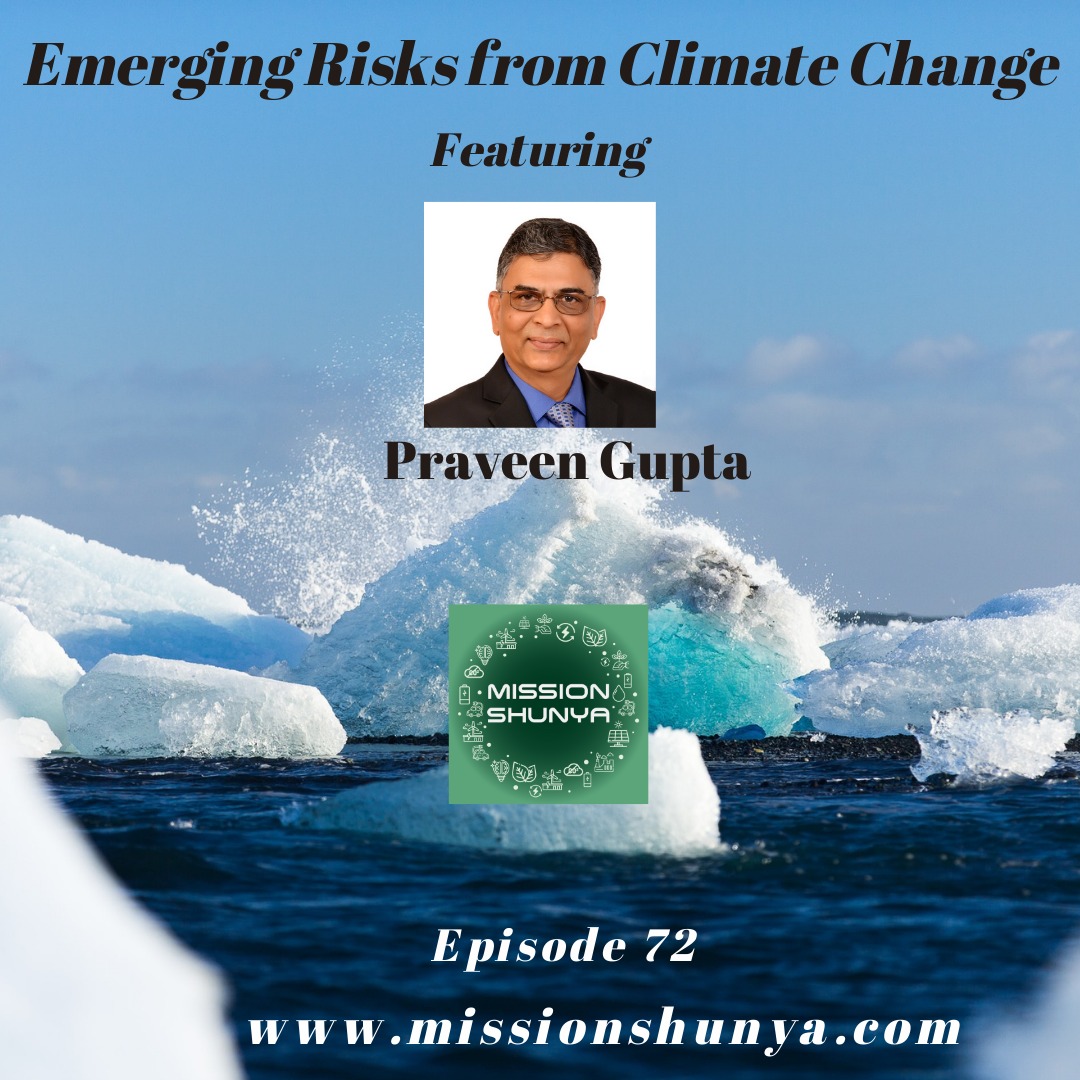
Emerging risks from Climate Change: Praveen Gupta is now live across platforms
Subscribe and listen on
Apple Podcasts: https://apple.co/3thZiTU
Spotify: https://spoti.fi/3q7O1DN
Other Audio Platforms: https://bit.ly/3JQYhbr
YouTube: https://youtu.be/E-LCuojkl6w
Web: https://bit.ly/3I3on9F
Liked the story? Give a rating and write a review on Apple Podcasts (https://apple.co/2LFBCVw).

