India: “A landscape that has lost its ability to hold water and to move it”

In this part two of our conversation – Rob de Laet reminds how nature continues to be a blindspot for us. Given his first hand experience of India – Rob shares specific insights. Despite all the challenges he lists and solutions he prescribes, It is his optimism that stands out.
“That India is not waiting for a technology. Every element is already present: the largest employment guarantee on Earth pointed at water conservation, a state that has moved nearly two million farmers into a system that uses half the water, canals refilling an aquifer in Punjab, mangrove restoration on both coasts, a city cooling model from Medellín that pays for itself in a summer. The gap is not capability and it is not even money. It is measurement, and the accounting that follows from measurement.”
Praveen Gupta (PG): You keep insisting that the road out of the climate mess runs through nature rather than through energy. Why?
Rob de Laet (RDL): Because roughly half of the machine that regulates the climate has already been dismantled, and none of it sits on anyone’s balance sheet. The living matter of this planet has fallen from something in the order of 1,100 gigatonnes of carbon before agriculture to around 550 today. Treat those as order of magnitude rather than precision, but the direction is not in dispute: we have removed about half of the living Earth.
That loss is usually filed as a carbon problem. It is not, or not mainly. Living systems do physical work on the climate every day: they evaporate water and turn sunlight into latent heat instead of hot air, they release the particles around which cloud droplets and ice crystals form, they change how much sunlight the surface reflects, and they move moisture from the ocean deep into continents. Strip the vegetation and you have not only released carbon, you have switched off machinery.
The Cooling Climate Quickly work, which I contribute to alongside Peter Bunyard and others, puts somewhere between 20 to 40 percent of today’s climate forcing down to that degradation. The band is wide because the measurement has barely been attempted. The consequence is sharper than the number: conventional carbon accounting undervalues the climate benefit of repairing a landscape by something like four to ten times.
This is not a plea to stop worrying about fossil fuels. Emissions have to come down and nothing here substitutes for that. It is a statement about time. Carbon dioxide stays in the atmosphere for centuries, so even perfect decarbonisation cools nothing this decade. The biological levers work on days, seasons and years, and they are the only fast cooling we have that does not involve gambling with the stratosphere.
PG: How fast, in practice? I have seen claims of two to four degrees of cooling almost overnight.
RDL: Then let me be careful, because that claim is often misquoted. Established tropical forest runs two to four degrees Celsius cooler than adjacent cleared land. That is a measured difference between two surfaces, not a promise about speed. Protecting a forest delivers that difference from the day clearing is prevented, which is why protection is the fast lever. Restoration builds toward it as the canopy develops, over ten to twenty years in the tropics and longer in cooler places. Ground cover, mulch and soil work give a smaller effect much sooner, and in a hot dry landscape a smaller effect sooner is still worth having. Anyone who tells you a plantation cools a district within months is overselling, and the overselling is what gets the whole field dismissed.
PG: And the money? None of this shows up in a financial statement.
RDL: That is the whole problem, and it is a defect in the accounting rather than in the biology. Envisionation, whose Empathy Economics framework I follow closely, put it plainly: the biosphere is humanity’s primary asset, every supply chain and every balance sheet depends on it, and finance treats it as a free input. Half the asset has been consumed and nobody booked the impairment. Accept that framing and restoration stops being a cost centre with a moral justification attached and becomes the largest asset recovery opportunity available.
“Conventional carbon accounting undervalues the climate benefit of repairing a landscape by something like four to ten times… Established forest runs two to four degrees Celsius cooler than adjacent cleared land… Anyone who tells you a plantation cools a district within months is overselling, and the overselling is what gets the whole field dismissed”
What makes it investable is a unit. Carbon has one, the tonne, which is why carbon gets funded. Cooling does not, which is why it does not. The unit we argue for is watts per square metre against a stated baseline: physical, measurable from satellites and flux towers, and capturing shade, evaporation, reflectivity and cloud formation in one number instead of crediting only the carbon. Get that unit accepted and a municipality, a state or a farmer collective can raise capital against a measured result rather than queue for a grant.
India is where I would test all of it, and I would take four cases: Punjab underground, Lucknow in the street, the two coasts of the south, and the Himalayan snow. But first the thing India already has and nobody counts as climate policy.
PG: Which is?
RDL: The workforce. MGNREGA, the Mahatma Gandhi National Rural Employment Guarantee Act, guarantees a hundred days of paid work a year to every rural household as a legal right. It runs at roughly 86,000 crore rupees a year, about ten billion dollars at approximately 85 rupees to the dollar. On any given day something like fifteen million people are at work across 1.4 million sites, and a single year generates over three billion person-days of labour. Close to sixty percent of that work is already natural resource management: water harvesting, afforestation, soil improvement. More than thirty million water conservation assets have been built since 2006, and the assets are geotagged before, during and after construction.
Then the rules tightened in a way that should have made climate people sit up. In over-exploited groundwater blocks, 65 percent of the money must now go to water conservation. That points something like 35,000 crore rupees a year straight at rehydrating the Indian landscape. Nearly five lakh water works were completed in a single year.
Read that as a climate programme and it is remarkable. India is already paying millions of people to do precisely the work that cools and rehydrates land. Two things are missing. Nobody measures the cooling that work produces, so it is invisible to climate finance and therefore unfunded by it. And the wage is low. Measure the output properly and pay for it from climate capital rather than the rural development budget alone, and India has the largest planetary cooling programme on Earth, already staffed. For scale: half a percent of global GDP (roughly the amount of money we need to invest to regenerate the Earth’s biosphere for about two decades) is roughly fifty-four MGNREGAs. India has proved that one of them can be built and run.
The return profile is the part usually missed. This is not a cost with a climate benefit bolted on. It rebuilds soil, water cycles, biodiversity and food security, and pays several hundred million rural households while doing it. Solar radiation management gives a community nothing locally, and neither does carbon capture. Emissions reduction gives diffuse global benefits and imposes local costs. This is the only intervention where what is good for the family doing the work is also what is good for the planet.
Sources: Union Budget allocation of Rs 86,000 crore for FY 2024-25 and FY 2025-26; 309.2 crore person-days in FY 2023-24; approximately 15 million workers daily at 1.4 million sites; roughly 60 percent of works under natural resource management; over 30 million water conservation assets since 2006; Ministry of Rural Development 2025 amendment to Schedule I mandating 65 percent of expenditure to water conservation in over-exploited and critical blocks, 40 percent semi-critical, 30 percent safe; nearly 5 lakh water works completed in 2024-25 at Rs 17,889 crore. The 0.5 percent of global GDP estimate is from Cooling Climate Quickly v10h. Budget figures change annually and should be checked against the current year before use.
PG: And you single out Andhra Pradesh?
RDL: Because Andhra Pradesh has already shown that a transition of this kind can be delivered by a state, at scale, without a permanent subsidy holding it up. Community Managed Natural Farming now reaches more than 1.77 million farmers across some 920,000 hectares. Most are women, around ninety percent are small and marginal holders. Farmer incomes are up 38 to 66 percent, water use down by as much as half. Input costs fall while yields hold or rise, which is why the change sticks. The state puts its own return at six to eight dollars for every dollar invested. It won the Gulbenkian Prize for Humanity in 2024 and the Food Planet Prize in 2026.
“India has the largest planetary cooling programme on Earth, already staffed. For scale: half a percent of global gross domestic product is roughly fifty-four MGNREGAs. India has proved that one of them can be built and run”
What nobody has measured is what a million transitioned hectares has done to the surface temperature and the water balance of Andhra Pradesh. My own suggestion for making it cooler still would be to raise the number of useful trees inside the system, because canopy is what turns a cooler field into a cooler district. This programme is the clearest example anywhere of the gap we are trying to close, and it is the best place in the world to close it. You can fight heat, drought and extreme rainfall damage, raise food and water resilience, and cool the region, all at once. Now measure it, and the scaling becomes investable.
PG: Let us take your four cases. Punjab’s aquifers, the heat in Lucknow, floods in Kerala. Are these separate problems?
RDL: They look like three problems and they are one, seen at three points in the water cycle: a landscape that has lost its ability to hold water and to move it. Vegetation is the biological regulator of that cycle, and the principle is simple. Do not let water run off easily. Make it travel through soil, through aquifers, through roots, up through the canopy, where it cools and makes cloud and rain.
PG: Shall we start with Punjab?
RDL: Punjab pumps more groundwater than any state in India, around 164 percent of annual recharge against a national average near 59. The engine is free farm electricity, some 10,000 crore rupees a year for tubewell power, and the subsidy is highest per acre in exactly the districts where the aquifer is emptiest. As the water table drops, pumps lift further and cost more, so the bill grows with the damage it causes, and it peaks with paddy transplanting on a grid already close to 17,500 megawatts.
The part missing from the agricultural accounts is the heat. Evaporative cooling runs on plant-available water. When the water table falls beyond root reach and the crop shuts its stomata to survive, the sunlight that had been evaporating water heats air instead. The cooling stops on precisely the days heat is doing most damage. The land becomes hotter because it has become drier, and drier partly because it has become hotter.
The encouraging half is that Punjab has begun refilling. Canal coverage has gone from about 26 percent of the state in 2022 to a reported 78, with the Kandi Canal running after forty years out of service. Canal water does two jobs at once: every litre delivered is a litre not pumped, and seepage recharges the aquifer on the way. The Board now reports 74 blocks improving and 57 percent of monitored wells standing higher than a decade ago.
Recharge alone cannot close it. The gap is around eleven billion cubic metres a year, needing roughly a 39 percent cut in extraction or a 64 percent rise in recharge, so the demand side still has to move, through direct-seeded rice, delayed transplanting and eventually diversification out of paddy. The way to make that survivable is to change what the subsidy buys, paying for water saved rather than electricity consumed, and to build the recharge with labour that is already funded, since MGNREGA must now put 65 percent of its spending in over-exploited blocks into water conservation, and almost all of Punjab qualifies.
“Medellín built its Green Corridors for about sixteen million dollars, with under a million a year to maintain, and brought city temperatures down by two to three and a half degrees within three years. If Lucknow did the same, the quantified benefits would repay the whole installation inside a single summer, in roughly six to thirteen weeks”
Measure the result in watts per square metre and the prize becomes visible. When the aquifer returns within root reach, transpiration returns and the surface cools. One intervention lowers the subsidy bill, cuts the summer peak, raises farmer margins, refills the aquifer and cools the land. Five ministries want the same thing and none of them has noticed.
Sources: Central Ground Water Board, Dynamic Ground Water Resources of India, 2023 and later; PSPCL and PSERC tariff orders via the Indian press; Gupta (2023), Agricultural Economics; Punjab canal-coverage figures via SANDRP. Canal and extraction figures are government claims from 2025 to 2026 and move quickly; check before quoting.
PG: Second case, Lucknow. What is a cooler city actually worth?
RDL: Take one Indian city and ask what it would be worth to drop daily peak temperature on hot summer days by five degrees. I should say plainly that what follows is a quick back-of-envelope estimation, so do not trust the numbers, trust the direction of travel. Even so, the size of the prize is startling.
Lucknow’s summer peak electricity demand is running toward 2,000 megawatts, and cooling accounts for roughly a third of it. Drop the outdoor temperature five degrees and two things happen at once. Heat crossing the walls of every building falls by about a quarter, and every air conditioner in the city runs more efficiently at the same time. Below thirty-eight degrees, many households switch the air conditioner off and the fan on. Together that takes 150 to 250 megawatts off the peak and around 500 gigawatt hours off the year.
That electricity carries three separate values, and only the first is usually counted.
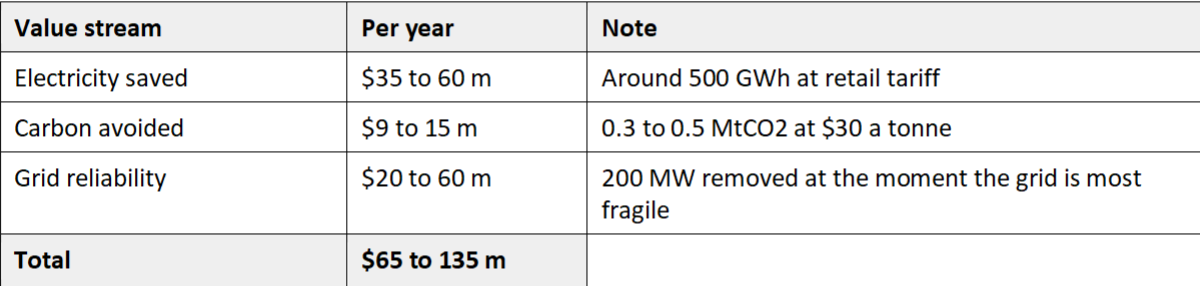
The third row is the one Indian planners should study hardest. Grid collapses are not caused by average demand. They are caused by the last few percent of load at the peak. Removing 200 megawatts from a 2,000-megawatt peak is a ten percent cut at exactly the hour the system is closest to failing, in a state with a chronic history of summer load-shedding and a place in the largest blackout in history.
“India, with the Ghats and two contrasting coasts… A coastal community protecting mangrove, a hill farmer restoring infiltration and a dryland farmer planting shade are all producing the same service at different points in the same conveyor”
Now the cost. Medellín (2nd largest city of Colombia) built its Green Corridors for about sixteen million dollars, with under a million a year to maintain, and brought city temperatures down by two to three and a half degrees within three years. If Lucknow did the same, the quantified benefits would repay the whole installation inside a single summer, in roughly six to thirteen weeks. On electricity and carbon alone, ignoring the grid entirely, payback is still under five months.
And none of that counts what matters most: the heat deaths avoided, the hospital admissions, the outdoor labour hours not lost, the children who can sit an exam in May. In the Medellín literature those benefits are typically larger than the electricity savings, and they land on the poorest households first, because they are the ones without air conditioning.
Then multiply. India has dozens of cities in Lucknow’s class. Twenty of them would cost around 330 million dollars to green at Medellín prices and would return somewhere between 1.3 and 2.7 billion dollars a year, cut six to ten million tonnes of carbon dioxide annually on the demand side without building a single new power station, and take three to five gigawatts off the national summer peak. That is a meaningful share of the shortfall the National Load Despatch Centre has flagged for high-risk summer months.
PG: Is it all about trees?
RDL: No, and the physics is not complicated. A white roof coating returns 130 to 210 watts per square metre straight back to space, costs very little, and can be applied in one season by residents themselves. Roofs are twenty to thirty percent of a city’s surface, which makes reflective roofing the single largest district-scale lever available. Trees do something different and equally necessary: they cool at the height where people walk, dropping pavement surface temperature by fifteen to twenty-five degrees. Water harvesting, permeable paving and restored drains supply what the trees run on, because a tree is a machine for turning water into cooling and without water it is a stick. So: reflective surfaces where nobody stands, shade where people do, permeable surfaces where possible to improve infiltration and avert floods.
The last piece is the one we are building. None of this cooling is currently measured in a way a financier can price. The electricity saving surfaces on a distribution company balance sheet months later, the carbon is not a registered methodology under India’s Carbon Credit Trading Scheme, and the avoided blackout never appears at all. Measure the cooling directly, in watts per square metre against a stated baseline, and a municipality can raise capital against it instead of waiting for a grant. That is the difference between a nice park and a piece of climate infrastructure with a balance sheet behind it.
Electricity, carbon and grid figures from the Lucknow pilot estimation, April 2026, drawing on UPPCL, the Central Electricity Authority, the National Load Despatch Centre Short-Term Resource Adequacy Plan 2025, and Medellín Green Corridors reporting. Roof albedo and canopy figures from the cities workstream paper. All figures are order-of-magnitude estimates with wide uncertainty, particularly the grid-reliability row; the electricity saving is the most robust. Carbon value assumes $30 a tonne, above current Indian compliance prices, and cannot be both counted toward India’s Nationally Determined Contribution and sold as an offset without a corresponding adjustment.
PG: Third case, the South. Kerala drowns, interior Karnataka dries?
RDL: Two problems on paper, one system in reality. South India is usually described as having too much water on the windward side of the Ghats and too little on the leeward side, with the rain shadow of interior Karnataka now showing genuine desertification. It is one landscape that has lost the ability to move water from where it lands to where it is needed, and the same design that fixes one end fixes the other.
“Put a physical unit on cooling and rehydration, book the biosphere as the asset it is, and every one of these programmes stops being a welfare line item and becomes infrastructure with a return. The country that does this first will not only cool itself, it will write the standard everyone else has to adopt. India is the obvious candidate”
In a concept note I presented to civil servants at the Ministry of Environment in Kerala, called Balancing the Waters, I argued that continuous forest draws ocean moisture inland and that forest aerosols turn that moisture into rain. What follows adds the piece sitting upstream of that, and the reason the two ends of the Ghats are one design problem rather than two engineering ones.
The coast is the ignition, not a corridor
A tropical coastal morning follows a schedule. Land warms faster than sea, thermal contrast builds, and by mid-morning a sea breeze carries humid marine air inland. Cloud builds through the middle of the day and by mid-afternoon it rains. Anyone on the Kerala coast decades ago will remember how regular that clock was. The energy comes from the ocean. What the coastal land supplies is the trigger: the thermal contrast that drives the breeze, the roughness that helps the front converge, and enough near-surface moisture to keep the condensation level low so cloud forms early rather than late.
Mangroves prepare the sky
Mangrove and estuarine systems release four things that seed cloud, none of which appears in a water management plan. Anoxic sediments bathed in seawater sulphate produce dimethyl sulphide, ventilated on every tidal cycle, the same chemistry that makes marine cloud over the open ocean, here concentrated into a narrow band and pumped twice a day by the tide. Isoprene and other biogenic volatiles oxidise into the aerosol that droplets condense on. Bacteria, spores and organic fragments mobilised by wave action nucleate ice at temperatures where mineral dust does nothing, which decides what falls as rain rather than passing overhead. And sea salt lofted from a rough vegetated shoreline carries a different size distribution from salt off a bare one, which changes droplet size.
The chemistry is well grounded. The fluxes are not yet measured and I would attach no number to them. But the direction is clear. A living coastline prepares the sky, and the rain that follows falls in more regular patterns inland, in waves, with part of it drawn over the Ghats provided the ridge tops carry native forest, so that not everything rains out from orographic forcing and some is pulled across into Karnataka. Fewer floods on one side, more rain on the other.
Sealing the coast dries the interior
Roofs, roads and hard drainage change all three triggers at once. A vegetated coastal plain runs a Bowen ratio around 0.3 to 0.5; sealed surface runs 2 to 5. Latent heat collapses, near-surface air becomes hotter and drier, and the lifting condensation level rises, on rough figures from around 600 metres to well over 1,200. The trigger fires later and less often, and when it fires the cloud must grow deeper before it precipitates. That is the cloudburst pattern which has been steadily worsening Kerala’s floods, and it is the same mechanism that starves the interior: the same annual rainfall arriving in fewer, heavier events on the coast, and less of it carried over the crest. Kerala’s floods and Karnataka’s drying are two readings of one broken conveyor.
The design that balances them
Read as one system, the interventions stack in sequence rather than compete for funding. A living coastal band restores the ignition and the cloud chemistry. Continuous windward forest on the Ghats does the lifting and the moisture recycling. Restored infiltration on the slopes converts a flood into base flow, which is what made the Cauvery perennial in the first place. Agroforestry, tank restoration and soil rebuilding on the leeward plains catch and hold what arrives, so each rainfall event recharges rather than runs off.
Every one of those steps is already being done somewhere in South India. What is missing is that they are planned as separate programmes in separate departments, and none is credited with what it delivers to the next link in the chain. Tamil Nadu’s mangrove restoration at Pichavaram and Muthupet is funded as coastal protection and biodiversity. Nobody credits it with rain falling two hundred kilometres inland. Kerala’s Kuttanad and Vembanad work, Cauvery Calling, tank restoration across Tamil Nadu and Karnataka: all pointing the same way, none of it wired together.
The measurement that makes it plannable, and financeable
This is testable now, on free public data. A forty-year global mangrove extent record was published in Science in June 2026, and geostationary satellites give ten-minute cloud and rainfall imagery over the Indian coast going back decades. Compare stretches of coast that lost mangrove with stretches that did not, measure the hour of first cloud, the hour of peak rainfall and the variance of onset across a season, and control for sea surface temperature and inland land use. If convective onset tracks mangrove loss after those controls, the coastal trigger has an observational anchor at regional scale.
“Carbon dioxide stays in the atmosphere for centuries. Soot stays for about a week. Clean up the sources and the snow gets whiter in the same season. It is one of the very few climate levers where you see the result in your own lifetime rather than your grandchild’s”
India, with the Ghats and two contrasting coasts, is the best place on Earth to run that test. Once cooling and moisture delivery are measured in a common physical unit, the chain can be financed as one asset rather than eight grants. A coastal community protecting mangrove, a hill farmer restoring infiltration and a dryland farmer planting shade are all producing the same service at different points in the same conveyor. Pay them as though that were true and the two water problems of South India become one solvable design question.
Sources used: Cooling Climate Quickly v10h (energy hierarchy, degradation share, the 0.5 percent of global GDP estimate, the UNEP Adaptation Gap Report finance shortfall of 187 to 359 billion dollars, and the alignment-of-scales argument); Shahid 2026 for the surface-to-atmosphere transfer fraction; the cities workstream paper for roof albedo figures. Check each against the current version of the source before publication.
PG: Fourth case, the Himalaya.
RDL: The melting of the Himalayan glaciers will be a very large water availability problem decades from now, and the snow is disappearing for two reasons. The first is heat, which is about global emissions and which nobody fixes overnight. The second is dirt. Soot from brick kilns, cookstoves, diesel and crop burning settles on the snowpack and turns it grey. Grey snow absorbs sunlight instead of reflecting it, so it melts faster. That part is fixable.
The striking thing is the speed. Carbon dioxide stays in the atmosphere for centuries. Soot stays for about a week. Clean up the sources and the snow gets whiter in the same season. It is one of the very few climate levers where you see the result in your own lifetime rather than your grandchild’s. It will not save the glaciers on its own, nothing local will, that takes cutting emissions. But it buys time for two billion people who depend on that snow for their water, and buying time is not nothing.
A subplot of the same story is glacial lake outburst floods (GLOFs) which can be reduced with simple and affordable measures. Kedarnath in 2013 and the Sikkim disaster more recently are the kind of event where cheap engineering and monitoring would have changed the outcome.
PG: If an Indian reader takes one thing from this, what should it be?
RDL: That India is not waiting for a technology. Every element is already present: the largest employment guarantee on Earth pointed at water conservation, a state that has moved nearly two million farmers into a system that uses half the water, canals refilling an aquifer in Punjab, mangrove restoration on both coasts, a city cooling model from Medellín that pays for itself in a summer. The gap is not capability and it is not even money. It is measurement, and the accounting that follows from measurement.
Put a physical unit on cooling and rehydration, book the biosphere as the asset it is, and every one of these programmes stops being a welfare line item and becomes infrastructure with a return. The country that does this first will not only cool itself, it will write the standard everyone else has to adopt. India is the obvious candidate.
General note on figures: numbers in this interview are drawn from Cooling Climate Quickly v10h, Indian government sources and the estimations described above. Several are order-of-magnitude estimates, several change annually, and I would ask any reader intending to quote them to check the primary source first.
PG: These excellent insights ought to be music to everyone’s ears, Rob. Next, this should also be falling on the right ones. Thanks so much. Hoping to see you in India, soon!

