“The first step is to find a needy community… a solar solution to establish a regular wealth creation method”: Dr. I.M. Dharmadasa
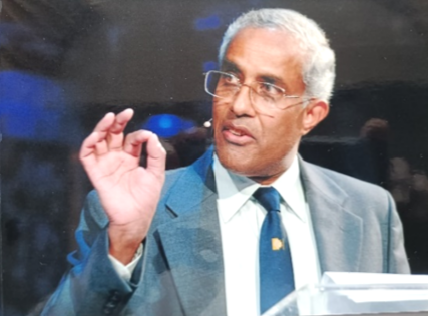
Professor I. M. Dharmadasa has been actively promoting clean energy for sustainable development, poverty reduction and climate action, over the past thirty-five years. In 2008, he piloted the “Solar Village” project in Sri Lanka, which he has monitored for several years and which he is now replicating. To date, eight large solar villages have been established, with further replication underway.
Dr. Dharmadasa is an Emeritus Professor at Sheffield Hallam University, United Kingdom. He is an alumnus of the University of Peradeniya in Sri Lanka. In 1977, he was awarded an open Commonwealth scholarship, allowing him to complete his PhD in Solid State Electronics at the University of Durham, UK. Dhamadasa is a Chartered Physicist, Chartered Engineer and Fellow of the Institute of Physics in the UK.
He currently serves as an assessor and panel member for the Queen Elizabeth Commonwealth Scholarships. And has advised on renewable energy projects for countries such as Germany and Chile.
Praveen Gupta (PG): How did the Solar Village project commence?
I.M. Dharmadasa (IMD): Solar village project evolved out of a six-year Higher Education Link (HE-Link) programme completed in the 1990s, funded by DFID-UK and administered by the British Council. I initiated and led the programme between my employer, Sheffield Hallam University, and Peradeniya, Colombo, Moratuwa, Jaffna, Kelaniya & Matara Universities in Sri Lanka to collaborate on solar energy conversion research in Sri Lankan universities and promote renewable energy applications. Two active products, solar village project and the solar Asia conference series evolved because of the national and regional networks established by this HE-Link activities.
PG: What is a Solar Village?
IMD: The ‘Solar Village’ or ‘CARES – Centres for Application of Renewable Energy Sources’ initiative was designed to help rural areas across Sri Lanka with communities in need, to promote renewables, implement clean solar energy solutions and generate regular income to support sustainable development.
In an attempt to accelerate and promote the scale-up of solar power, which is readily available in Sri Lanka, the solar village concept was designed by me and my colleagues and piloted in 2008. The first step is to find a needy community with about 1000 inhabitants, identify their main issues holding the rapid development, and find a solar solution to establish a regular wealth creation method.
When any new technology is introduced to the community, there are numerous issues to solve at the technology/community interface. The main steps to deliver each solar village project focus on raising required funds, selecting a suitable site, working with the community to share the benefits of the project, establishing the project, monitoring, guiding and reporting on the progress of the project. Effective communication is the key to success of this project.
First, the solar village team identify a village cluster with around a thousand inhabitants that would benefit from solar energy. The team works with a local project coordinator to explain the advantages of using solar energy and the aims and benefits of the project which leads to sustainable development. A Village Development Committee (VDC) is set up with a treasurer and equal numbers of male and female members.
To manage the project the VDC opens a bank account with all the income generated paid into this account. The project team obtains three tenders for the supply and installation of a solar application system. Solar village team design a “wealth creation method” to assure a regular income to the VDC account.
Three main income generation methods were used to date in solar villages. (i) solar water pumping for clean domestic water supply, and the users pay their water bills to the VDC account (ii) installing a ~5 kW solar roof on a community building, connecting it to the national grid using the net-plus scheme and receiving a regular income to the VDC account from the Ceylon Electricity Board (CEB) (iii) solar water pumping for drip irrigation/irrigation for food production and participants contributing to the VDC account.
“The first pilot solar village was started in 2008 saving a primary school, from its intended closure and now thriving producing excellent results”
PG: What happens within a Solar Village?
IMD: With the guidance from the solar village team, VDC members organise various activities, voluntarily to improve (i) Education; by developing the nursery, primary school and a library (ii) Environment; by tree planting, organic farming, beekeeping and road repairs and (iii) Climate Actions; by reducing carbon dioxide emissions utilising solar power and re-absorbing carbon dioxide from the atmosphere by increasing vegetation.
The community members work together to develop themselves introducing various methods like micro-credit schemes, to strengthen their savings and supporting needy children for their education to reduce poverty within the community. Special attentions are given to support single mothers and to solve girl children’s period poverty in rural communities.
PG: How many Solar Villages completed thus far?
IMD: The first pilot solar village was started in 2008 saving a primary school, from its intended closure and now thriving producing excellent results. Since then, twelve solar villages have been established in different parts of the country. These are namely, Kaduruwewa, Pulmudai, Nochchiya, Puthier Nagar, Monaragala, Sobithagama, Mediyawa, Kanatholuwa, Panama, Kadurukotte, Wannipalugaswewa and Handungamuwa.
These were all funded by the personal donations and contributions from charities like Helasarana, APSL-UK and Helio Foundation in the United Kingdom. The unique feature of this project is by establishing a wealth creating method to empower a needy community for their sustainable development, reduce poverty and contribute to the mitigation of damaging effects of climate-change.
PG: What are the main benefits of the Solar Villages?
IMD: In all solar villages, community members work together to develop themselves, and the solar village team regularly have meetings for monitoring progress and guide them with new development ideas. Success stories and good practices in productive solar villages are spread into new solar villages to encourage them for rapid development.
Since some of these villages suffer from elephant-human conflict, possible ideas are researched and explored using beehive-fences and planting elephant repelling trees like Gaja-madara. Most villages show a sustainable and rapid development of every aspect of the society.
Out of the established solar villages, the pilot solar village saved a primary school from its closure and now performing at a very high level in the region. The primary schools have become the epicentre of empowerment of the community. The most successful performance is shown by the third solar village at Nochchiya established in 2017.
This project was initiated by installing a 7 kW solar roof and connecting it to the national grid. The power from the solar roof was fed into the national grid and the income generated covered the cost of two water pumping stations and a water purification system operated by grid electricity.
Surplus purified water was sold to seven surrounding villages at a nominal cost to cascade the benefits beyond the village. Since this area was suffering from kidney disease, selling purified water became an excellent income generation method to Nochchiya solar village. The project empowered the community by spending only Rs 1.8 million, but after nine years of operation VDC has saved over Rs 7.3 million. These savings are in addition to building a new community hall, office building and an IT lab for the village, and repairing a 3 km road by voluntary work.
The most remarkable and notable benefits are the contribution of Rs 100,000.00 from the Nochchiya village and Rs 25,000.00 from the recent solar village at Mediyawa. Villages supporting other villages in the country to establish similar projects is a prior indication of the rapid development of the country.
The Sri Lankan expatriate community, the solar energy companies in Sri Lanka and other citizens who love to see the country developing are the potential donors for this socially worthy project. The project was initially designed to practically promote the solar energy applications in the country. The activities within the solar village fulfills 13 out of 17 UN sustainable development goals (SDGs).
“The unique feature of this project is… to empower a needy community for their sustainable development, reduce poverty and contribute to the mitigation of damaging effects of climate-change“
PG: Did you encounter any barriers?
IMD: Normal obstacles experienced for this project are the fund raising, language barriers, communication difficulties and long distance travelling to remote villages. Continuous CEB resistance for this project has been dominating due to delays in approval of solar roofs installation, connecting these to the national grid and initiate regular payments. In addition, CEB reduced the solar tariff from Rs 37 in the past to Rs 27 and finally to ~Rs 20. This slowed down our solar village project expansion using solar roofs due to smaller income received via reduced solar tariff.
Solar village team took this setback as an opportunity to modify the solar village activities. We designed a new way of progressing using solar water pumping for drip-irrigation and food production avoiding CEB involvement. Solar village team also now introducing “Community Gardening” or “Allotments” concept very successful in the UK and USA to Sri Lanka as a solution to possible food insecurity due to climate-change and El Nino effects.
Team is currently organising three pilot community gardens within our 12th solar village at Handungamuwa in Matale district. This allotment concept is a great idea to spread throughout the country to survive during the difficult periods ahead and for sustainable development.
PG: What is your vision?
IMD: Above projects were first carried out slowly during my full employment but helped to accumulate a wealth of knowledge and establish domestic and regional networks, SAREP over the last two decades. To attract more funds and accelerate the project progress, a community interest company (CIC) called solarvillagesdg (www.solarvillagesdg.org) was formed in November 2024.
Our aim is to increase the number of solar villages in Sri Lanka and then introduce this project to other developing countries if possible. I have supervised 31 PhD candidates during my time at Sheffield Hallam University, and most of them are from developing countries in Asian and African continents. They are now holding senior academic positions in their countries, familiar with the solar village project, and very keen to initiate similar projects in their native countries.
To initiate a new solar village only a small amount of funds (~£5000) is required. Any personal or institutional donations are very welcome to participate in this socially worthy project. The local government involvement for this type of projects will lead to a rapid development of the country helping the needy communities.
PG: What is SAREP and how does it work?
IMD: During the HE-Link programme, our activities were noted by a senior member, late Mr Peter Lane, at DSL Consultants in London. After an introduction via the British Council office in London, we worked together for a while and launched SAREP (South Asia Renewable Energy Programme) at the Bangladesh High Commission premises.
Although we didn’t formalise SAREP, it is self-sustaining as an informal academic network to promote renewables in the region. We initiated Solar Asia conference series in 2010, held four times so far, twice in Sri Lanka, once each in Malaysia and India. Our 5th conference is due to take place in February 2027 at the BHU in Varanasi, India (https://solarasia.bhu.edu.in/).
PG: Hearty Congratulations for your exceptional work, Prof. Dharmadasa. The Global South has much to learn and benefit from this multi-pronged initiative.

