Illuminem: Originally published on http://www.thediversityblog.com
February 24, 2024

https://illuminem.com/illuminemvoicesprofile/praveen-gupta
Umesh Pratapa (P Umesh) and I explore evolution of liability niche in the Indian insurance market-place. What appeared to be a glacial shift – Bhopal Gas Tragedy to Satyam Computers was just that – has suddenly assumed a lightning pace. Tata Sons, IL&FS, ICICI, BharatPe, Zee Sony, PayTM, Byju are but a few names with recent board level action. The list keeps growing.
With ongoing ‘notional’ extension of board theatre – a D&O does not stop with manifestations of management liability. Environmental, Societal & Governance (#esg), #greenwashing, #ecocide, et al nudge it into a cross class realm.
It is not just the insureds and their boards getting sued. Insurers too are getting drawn into the ring. Something that Zaneta Sedilekova and I explored here: https://lnkd.in/dqZnmSRs.
And how is a new age climate #disclosure changing business? “Businesses and financial institutions that want to attract investors in a global market must adopt international standards, regardless of whether it’s a requirement in their home country.” Something that Indian boards hungry for overseas capital need to bear in mind: “Access to international financing will increasingly hinge on adherence to global climate #reporting,” says Pietro Rocco, Head of Green Finance at The Carbon Trust.
According to David Grayson, Chair of the United Kingdom’s Institute of Business Ethics, that will involve much more than preserving the climate.
“It’s a much wider waterfront covering #humanrights, labor standards in global #supplychains, modern day #slavery, #livingwage and #accountability for the misuse of a company’s products,” he tells The CEO Magazine. No respite in sight as boards must now equip to deal with #Polycrisis.
“Climate risks are here before us and we need to address them now. Obviously the first step is to get on board people who have a good understanding of climate risks in the wider sense of the word”, advises Umesh.
Hopefully this is not falling on deaf ears!

I recently spoke to P. Umesh whose book on Directors and Officers Liability (D&O) is expected, shortly. Given his four plus decades of first-hand experience in the Indian insurance industry, he shares insights on how a corporate/commercial market – predominantly property class – began embracing the liability class. More importantly, what lies in store for boards and independent directors – with a climate breakdown staring us in the face.
Over these years Umesh has worn several hats – lecturer, insurer, broker, lawyer and author. He is currently an independent consultant in liability insurance. Umesh is a recipient of IKON (International Knowledge and Opportunities Network) Dronacharya of the year award in June 2018. He is a member of the Institute of Directors (IOD). He chaired the Working Group constituted by the Insurance Regulatory and Development Authority of India (IRDAI) to Study Cyber Liability Insurance. His articles and updates can be seen on www.liabilityinsurancepractice.com.
Praveen Gupta: What steered a predominant property class driven corporate/commercial market that India was – during the 1980s – towards the ESG zone?
P. Umesh: The Satyam story is certainly one of the main triggers for an intense discussion and renewed interest in corporate governance in India. Interestingly this fraud at Satyam was not discovered by an external agency. But it was the admission followed by the resignation of B. Ramalinga Raju, founder, and CEO of Satyam Computers that brought out the fraud. Immediate investigation by Government of India and action by the regulators from USA, since shares of Satyam were also listed there, brought increased focus on corporate governance and the need for stricter rules and better compliance.
This subject has also acquired attention thanks to one corporate scam after another getting unearthed in various parts of the world. The discovery and reporting of these scams got accelerated because of legislative and regulatory activism, coupled with the fact that the Indian economy was opening, inviting closer scrutiny from global fraternity. D&O policy gained traction once Indian companies started getting listed abroad.
As regards Environmental Society and Governance (ESG), as we understand it today, it was the Bhopal Gas Tragedy, which sparked a furious debate for stricter regulations and better safety standards for environment protection. It also led to the enactment of The Environment Protection Act, 1986. In terms of specifics, it was in the year 2012, SEBI made it mandatory for the top 100 listed firms to have a business responsibility report and in the year 2023 introduced new norms for ESG disclosures by the top 1,000 listed entities by market capitalization.
“As regards Environmental Society and Governance (ESG), as we understand it today, it was the Bhopal Gas Tragedy, which sparked a furious debate for stricter regulations and better safety standards for environment protection“.
PG: Do you see PIL as a precursor to Class Action? We are yet to see one.
PU: To begin with – Public Interest Litigation (PIL) is not defined by any law in India. It is not filed by the affected person but another person for the greater good of society. I do not see PIL as a tool or facilitator for class action, the goals of both instruments being different. PIL is used for public good whereas class action is for the relief of the affected parties. While it was possible to file a representative suit under the CPC (Order I, Rule 8), nothing significant has happened so far. Only after specific provisions were incorporated under other statutes like The Companies Act, 2013, and The Consumer Protection Act 2019, the talk of class action has gained momentum.
I feel third party funding may prove catalytic in this area. The advent of “Third party funding” in India is likely to provide an infrastructural platform for classes to come together and receive funding to pursue legitimate actions of enforcement of rights. Contrary to what happened in some jurisdictions class actions may follow, instead of preceding, the development of third-party funding. It would be no surprise if third party funding contributes significantly in the evolution of a sophisticated class action regime.
PG: Despite the onerous liability of independent directors – D&O solution remains commoditised?
PU: Yes. Perhaps unavoidable in big markets like India, till claims start surfacing posing unexpected challenges and resulting in unpleasant surprises to all insurance supply chain. It is imperative for the insurance providers to underscore the intricacies at play, while it is equally important for purchasers to grasp and acknowledge these complexities. Informed buying is as important as informed selling.
Coming to the question of Independent Directors – The guidelines on Appointment of Independent Directors and Process of Board Evaluation issued by CII on 5th February 2024 are very timely. While in a few cases independent directors did not act the way they were expected to act, resulting in questioning the very relevance of that institution, independent directors do play a major role in ensuring compliance with all relevant norms for better corporate governance.
The Companies Act, 2013 – Sec IV Code for independent directors – Manner of appointments makes a reference to D&O policy as under: (d) provision for Directors and Officers (D and O) insurance, if any. The appointment of independent directors shall be formalised through a letter of appointment, which shall set out, besides other things, provision for D&O insurance, if any.
Recognising the importance of protection afforded by D&O insurance for independent directors, SEBI has mandated this policy for the top 1000 entities by market capitalization. If independent directors evince interest to read, understand the D&O policy and demand appropriate coverage, it will ‘decommoditise’ the policy, if I can use that expression. There was a case where a director insisted on having a D&O policy of certain features in place before joining the board. It is necessary for all directors, not only independent directors, to at least have the primary understanding of the D&O policy.
“In India, corporates are yet to see regulatory interventions, companies with global foot print need to have strong risk management systems… Any green washing will prove to be very costly in terms of financial implications and reputational damage”.
PG: While the U.S. SEC continues to dilly-dally, significant progress has been made in the EU. Corporate Sustainability Reporting Directive came into force at the start of 2024. This calls for Indian boards with global footprints to be more robust in risk managing?
PU: The EU has always been ahead in these matters like ESG or data protection. As per European Union’s Corporate Sustainability Due Diligence Directive (CSDDD), certain companies are required to exercise due diligence in their supply chains in accordance with the human rights and environmental due diligence obligations. There are significant fines for failures. While in India, corporates are yet to see regulatory interventions, companies with global foot print need to have strong risk management systems in place lest they face adverse consequences. Any green washing will prove to be very costly in terms of financial implications and reputational damage.
PG: Carbon footprint of directors and officers is easy to monitor – thanks to technology. Most recently Elon Musk and Taylor Swift have been under vigorous scrutiny?
PU: These are viral news. Sometimes revival of economies is attributed to some of the celebrity personalities. Approaching the subject dispassionately, D&O policy would view it in terms of whether there was any wrongful act and whether it would attract any exclusion. Merely logging in more air miles and facing the allegations about carbon polluting may not result in denial of claim unless these activities are prohibited by law or insurance companies choose not to underwrite them.
PG: Given the rise in environmental activism in many jurisdictions, aren’t Indian directors and officers increasingly more vulnerable when travelling there?
PU: That is a genuine concern. Given the rise in environmental activism, directors are certainly exposed to these risks. Criminal actions on these violations appear unlikely soon. One needs to watch out for how the new legal concept ecocide develops. Wikipedia describes ecocide as “the mass destruction of nature by humans.[1] Ecocide threatens all human populations who are dependent on natural resources for maintaining ecosystems and ensuring their ability to support future generations”. Europe is in the forefront in this area also.
D&O risks being global in nature, it is necessary for the D&O policy to respond to these situations. One of the examples I can think of is coverage for extradition proceedings which assumed significance following the high-profile extradition of three British bankers to the USA to face fraud charges.
As regards kidnap and ransom risks, there is some coverage available under the D&O policy. This coverage provides for response costs in the event of a kidnap of an insured person. Coverage is for only response costs and not for settlements and that too when kidnap takes place outside the country of the insured person’s normal and ordinary residence. This coverage, therefore, cannot be seen as a substitute to Kidnap & Ransom insurance policy. One also needs to check the excluded territories for this coverage and other stipulations.
PG: Climate breakdown, Bio-diversity loss and Pollution are transforming management liability triggers into #polycrisis. How should D&O evolve?
PU: These should worry all as individuals first. Climate risks are here before us and we need to address them now. Obviously the first step is to get on board people who have a good understanding of climate risks in wider sense of the word. It is necessary to be compliant on substantiality and on disclosures, more as a matter of conviction than just compliance.
As regards climate change risks, whether gradual or otherwise, directors could be exposed to liability if they fail to grasp the seriousness of the issues and comply with the relevant laws. Greenwashing may also lead to litigation. Greenwashing refers to erroneous, misleading, or unsubstantiated claims on ESG commitments or failure to deliver on them. D&O policy should respond when directors encounter claims in spite of all the care and caution they exercise.
“Climate risks are here before us and we need to address them now. Obviously the first step is to get on board people who have a good understanding of climate risks in wider sense of the word. It is necessary to be compliant on substantiality and on disclosures, more as a matter of conviction than just compliance”.
Particularly with regard to climate risks, investigations by various regulators would be a concern. Regulations are getting more stringent and regulators are getting tougher. There are cases in India and abroad resulting from ESG noncompliance. The statement of Mr. Lester Brown “We have not inherited this earth from our forefathers; we have borrowed it from our children” should be a word of caution and source of inspiration and a stark reminder for all.
World would be a safe place only when we deeply appreciate the definition of environment as given in The Environment (Protection) Act, 1986, as “inter relationship which exists among and between water, air and land, and human beings, other living creatures, plants, micro-organisms and property”. In the Indian context climate litigation at present is mainly focused on environmental pollution. But it is yet to reach a noticeable phase against the boards. In some cases, the National Green Tribunal (NGT) did issue directions for appropriate actions against the officials for violations of the acts.
PG: What would be your guidance in terms of adequacy of cover?
PU: Very important issue. A D&O policy should not be seen as another policy purchase. It is to be treated as an integral part of board risk management. While there is no set rule which determines the scope and limit of the policy, it helps to get the exposure study and policy health check done by professionals. Current and emerging exposures need to be factored in for this purpose.
The limit of indemnity to be chosen depends upon many factors like the company’s nature of operations, foot print, share holding pattern, asset size and revenue generation territories etc. For listed companies market capitalisation would also be a factor. Peer group comparison also gives a good idea. It would be useful to seek benchmarking and data analytics reports, well in advance, from the insurance broker and insurer to evaluate various alternatives to choose the limit of indemnity.
PG: To what extent does your book de-mystify D&O/ Management Liability?
PU: The primary purpose of the book is to demystify the D&O liability insurance concepts and coverage. Once the conceptual foundations are well laid, it becomes that much easier to build further on them. This book talks about the various exposures the directors have and the ways to mitigate them. It is not enough if a company buys a policy as a mere tick box exercise.
A well-considered and regularly reviewed approach is necessary to ensure that insurance serves its intended purpose. It needs to understand the coverage, exclusions, extensions and various terms and conditions including what it needs to comply with during the policy period and in the event of a claim.
There were cases when a company, despite having a D&O policy, was not aware of the existence of the policy, had to forego a claim. The language used in a D&O policy is not really that complex. One only needs to realise the importance of the policy and read the document carefully.
My idea through the book is to facilitate understanding. It does not dispense with specialist advice though. The ideal way is to behave as if uninsured – that is to be professionally committed to the implementation of all stipulations and treat insurance as the last port of call.
PG: Many thanks Umesh for sharing an excellent perspective of several decades and where it is headed. My best wishes for your forthcoming book launch.
February 4, 2024
SOCLEEN Journal


The Insurance Times
January, 2024
My CII Journal blog published by the Insurance Times January 2024: https://online.flipbuilder.com/yojw/bpal/

Illuminem
February 5, 2024
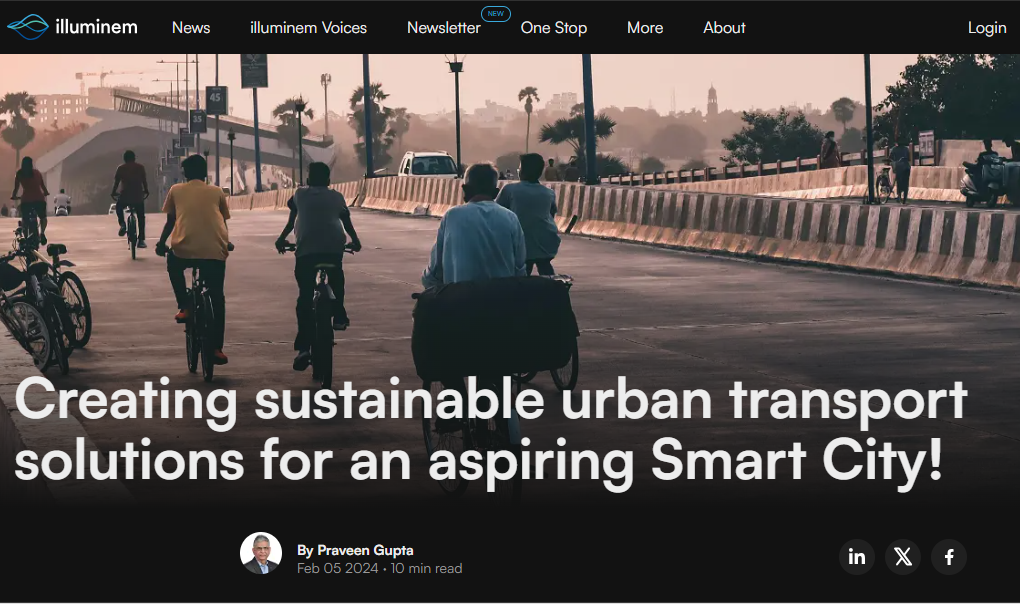
It was a pleasure chairing Technical Session1 at the Society For Clean Environment (SOCLEEN: https://lnkd.in/d93ZMsdp) flagship annual event yesterday, at Vadodara (Baroda). This rapidly growing Gujarat city is a potential megapolis in the making. ‘Sustainable Urban Transportation Solutions’ is desperately needed to realise its #smartcity aspiration.
Like any other city, #transportation is dominated by private cars, three and two wheelers. The once significant cyclist population has dwindled and there is virtually nowhere to walk. A hurried metro plan is surely not the best idea as one heard from the learned keynote speaker Dr.@O P Agarwal, IAS. My panel members – Dr. Shalini Sinha and Dr.Nachiket Gosavi – brought out the deficiencies unique to Baroda and substantiated with excellent examples and data.
The Socleen Vice President Dr. Sanjay Pandit, a renowned physician, lamented the serious health implications of rising traffic and fossil fuel emission. Building overbridges, underpasses, bypasses and ring roads will not take us anywhere, he warned. And as the keynote speaker reminded – cities and their transportation systems cannot be left with engineers.
Just like all other cities, Baroda’s story of transportation intersects with brutality of their roads. It deserves to be addressed more holistically. Perhaps, therefore, it deserves benchmarking with sustainability index of global cities? Corporatisation of municipal affairs as it inches towards a US $ 1 billion annual budget? Last but not the least, return to an enlightened vision of Sayajirao which has sustained the city thus far!
All eyes on Prof. Chetan Vaidya now for an action plan to share with the city managers. A playbook in making for all other Indian cities and citizenry that moan and groan – confronted by the anarchic ways of #mobility.
#sustainability #urban #ESG
illuminem Amsterdam Smart City C40 Cities
Illuminem
January 31, 2024
https://illuminem.com/illuminemvoices/a-remedy-in-sight-for-fossil-fuel-deaddiction
Can insurers push back the #fossilfuel industry? From the emerging signals, howsoever faint, I believe insurers have the resolve to push back. Here is some evidence. Even at the cost of sounding far-fetched, we must begin somewhere.
This Op-ed for illuminem cites how U.S. insurers responded to the Opioid crisis. They made McKinsey & Co. accountable for ‘turbocharging’ the OxyContin sales.
The recent news on the consulting firm paying up US $78 million, to settle claims from insurers and healthcare funds, needs to be in the least welcomed if not celebrated. In turn insurers (and reinsurers) must think afresh before completely writing off the Net-Zero Insurance Alliance (#NZIA). “Concerns over antitrust risk” is not proximate enough a cause to abandon NZIA.
Needless to mention, there may be no time for Lloyd’s kind of an apology for the past shortcomings – given the pace of #Climatebreakdown.
There is a remedy in sight for fossil fuel de-addiction!


MNISI The Rainbow Bird
LISTEN TO THE GRASS GROWING
SHOWING YOU HOW TO GROW
LISTEN TO THE SEA FLOWING
SHOWING YOU HOW TO FLOW
LISTEN IN THE BREATHLESS DARK OUTSIDE
TO CRICKETS IN THE COOL NIGHT AIR
CONSPIRING IN CRISP STAGE WHISPERS
ABOUT WHO AND WHAT AND WHY AND WHEN AND WHERE (AND HOW )
– Lyrics from musical theatre work: The Rainbow’s Child (premiered in Johannesburg in 2001).
Dr. Rexleigh Bunyard is a highly trained classical performer and composer, she has always had one foot in lighter music of various genres, and has freelanced in several capacities in the “light” music industry. These have included partnerships, including with composer Louis van Rensburg, for whom she was the music producer for the TV series Kinders van die Sabbatsee, (Children of the Sabbath Sea) Arende 1 & 2 (Eagles 1&2) and the full-length movie, The Fourth Reich.
Her interests include ecology and she runs a humanitarian arts-in-service-of-community public benefit organisation called Requiem for the Living NPO.
Rexleigh is M.Mus in piano performance (1983) from University of Cape Town, a Diplộme Supérieur d’Exécution from the prestigious École Normale in Paris, France (1985) and a D.Mus (Composition) with Honorary Academic Colours, from University of Pretoria (2010).
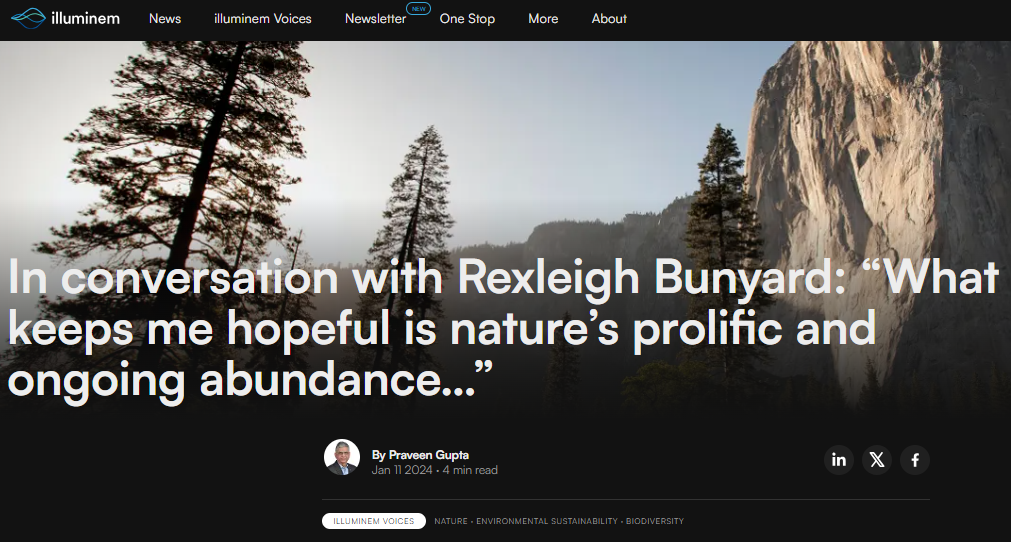
Praveen Gupta: How did your interaction with Nature influence your early evolution as a musician?
Rexleigh Bunyard: I spent a lot of my childhood playing in our garden, taking long walks on the local golf course, camping with my family at the seaside, listening to nature in forested areas on holiday. Sharing my father’s love for birdcalls, and appreciating the voices of insects and frogs. We lived in a windy city; the varying sounds of wind, of leaves rustling, and of dramatic thunderstorms with rain and sometimes hail, all played a role in my youthful soundscapes.
“Certainly these sounds and those of wild animal calls heard in nature, and the desert silences or the singing of cicadas in summer heat, influenced my musical evolution…”
Certainly these sounds and those of wild animal calls heard in nature, and the desert silences or the singing of cicadas in summer heat, influenced my musical evolution, due to the rich tapestry they fed into my sonic imagination.
PG: In what ways do Climate stressors impact your musical journey?
RB: My awareness of climate stressors started early, in 1970, which was “water year” in South Africa, where we have always faced (and are still facing) water challenges. Right up until today, when my focus on water as the elixir of life propels my vision and activities towards wave research, and towards supporting “water technologies” via my ecological fantasy concept, called The Rainbow’s Child.
PG: What keeps you hopeful rather than despair. And how does that manifest in your creative work?
RB: I think I naturally lean towards optimism as a personality; what keeps me hopeful is nature’s prolific and ongoing abundance, my jungle-garden, sunsets, the sounds of the ocean, and good sleep! (+sensible food and exercise). This manifests in my creative work as improvisation on the piano, and a spontaneous inner world of ideas, some of which are sonic.
PG: Was ‘Requiem for the Living’ one such project?
RB: Requiem for the Living was a musical work I created in support of the AIDS orphans and people who have suffered devastating loss. It premiered in 2016 in Johannesburg and Pretoria. I tried to illustrate our natural connectedness to all living things in some of the movements from this humanitarian oratorio.
It was a journey of personal re-integration. A turning around from death to life. It contains a lot of references to the natural world, including humpback whale calls, the dance of the cosmos expressed in a very slowed down “kwela” (African music style). And the sounds of creeping crawling nature, bells and storms, reflected through orchestral instruments and my orchestration choices.
“Experiencing the huge power of Nature in natural childbirth, and from my observations of nature re-establishing itself, whenever human influence is removed, when areas are cleaned up, or when rewilding is encouraged”.
PG: Outside of music – what are the key influencers that give you the conviction in the regenerative powers of Nature?
RB: Experiencing the huge power of Nature in natural childbirth, and from my observations of nature re-establishing itself, whenever human influence is removed, when areas are cleaned up, or when rewilding is encouraged. Watching my garden-jungle growing before my eyes in summer heat and rainfall, in Johannesburg. “Weeds” growing in pavement cracks. Goats fearlessly bouncing from one cliff to another!
PG: A lot of what you do focuses on children?
RB: The child spirit in all of us, yes. And children, literally, through my lifetime of music teaching and generating educational tools involving stories, games and music.
PG: How could music restore our lost connection with Nature? Any thoughts on the forms of music prevalent in other creations?
RB: Music can induce awe, and this can reconnect us with our own nature, with each other, and overlaps with the awe we experience when exposed to the wonders of nature. Rhythm and flow and the capacity to connect and communicate subliminally, are present in all artistic creations, in varying degrees. Music helps us to re-pattern and resolve our inner conflicts.
PG: You’ve lived in very momentous times of South Africa’s history. Any outstanding recollections?
RB: The release of Nelson Mandela from prison, and later, his attendance at a dinner in his honour in Johannesburg, where he and famous violinist Yehudi Menuhin came together, as part of an international initiative to deliver violins to local children.
PG: Many thanks, Rexleigh. May your music continue to induce awe, reconnect us with our own nature, with each other, and may it overlap with the awe we experience when exposed to the wonders of nature.
Illuminem.com
December 20, 2023

In this incisive interview Prof. Rupert Read shares outstanding insights into how #insurance can make or break the #environment.
“Insurers are powerful #enablers and defacto #gatekeepers to many highly extractive and destructive industries. They are party to not only the risks these industries face but also to those they created”, he recently told me.
Interestingly, a forthcoming book – ‘The Climate Majority Project’ – co-edited by him, devotes one full chapter to insurance.
For most of his life, Rupert has been committed to the cause of the environment. He recently gave up his full-time teaching role for the #ClimateMajorityProject (CMP).
“I was a spokesperson and political strategist for Extinction Rebellion and a spokesperson, national parliamentary candidate, European parliamentary candidate and councillor for the Green Party of England and Wales. I also formerly chaired the ecological think tank Green House. These have been steps on my path to the Project I now find myself co-leading”, he explains.
“Everywhere and everyone is now on the climate frontline. As a result, we need action, not just activists”, reminds Rupert.
 The Diversity Blog