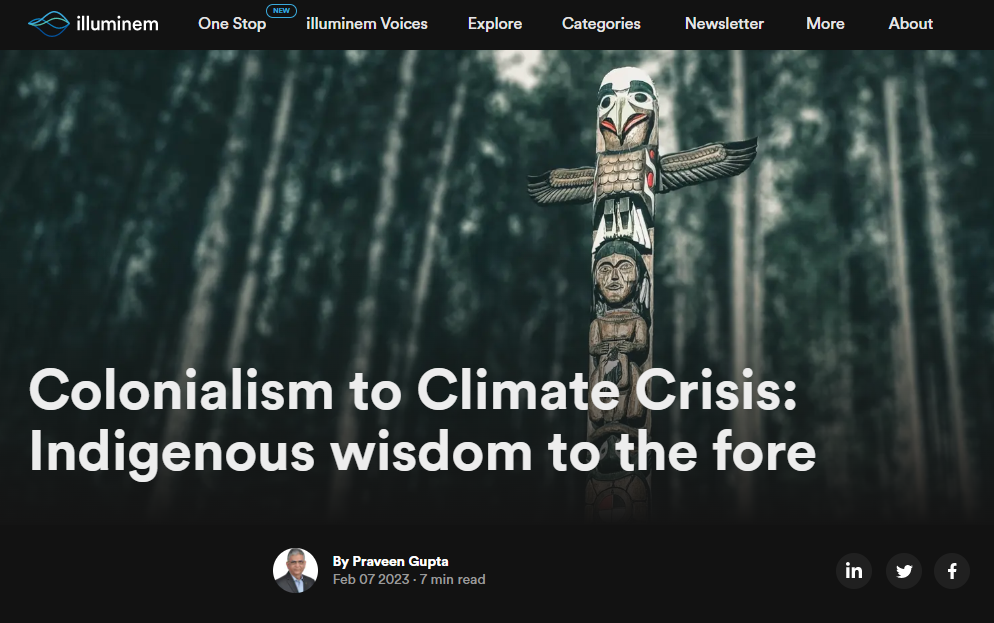
My column for the Illuminem: February 7, 2023
https://illuminem.com/illuminemvoices/c14ab26f-1b7c-4bd3-bcdb-4fe0de09a6ed
Brutalization of Americas – its land and the indigenous peoples – was the worst form of colonizing. Amitav Ghosh’s brilliant novel ‘The Nutmeg’s Curse’ is a graphic account of how all these actions became a major trigger for the Climate Crisis that we are today enmeshed into.
I pick recent news stories of four Native American Tribes (Canada and the US) which are early rays of hope. Hoping and wishing that the indigenous peoples will get back into the Stewardship of Nature. Reviving “the belief that spirit existed in all matter”. A belief that the colonizer tried very hard to erase. The only hope for getting us out of the mess we are in.
But then this is not just about the Americas alone, anymore. Ghosh reminds us: “Much, if not most, of humanity today lives as colonialists once did – viewing the Earth as though it were an inert entity that exists primarily to be exploited and profited from, with the aid of technology and science…”.
Can we think seven generations ahead when making decisions? Chief Oren Lyons, a Native American Faithkeeper of the Turtle Clan tells us: “In our way of life, in our government, with every decision we make, we always keep in mind the Seventh Generation to come. It’s our job to see that the people coming ahead, the generations still unborn, have a world no worse than ours – and hopefully better…”.
“Would that we consider those unborn generations as we trample our forests and pollute our skies in the name of progress and our present-day entitlement”? Asks Wayne Dyer.
Chartered Insurance Institute blog: February 3, 2023
https://thejournal.cii.co.uk/2023/02/02/chatgpt-opportunity-or-threat
As a long time follower of the UK market – I commence this piece with the ‘tech nudge’ from ‘Direct Line’. Fast forward it all to the arrival of internet, big data and ethical issues. Talking about ethics I bring in the hawk-eyed industry expert – Duncan Minty – who continues to challenge insurers/ regulators with many a profound issues.
I end this with an element of ‘wishful’ thinking wrt the just born but extra precocious ChatGPT. It can be multi-edged. If things do work well, ChatGPT may even facilitate potential solution/s for addressing climate change. Something that the insurance industry continues to struggle with. And finally, insurers may have no excuse to ignore the customer?!
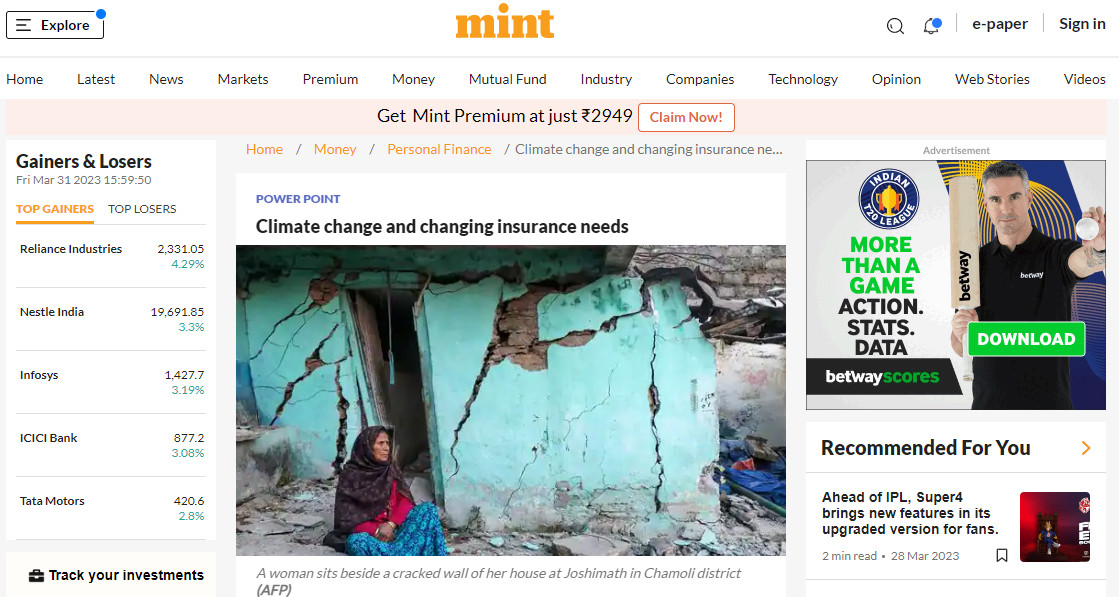
Mint: January 30, 2023
Co-authord with Abhishek Bondia.
Looking after our homes and health was never so important. Unfortunately, we have some of the most polluted cities in the world. Delhi generally tops the list. Adverse natural forces have been unleased due to #biodiversityloss, #pollution and #climatechange. #women and #children are the most vulnerable segments. Talking about Delhi, Dwarka residents coming together to address subsidence is an inspiring story (‘PS‘).
Glad to note that Abhishek Bondia puts timely spotlight particularly on “the fast pace of climate change” and that “Delhi suffers from extremely poor #airquality for extended periods of time”. Given “the threat climate change is posing to human health is no longer theoretical but a very current, real, and multifaceted menace”, HMX – Harvard Medical School has decided to introduce Climate Change into its MD curriculum.
Professional advice, not just in the corporate commercial classes but #personalinsurance as well, can make all the difference.
Illuminem.com’s rating for 2022

https://illuminem.com/illuminemvoicesprofile/04c7daf4-afe2-4c13-b875-2a1a30098e74

My column in Illuminem: January 19, 2023
https://illuminem.com/illuminemvoices/c8f9d9e8-3452-4f9b-b5c0-decdfc362168
Threatened by their own actions the new breed of billionaires now wish to burrow where they can sustain themselves and the progeny. The prospects of a doomsday haunts them.
When Bezos announced he was going to space, many people joked that he should stay there. The problems of the world that he is working towards escaping were created by rich people just like him. I draw these excerpts from Hamilton Nolan‘s excellent feature for The Guardian.
It is not a coincidence that the richest people in America are funding a new space race. They are not motivated by a love of technology, or even a belief in the universe as a business opportunity. Let’s call this what it is: they are making plans to get the hell out of here, says Hamilton. In the same way that every good billionaire has an armored escape room in each home and a helicopter on call to whisk them away from any sinking yacht, so too do they expect to have a way off Earth if things go bad here. It may sound absurd to us, the little people without an Ultra Success Mindstate, who have accepted that our fate is bound to the fate of this planet. But it is perfectly in line with the sort of thinking that drives men to become billionaires in the first place.
Looming climate change disaster – he says – is not a reason to come together and recognize that our destinies are linked with those of all living things; rather, it is a sign that the time has come to build the escape vehicle.
The very behaviour and lifestyle that gets them the billions, also ensures their dystopic ways. They seem to be good at sensing what next. Ain’t it a self fulfilling prophecy, afterall?
http://www.thediversityblog.com
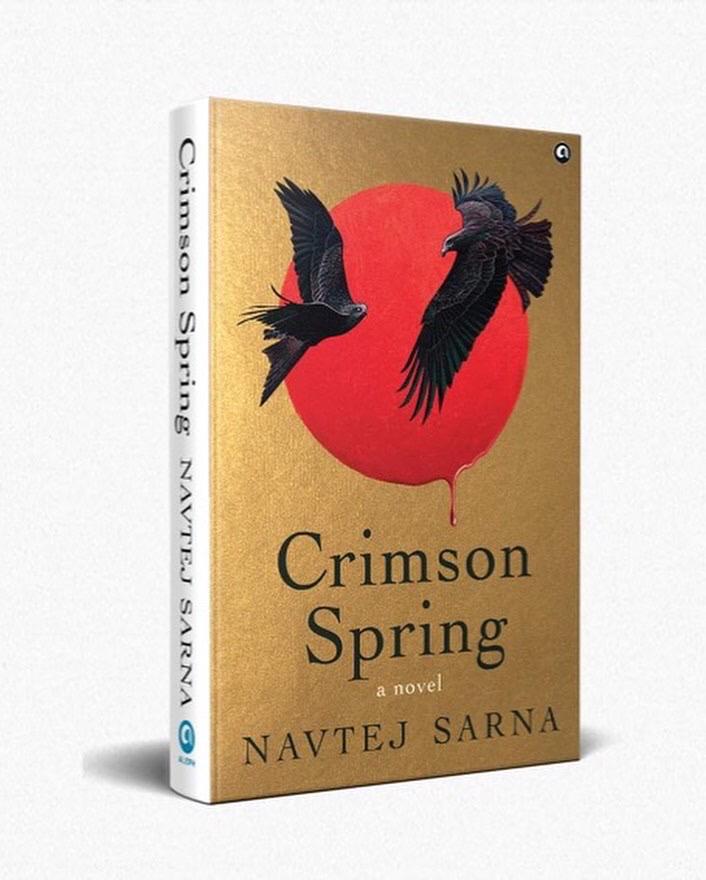
“Writers often carry several persistent aspirations in their hearts, not knowing quite what to do with them. In my case, some of the things I have long wished to write about included the Jallianwala Bagh massacre, early twentieth century Punjab, the Indian soldiers who fought in the Great War, and the revolutionaries who died for India’s freedom”: Navtej Sarna.
I begin where Crimson Spring by Navtej Sarna ends. The tail end of a stirring soliloquy by heroic Udham Singh, at the time of his hanging at the Pentonville prison, London: “The hangman is in front of me, He whips out a white handkerchief from his pocket. No, it’s a white sack that he opens out. The sack is over my head even as the priest is saying the prayers. I see nothing more. I feel the noose around my neck, loose at first, and then tight. Then the ground opens under my feet. I have become immortal. I have become one with Bhagat Singh”.
Udham Singh soliloquy in the author’s voice.
Udham Singh was charged with the murder of Michael O’Dwyer, Lt. Governor of Punjab during the brutal Jallianwala Bagh incident, in faraway UK 21 years after the incident. And he had no regrets: “Though I had killed O’Dwyer and I was prepared to hang, I wasn’t going to make it easy for them. I wouldn’t admit my guilt, like they have never admitted theirs. I have seen people starving in India under British rule. All the money only goes to make big estates in England. Growing things only for England. Indigo, tobacco, cotton…what about food for my people? I had to protest against all that. This was my duty, and I am not sorry. I do not mind the sentence you give me, ten, twenty, or fifty years, or hanging…”.
“I have seen people starving in India under British rule. All the money only goes to make big estates in England. Growing things only for England. Indigo, tobacco, cotton…what about food for my people? I had to protest against all that. This was my duty, and I am not sorry”.
Exploring a book, particularly a work of fiction, generally poses two challenges. Unravelling the author’s mind and the book’s soul. Crimson Spring has a third dimension. While the book centres around ‘horror of the atrocity’ at Jallianwala Bagh in Amritsar – on April 13, 1919 – it is also a ‘wider meditation on the costs of colonialism and the sacrifices and heroism of ordinary men and women at a time of great cruelty and injustice’. Navtej Sarna’s works, on assorted themes, span many centuries. Most of these, howsoever diverse, converge into his passion for Punjab. “Thanks to that Island of the soul… an Island where there is peace and writing can be a waking dream” – that leads him to the soul of each of these creations.
Despite being mindful of risking too simplistic an interpretation, I think it is a holy terrain worth treading upon. The jigsaw puzzle, the sum of his works as I deduce, assumes a fascinating form.
In his book Second Thoughts, Navtej dedicates a chapter to Udham’s idol Bhagat Singh.The latter points to the myriad horrors of social and political exploitation to question the existence of a benevolent God and asks why such a being would create a world of ‘woes and miseries, a veritable, eternal combination of numberless tragedies. His cold rational courage has the feel of steel’, describes the author: ‘I know the moment the rope is fitted round my neck and rafters removed from under my feet, that will be the final moment – that will be the last moment. I, or to be more precise, my soul, as interpreted in the metaphysical terminology, shall all be finished there…’. Bhagat Singh gave up his life at 23 fighting the evil colonialist.
Mystic to martial
One may wonder how Baba Farid’s visit to Jerusalem in the 12th century fits in here? Indians At Herod’s Gate is the answer. Soon after landing in Tel Aviv as the India’s ambassador Navtej hears about Baba Farid’s Hospice in Jerusalem. A seed for the next book is safely lodged in the fertile and curious recesses of a creative mind. “History sometimes leaves no traces” and certainly in what seems on the face of it a very mundane theme, the author’s engaging research finds the links and trails that lead us to a fabulous story.
Baba Farid established the Chisti Sufi order in Punjab. His thought and writing, would give birth to the Punjabi literary tradition, would also influence many masters who would follow him including Guru Nanak, the founder of the Sikh faith. A number of Baba Farid’s verses… are to be found in the Granth Sahib, the holy book of the Sikhs. The holy man incidentally meditated non-stop for 40 days at the site of the present hospice, whilst in Jerusalem.
‘When all has been tried, yet Justice is not in sight It is then right to pick up the sword, It is then right to fight.’
From The Book of Nanak to Zafarnama – marks the evolution of a mystical faith into one that combined mysticism with martial traditions. Its DNA was re-engineered in the face of invasions, persecution and oppression; the use of arms in the righteous defence of the weak became an important dimension. ‘When all has been tried, yet Justice is not in sight It is then right to pick up the sword, It is then right to fight’, wrote Guru Gobind Singh in the Zafarnama, a letter written in 111 exquisite and stirring Persian verses by the Guru to Emperor Aurungzeb indicting the latter for the moral and spiritual bankruptcy of his empire. This evocative translation by Navtej brings to life the valiant voice of the Guru and the power of his poetic genius in a passionate disavowal of tyranny that remains ever relevant.
Origins of Ghadar?
As the British annexed his kingdom, Maharaja Duleep Singh was separated from his mother and his people, tells us Navtej Sarna in The Exile. He was taken under British guardianship and converted to Christianity. At sixteen, he was transported to England to live the life of a country squire – an exile that he had been schooled to seek himself. But disillusionment with the treatment meted out to him and a late realization of his lost legacy turned Duleep into a rebel. He became a Sikh again, and sought to return to India and lead his people. But the attempt only dragged him into the murky politics of nineteenth-century Europe, leaving him depleted and vulnerable to deceit and ridicule. He died a lonely, defeated man in a cheap hotel in Paris.
Navtej’s research unearths Duleep Singh’s voice. A son of the ‘Lion of Punjab’ – Maharaja Ranjit Singh – wouldn’t give up without a fight: “Rebellion seemed to call me from every street corner. I felt free. Free of the terrible ‘Terms of Annexation’ that hung around my neck since childhood, the endless treachery and tricks of the India Office, the deceptive lure of my English life”.
“Rebellion seemed to call me from every street corner. I felt free. Free of the terrible ‘Terms of Annexation’ that hung around my neck since childhood, the endless treachery and tricks of the India Office, the deceptive lure of my English life”
While the Ghadar movement’s birthplace was the Pacific Northwest (US/Canada) – perhaps there is room to credit the Maharaja for sowing its seeds. Duleep reached out to multiple global powers capable of rivaling the British empire. For instance: “I told the Czar that I sought no personal gains but only freedom from British yoke for my countrymen. My brother princes would rise with three hundred thousand men if I were allowed to accompany the Russian Imperial army to the Indian frontier. The Sikh soldiers in the British army would revolt; my people, the brave and proud people of the Punjab would rise to cut railway and telegraph lines. Conquest would be made easy, India would prove to be a goldmine for the Russians, just like it had been for the British”.
Unfortunately, that is not how it turned out to be. The author underlines the tragic finale in his epilogue to the book: “Perhaps our Punjab was to be left only with the memory of a Maharaja-in-exile. Only with a story to be told around winter bonfires”.
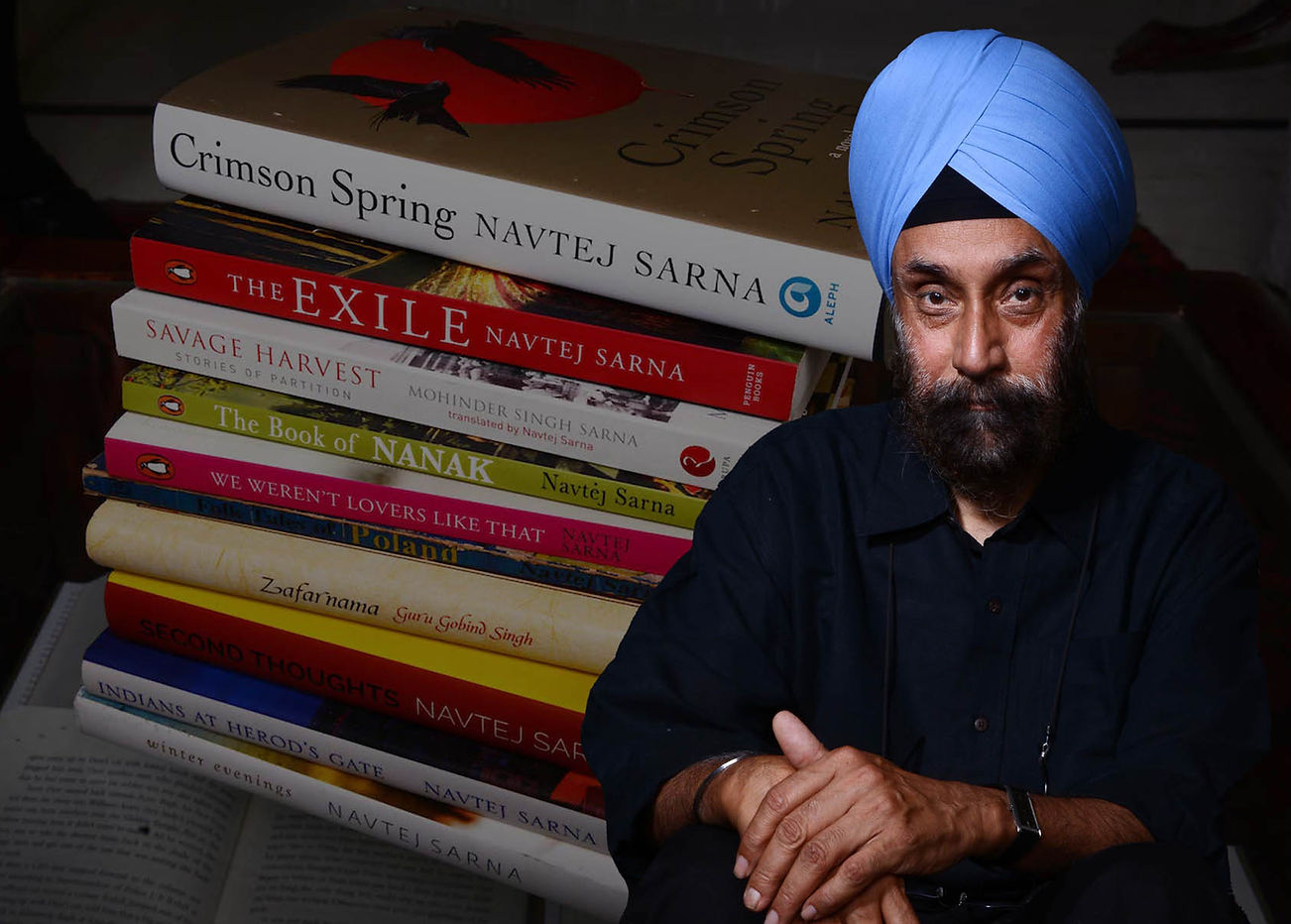
Navtej Sarna’s excellent research and brilliant story-telling moves the baton from Bhagat Singh in ‘Cold Courage of a Godless Revolutionary’ to Udham Singh in Crimson Spring. Making sure that future generations stay inspired.
Savage Harvest
Savage Harvest is Navtej’s translation of his father’s moving short stories around the Partition. They trigger several thoughts. How did a social fabric renowned for its ‘unity in diversity’ suddenly hit the boiling point? Why did the colonial masters not think through the end game of the partition? Was it an outcome of poor governance? Or was it a logical extension of the infamous ‘divide and rule’? Thereby, was ‘Radcliffe line’ one of their most callous acts? If the empire failed, why did we choose to behave violently despite ‘an accursed political decision of departing rulers’?
In a story titled ‘Hope’ the author when alluding to the Hindus and Sikhs migrating from the Northwestern part of the then-country makes a very profound observation. “They had been on the wrong side of the line which had been drawn to divide the country. To come from the wrong to the right side, to cross that bloody line, they had to pay a very heavy price; everybody’s fault was the same, but each one paid a different price.”
Jallianwala Bagh was a savage harvest that turned the spring of 1919 crimson. The incident marks the worst form and highwater mark of colonialism.
Jallianwala Bagh was a savage harvest that turned the spring of 1919 crimson. The incident marks the worst form and highwater mark of colonialism. Having secured significant territorial gains in the Indian empire, destroyed its self-sufficient agriculture and small industries, made it a perfect colony which would supply the colonial master all the raw material and become a market for finished goods, supply soldiers for its military conquests between the two great wars – whether they were Hindus, Sikhs or Muslims. The loot impoverished a flourishing domestic economy which became vulnerable to frequent famines.
Under the guise of abolition of slavery, vast number of people were forcibly moved as indentured labour to cultivate cash crops in distant lands. Compulsively feeding the insatiable machinery of industrial revolution. It was ready to use extreme force, divide & rule – against the innocent and loyal when it saw a unified outcry followed by a determined attempt to be forcibly ejected.
The Ghadar movement was a unique multinational endeavour. It rattled the empire to the core. The movement may not be credited for winning us the freedom but cannot be denied the due role in making it happen. It threw up a breed of men and women who were willing to lay their lives quietly with no expectation. We do not even know much of them. ‘When the fate of a country is being decided, the fate of individuals should be forgotten’ was Bhagat Singh’s level of idealism. That should not translate into forgetting such individuals once a country’s tryst with destiny is done, reminds Navtej Sarna.
“Writers often carry several persistent aspirations in their hearts, not knowing quite what to do with them. In my case, some of the things I have long wished to write about included the Jallianwala Bagh massacre, early twentieth century Punjab, the Indian soldiers who fought in the Great War, and the revolutionaries who died for India’s freedom”. Gladly for us readers, Navtej Sarna’s excellent research and brilliant story-telling moves the baton from Bhagat Singh in ‘Cold Courage of a Godless Revolutionary’ to Udham Singh in Crimson Spring. Making sure that future generations stay inspired.
http://www.thediversityblog.com

May the Cosmos conspire: My hope is that you will not take pure air, clean water and productive soils for granted as my generation did. That you will, instead, respect and venerate these as the priceless gifts as our ancestors did.
Praveen Gupta: In the last 5 decades of your involvement with Nature – what has indeed changed for good?
Bittu Sahgal: Two specific developments offer me hope.
First… young people from the four corners of the earth have witnessed, and are convinced, that our climate crisis is a direct result of the unfettered use of fossil fuels, coupled with the destruction of species diversity contained within Earth’s diverse biomes and ecosystems.
Second… our young realise that better planet management, and cooperation, will offer the long-term food, water, social and economic stability humans desperately need to survive the trials of life.
PG: What needs to desperately change with due urgency?
BS: Humans must accept, with humility, that adapting to bio-spheric imperatives, is a better survival strategy than relying on the nascent, untested technologies currently being deployed by us to refashion Earth’s biosphere.
It’s an anthropogenic climate misadventure. The result of believing that humans have become the gods we invented.
PG: How would you define the Climate Crisis that many around us still refuse to recognise?
BS: It’s an anthropogenic climate misadventure. The result of believing that humans have become the gods we invented. Climate economist Lord Nicholas Stern, Head, London School of Economics’, India Observatory, put it best in his landmark 2006 report, The Stern Review on the Economics of Climate Change: “Climate change could lead to the greatest market failure ever.”
PG: Your message to the young?
BS: My generation of elders are less wise than they claim to be. They are colonising your ecological future. But it is not too late to restore Earth’s balance. Working with nature you can and must start on the long road back to planetary stability by flowing with nature’s tide, instead of fighting to change its flow.
“Climate change could lead to the greatest market failure ever.”
PG: Your vision for the next 50 years?
BS: Charles Darwin’s stark ‘adapt or die’ prediction, coupled with Richard Dawkins’ Magic of Reality will become the mantra to reboot our planet.
As the COVID-19 pandemic proved, skies will turn blue again and rivers will run clean. Forests will regenerate. And the oceans will slowly begin to stabilise Earth’s climate. History will record how ignorance, avarice, arrogance and apathy combined to push Homo sapiens to the very edge of disaster. Stability and stasis will replace economic growth as the holy grail of long-term sustainability.
Economic choices have always been determined by scarcity and choice. And survival has always involved actions based on risk analysis. My generation has left you a world with fewer choices and greater risks. But it’s still a beautiful planet and you will still wake up each morning to the wonders around you. My hope is that you will not take pure air, clean water and productive soils for granted as my generation did. That you will, instead, respect and venerate these as the priceless gifts as our ancestors did.
PG: Many thanks Bittu for sharing these pearls of wisdom and hope. Here is wishing you A Blessed & Happy New Year!
Drawing from this timely story by Zuha Siddiqui for http://www.thethirdpole.net
December 26, 2022
Not too long ago, Karachi like Mumbai was part of the erstwhile Bombay Presidency. Cyril Radcliffe’s masters – wary of India’s proximity to Russia – did not wish an independent India access close to the Middle East’s oil. That is all history. Despite being on either side of the border, we continue to invite the wrath of climate forces. What’s reportedly been happening to Karachi gets dwarfed by Mumbai. The exposure to two other port cities – Chennai and Kolkata cannot be missed either. Author Amitav Ghosh tells us in his book ‘The Great Derangement’: “The reality is that ‘growth’ in many coastal cities around the world now depends on ensuring that a blind eye is turned towards risk.’’ Most residents generally remain blissfully ignorant as to where the seven islands – that constitute Mumbai – begin and end.
Banks continue lending for the ongoing asset buildup frenzy as do insurers concentrate the risk they carry and investments they make. Mangroves are under pressure, so is whatever remains of the green cover. An exploding population, rise in number of vehicles, resulting pollution, plastic menace, et al – will only aggravate with sea level rise. Ghosh, backed by scientific research, continues to warn us about the increasing frequency and severity of cyclones on the west coast. Its possible ramifications for the two nuclear facilities in the close proximity. Needless to mention concentration of country’s financial services and likely challenges in evacuating the population in event of an emergency.
“Karachi is among the world’s least liveable cities, ranking 136th out of 140 on the Economist’s Global Liveability Index. Warning signs of the impending climate crisis have been compounded by local authorities’ reluctance to mitigate its harmful effects by building climate-resistant homes and buildings, and ensuring the upkeep and maintenance of the city’s storm-water drains, which are choked with plastic waste”. Can we afford to lose sight of what Zuha Siddiqui has to say in thethirdpole.net? Or is it, “our collective inability to come to terms, or even imagine, the catastrophe that is currently staring us in the face from climate change. Depending on how bad it gets, present generations will remember our failure to confront reality with bafflement and probably rage”?
#strandedassets #climateemergency #biodiversity

My column for Illuminem: December 22, 2022
https://illuminem.com/illuminemvoices/a4bd0ef7-2486-4061-97c2-4586a505448f
An introspection and contemplation on what we stand to lose and at what price?
My year end column for illuminem draws heavily from the brilliant Maria Popova. We furiously continue to lose what we have. But do we really know all that we have? The magical biodiversity continues to unfold, reveal and amaze.
Rupert Read tells how “Avatar 2 should make us completely rethink our relationship with the planet”. He rightly warns that the #cop15 accord will be a paper tiger unless there is the will to implement it.
Marlene Greenhalgh shares some harsh truth. “The grave danger of the orgy of mutual self-congratulation that met the announcement of the Montreal accord is that it will encourage complacency among the public. It will give them (us!) the story that we all want to hear: that things are going to be ok; that we can safely outsource worrying about this more-than-issue to our governments; that they have this covered… Optimism of the intellect is not what we need at this time. For it amounts to little more than wishful thinking writ large. What we need is courage: to look the very difficult truth in the face. And a profound determination: to work together to start to build a different system; and to pressure this system we live under to transform”.
Daniel Christian Wahl has a time-tested prescription: “One way to rediscover the practices that helped Homo sapiens survive for over 200,000 years is to pay more attention to #indigenous wisdom and traditional place-based knowledge (where it has not already been completely lost). Indigenous human cultures are an expression of generations of co-evolution of humans within the ecosystems they inhabited… Cultures that have managed to survive for millennia within their bioregions have a lot to teach us. Over the last few hundred years we have developed the unfortunate habit of dismissing such knowledge as antiquated and calling such cultures ‘primitive’. Hypnotized by the apparent benefits of scientific and technological progress we made the mistake of dismissing traditional ecological knowledge that underpinned human survival for most of prehistory”.
Whatever, we continue to lose is not coming back. “Humanity is a weapon of mass extinction” to quote the UN Chief.
No form of insurance would protect us from that!

The Chartered Insurance Institute Journal: December 16, 2022
https://thejournal.cii.co.uk/2022/12/16/redressing-balance
My blog for the Chartered Insurance Institute Journal on #lossanddamagefund – which finally saw light of the day at the #COP27 – after three plus decades of discussion and negotiations. The insurance industry has been muted, thus far, in its response. While insurers have no role here, there is a room for synergy and a scope for learning. Climate losses are not the monopoly of #GlobalSouth alone. 2022 has demonstrated the firepower of ‘Mother Nature’ pushing back ‘Father Greed’. #GlobalNorth has borne a significant brunt.
Hardening insurance premia for natural catastrophes only evidence the fact that these losses are hurting #insurers and #reinsurers. Scientists tell us it can only get worse as global temperatures rise. Just that the small island nations and the lesser developed countries have been impacted for virtually no fault of theirs. Experience from handling of loss and damage portfolio could provide significant learning to the insurance industry in areas of adaptation, mitigation and resilience building. Needless to mention the likes of climate modelling, scenario planning and product development.
Loss and Damage would not only be a boon to the vulnerable countries but also signals a long overdue transformation of the global multilateral financial institutions. From Bretton Woods we could be in for a Bridgetown Initiative as envisioned by Barbados Prime Minister Mia Amor Mottley. The tireless and heroic work of island nations in particular has got us here.
Tyrone Hall, PhDRoger-Mark “R-M” V. De SouzaAngelique PouponneauKera Sherwood-O’ReganMairi DuparLisa McNamara
 The Diversity Blog