Several weeks after the Xian visit I was in Singapore and at a dinner talking to my friend Nimish about a possible connect between ancient China and Egypt. Pre-dating the Silk route! Coincidentally just then I get a text from my wife Medha confirming post card from Xian had arrived, the last of the four recipients. Some remarkable timing!
A fine meal concluded with an amazing adaptation of a designer moon cake by Raffles! Yet it’s the food for thought that warmed the resolve to continue our exploration of the ancient super highway…
Back at work in Mumbai, I get this most amazing mail from Nimish. A link to an authentic paper linking the origins of the Chinese race to ancient Egyptians. Now what do you make of something like this? Nimish calls it prescient! He also promises to introduce me to a Chinese book of antiquity on the Silk Road. In the meantime, for anyone wishing to explore this theme – here is the provocation: http://foreignpolicy.com/2016/09/02/did-chinese-civilization-come-from-ancient-egypt-archeological-debate-at-heart-of-china-national identity/?utm_content=buffer7bb49&utm_medium=social&utm_source=facebook.com&utm_campaign=buffer (Source: Foreign Policy.com).
Published in the Journal of the Insurance Institute of India
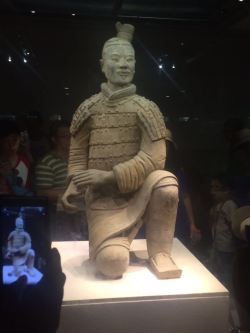
Recently back from Xi’an I am not surprised that China’s first ever emperor was a product of a Silk Route location – Xi’an or Chang’an in the Shaanxi province. Ying Zheng took the throne in 246 BC at the age of 13. By 221 BC he had unified a collection of warring kingdoms and took the name of Qin Shihuang.
Eighth wonder
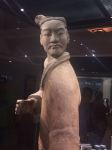
What is now referred to as the eighth wonder of the world, the Terracotta Warriors site, is a part of an elaborate mausoleum created to accompany the emperor during his eternal rest into the afterlife. One of the first projects the young king accomplished when alive was the construction of his own tomb. It is believed he never gave up the quest for immortality and continued his desperate obsession for discovering the elixir.
One enemy that would not give up pushing back the Qin Empire again and again was the Xiongnu tribes. As a response to this challenge came up what became the precursor to the Great Wall. The Qin dynasty lasted only a little past the lifetime of its first emperor (221 to 206 BC).
The Hans (206 BC to 220 AD) followed the Qin dynasty; it was under their Emperor Wu Di that first Chinese missions were sent to South-East Asia, Central Asia and eventually even Rome, marking the beginnings of the Silk Road. However, even before the Silk Route was formally established, could there be something that Qin Shihuang imbibed from ancient Egypt and its Pharaohs? Perhaps historians would some day be able to unravel the compelling drivers of the two legacies that the first Qin emperor left behind – the Warriors and the Wall.
Silk route
Thanks to the consolidation by the Qin dynasty, it created a platform for the launch of a first truly global trade route both by land and sea – the Silk Route. The stability and prosperity it brought about, made it a home to several dynasties, later also evolving into a major seat of Buddhist learning. Both Faxian and Xuanzhang the renowned traveler scholars, who extensively explored India, resided in Xian. The Big Wild Goose Pagoda housed Xuanzhang’s library – a collection of Buddhist scriptures he carried with him from ancient India.
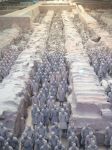
Now back to the present. The Terracotta Warriors’ site seems forever busy at a frenzied pace. Such is the rush that the traffic on the approach highway barely crawls owing to major traffic jams. Your patience gets further tested once you get inside the pit area which is covered by humongous hangar like structures. The thousands of eager tourists do not easily give into your desire to get close to anything you may wish to watch closely and patiently. You are bound to get pushed again and again by a sea of humanity. The rapid fire clicking of cameras feels like over-excited glow worms dancing in random orbital patterns.
Slowly and steadily we all get used to the sounds, hustle & bustle, dim lights and get the focus right to be attentive enough to hear what our guide Mr Li has to say. He has his own sense of humour. As we peer into the trenches where stand the formations and lies the rubble – he points at the mounds of clay next to them. ‘That is original clay which has been dug out from the pits to be sold for making fake terracotta soldiers for sale’!
Every now and then he reminds us what all to see and where to look for him ‘you have 20 minutes sharp’, if anyone in the group were to get swallowed in multiple directions. Dr Liang Rong, our guardian angel, from host Tsinghua University SEM keeps a watchful eye to ensure none of us go out of her sight. After centuries of subterranean existence the chance discovery of this amazing find has literally unleashed massive energy wave after wave of curious hordes. ‘Chalo Chalo’ (Let’s go, let’s go) shouts Li when he spots us. He informs our multinational lot as to how he has picked this from the several Indian groups that he receives. It is concise, loud and clear. ‘And I am the only one saying it’!
In pursuit of immortality
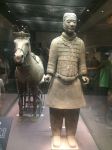
Despite all the din and distractions one is overcome by the scale of design and execution of the ‘project’. More importantly the enormity of restoring them all – six thousand plus warriors and the paraphernalia from virtual rubble. The Sherris couple who were revisiting since 1997 find the site no different from their first time. Dr Katja Hanewald who specialises in Population Ageing Research at the UNSW and I talk about how it has become scientifically possibile for humans to live a full 300 years. Maybe you need to really survive that long if you want to see a perfect recreation of what Qin Shihuang originally conceived and left behind! Chris Parsons from Cass Business School and I remain foxed by young Qin’s having to reconcile with putting together an empire, pursuit for immortality and life after – all at once!
As we sit down for our formal conference dinner, Katja seated next reminds me the cuisines are hot and extra spicy owing to the Central Asian influences on the Silk Route. They truly represent the culinary diversity of China.
Eight Weirdies In Shaanxi Province
Hot pepper is a delicacy
Local people may have their meals without any meat or vegetable, but they can never do without hot pepper which has already become a kind of delicious food. It can be put in noodle or steamed bread. The hotter the better. (Picture postcard quote)
Return post
Then on my return flight from Hong Kong (well ahead of Typhoon Nida making a landfall – it was Signal 1 raised then), I had this young man from Gujarat (Guangdong of India, as The Economist termed it) as a fellow traveller. Returning from Shenzhen where his company gets its I.T. hardware manufactured. He was visiting the client to fix some bugs is all I gather. His excitement about the wonderful commutes on the MTR across large parts of Guangdong was understandable. He did not follow Cantonese but managed his way courtesy the efficient systems. And food? There are plenty of vegetarian options, he said. I even found an Indian restaurant in Shenzhen!
With some time to spare, having checked in, I could not resist entering the airport post office. It was an abode of peace. The gracious lady manning the counter served me tea as I sat down and scribbled on the four picture post cards. Only the farthest one – to the US – has been delivered till date! The rest I guess are still somewhere on their way via the snail mail on the New Silk Route. A taste of slow paced nostalgia…


The last time I stumbled upon one such unsettling experience – it also opened to me an unknown side of the author MS Sarna – as I journeyed through canvasses of the vivid and moving stories he painted. But it was too late to pose some existential questions arising from his creations.
Shobha Rao’s book launch in faraway Seattle coincided with my holiday there. Yet another set of partition account? As I headed to The Elliot Bay Book Company where Shobha was reading her short stories titled An Unrestored Woman, I conjured some form of detached and benign fiction. My mental construct said she was too young to be authentic. Moreover, given her origins from nowhere near the epicenter of the un-great divide and living in the U.S. of A – this could only be a harmless though creative concoction!
Such is the intensity and immensity of the consequences of the line Mr Radcliffe drew across the subcontinent that it continues to pollinate the imaginations of distant generations in faraway geographies even today. And Shobha for sure is one such recipient who chose to deal with this historical aberration in her uniquely creative style. The bonus this time – I could speak to the author after the book reading and can seek answers if and when there are more questions.
The transfer of populations between India and Pakistan is considered the largest peacetime migration in all of human history. It is believed, says the author in her introduction, that eight to ten million people were displaced from their homes and villages, with primarily Hindus, Muslims, and Sikhs seeking refuge in what they hoped would be the relative safety of the religious majority. This mass movement of people incited numerous acts of violence on both sides, with nearly a million people killed in the migratory effort.
As with a majority of conflicts, says Shobha, women and children during the Partition were often the most vulnerable. Her key focus is on the specific brutalities inflicted on women including kidnappings. She cites official estimates that 50,000 Muslim women in India and 33,000 Hindu and Sikh women in Pakistan were abducted. Many of these were forcibly returned to families who, in some instances, no longer wanted them, considering them impure. Though the commonly used term for these women is recovered women, she chooses to refer to them as restored. The distinction may seem trivial, she says, but it is necessary, for I believe that while recovery of a person is possible, the restoration of a human being to her original state is not.
She distanced herself from the stories and let her imagination takeover
While she did interview a lot of survivors who went through the partition upheavals – Shobha says she then distanced herself from the real stories and let her imagination takeover. Read her stories and you can sense shades of aftermath of a war, holocaust, full of depravity, bestiality, siege, revenge, greed and deviant behaviour – be it the cause of what followed or caused by what followed? Relationships were tested, cracking the fragile ones and brought out of the blue some into a blossom. Kavitha and Mustafa perhaps is the most priceless of the stories.
The circumstances that unfold on the train ride suddenly witness the marriage of Kavitha and Vinod outlive its utility. Kavitha finds herself supporting little Mustafa’s cause who must cross into the Indian border and be ferried across to East Pakistan. The social fabric that held together its diverse constituents – suddenly gave way to a communal frenzy but there was always some hope. Kavitha’s fondness for Mustafa was surely one.
Shobha herself is a brilliant representation of how the Partition continues to influence a generation removed both by time and geography. In Curfew, she too very sensitively captures the remote melancholia of Safia who moves from Lahore to the UK as a small child. She seems to be forever running from or for something. As she says “We leave the places we’re born, the places we’re meant to die, and we wander into the world as defenceless as children. Against such wilderness, such desert.”
Farther in the United States Meena runs into erstwhile Police Officer Jenkins from Rawalpindi under strange circumstances leading to stranger outcome. Or Renu who turns from a housemaid to The Merchant’s Mistress and eventually fakes her way to South Africa disguised as the merchant! So it’s not just Safia alone, everyone’s running away from something that’s got something to do with Partition. It’s not always a flight. And Shobha brings out how women who suffer the most from civilisational upheavals can fight too.
A tonsured Neela ended up in CAMP FOR REFUGEES AND UNRESTORED WOMEN. District 15, East Punjab because her husband Babu was supposedly dead. Reunited yet again, Neela however decides to end her life. A tragic but heroic one. Some very moving words embellish this “The branches reached down and just as she closed her eyes they gathered her up onto their shoulders and held her as she had always dreamed of being held. As she would never be held again.”
Abheet Singh’s widow to Jenkins “Yes, I know”, she interrupted in Urdu. “ You want to express some condolence, some sadness. Isn’t that so?” and later, “Cruelty’s a strange thing,” she said after a long moment. “It gets so you actually miss it.” The exploitations of Bandra and how Zubaida pays back in Blindfold. The brave mother who chose not to leave her Noora behind because the law said no child of a Muslim father was to be allowed, in The Lost Ribbon. In The Opposite of Sex, the manipulative Mohan changes the boundary demarcation between India and East Pakistan to win over Lalita. A dramatic end follows but Lalita holds her ground. Another brilliant story in the form of Such A Mighty River is also set on the Eastern front.
While the stories leave you very uneasy, that’s the price one must pay to experience the tumultuous times many of us were not physically present in. The creator’s imagination, creativity and research are a fine attempt to simulate the ground reality as it unfolded back then. Thanks to her story telling, readers get their fair share of pathos, fear, anxiety, despair and all kinds of unsettled feelings. You are bound to be transformed to the gloomy and tragic past of our recent history.
Shobha duly credits sources of her inspiration, yet the craft is distinctly hers. What stands out is her graphic portrayal of the price women end up paying again and again in moments such as these and bear the brunt.Ms Rao would certainly make a great role model to aspiring authors in ensuring all such struggles find their due place in modern literature.
Published in The Journal of Insurance Institute of India, April-June 2016


Whilst at Maui
In Hawaii
Why must occur to me this hoo ha
About Wagah?
Defending territory
Seems a fixation since eternity
While two footed or four
Cannot crossover
The winged ones, scavengers or birds of prey
Have an unhindered cross border sway
Back in Amritsar city
You just cannot but surrender to the Temple’s mystic beauty
Land of a golden tradition
To resist any form of submission
Wanna witness a historical parallel?
Must to Mewar you got to travel
Just as gather all us spectator
Eager to watch the sound and light spectacle at Kumbhalgarh
Comes the Muezzin’s daily last call
From inside the fort’s own robust wall
Descendants of Muslim forces – who owed Pratap their loyalty
Resolute choices of this valiant Maharana brought him both – misery and glory
Fighting a central imposition
Proving you need not take sides based on religion
That bombings and strife
Has a brighter side as well, for Syrian life
Robin Yassin-Kassab and Leila Al-Shami narrate with intense passion
How local councils are running many a non-state sponsored institution-crucible for reinventing the idea of a nation?
Then on the flight to Kahului, in Maui – have besides me this Ukrainian origin family
Anna, Natalia, Svetlana and Uri
Having modest means
Does not come in the way of their American dreams
And as the names suggest, they are neither giving up on literature
Nor space adventure
Not sure what to make out of the whisper
Of a free Hawaiian state, at the Lahaina harbour
All this and lots more, whilst at gorgeous Maui
In far flung Hawaii…
After Seattle
Here not a sea gull
Albatross is elusive
Nene reclusive
Volcanoes barren
Exteriors not frozen
Lahaina no more a whale hunter’s paradise
Ever since fossil fuel did materialise
They can breed here in peace
A refreshing new lease
Once the calves arrived
The humpbacks for Alaska have departed
Now back in Washington
It is my intention
To sight them before they disappear onwards into British Columbia
Perhaps they could just be touching sunny California
It’s a real long way from Maui
In Hawaii…
Being a Woman Surgeon (edited by Dr Preeti R John) is not a commonplace theme at diversity forums. Glancing through the July 2015 Bulletin of American College of Surgeons, I pick this very interesting insight. Dr David B Hoyt, Executive Director, alludes to the book with the same title and shares his thoughts in his editorial.
Women have practiced surgery since the profession’s inception. Nonetheless, women continue to be underrepresented in surgery. Unfortunately, there are signs that fewer women will be entering the surgical workforce in the coming years as the number of women medical school graduates slowly declines in the US, he laments. In 2005, 49.5 percent of medical school graduates were women, but in 2014, less than 47.5 percent of medical school graduates were women. Furthermore, only 21.3 percent of all surgeons in the US are women.
In all, 60 women surgeons describe in essays, poems, and interviews how they have dealt with the challenges, joys, frustrations, and rewards of being a woman in surgery. Their stories range from the humorous to the heartbreaking and make for inspiring reading, he says.
As the authors note, surgical training and practice are challenging for all of us, but some of these difficulties are compounded by gender. Starting a family, for instance, creates specific obstacles for women in surgery simply because of the fact that they are child bearers. As a result, women surgeons have had to give more thought to whether and when to have children. Several authors opted not to have children. For those who did – once the babies arrived new challenges emerged.
Many women in the book also recount their encounters with sexism, ranging from the subtle to the blatant. Some gender stereotypes, on the hand, actually seem to have worked in favor of these women surgeons. Many of their patients say that women surgeons are better communicators and more empathetic than their male counterparts.
In fact, most of the authors point to many men surgeons who were willing to give women an opportunity to train at their institutions and who fostered the professional development of all their trainees – regardless of gender.
Most surgeons, including the women who share their stories in this collection, say that they didn’t choose surgery so much as it chose them. They knew from the first time they witnessed an operation that they wanted to be surgeons. As one author writes, “There is only one requirement to be a truly great surgeon – passion. You have to love it with your heart and soul.”
Anyone who agrees with that statement – male or female – will surely enjoy reading Being a Woman Surgeon, and hopefully, this book will make its way into the hands of medical students and encourage more women to pursue a surgical career. We need them now more than ever, emphasizes Dave. Imagine if we are not making the optimum search for the best of surgeon material in all of the potential talent pool, men and women put together, how much are we denying the humanity from its rightful healing touch?
 The Diversity Blog