London based Duncan Minty has built a solid reputation as an established independent consultant specialising in business ethics, with a particular interest in the insurance and financial planning sectors. Through his expertise, Duncan is able to deliver greater certainty for clients on ethical risks and opportunities, thereby building trust, reduce costs and enhance service.
The specialties he focuses on being: Business Ethics, Insurance, Identifying ethical priorities, Performance measures for ethical issues, Embedding ethics into management systems, Ethics Training Courses, Privacy and Conflicts of interest.
Q: Insurance is a service industry. We do not distribute products, we deliver service. Is distribution to delivery to ethical delivery a logical progression?
A: I see ethics more as a seam running through both distribution and delivery. Get the ethics of your distribution right and the customer is going to be primed and ready for what they’ve really bought, which is good service. This helps the policyholder see the insurer in more of a partnership light and less of a ‘them and us’ one. The ethical ingredient to your service then sets up the relationship for when claims occur, with trust rather than confrontation being the watchword. If you see your business as a suite of different functions, then you’re less likely to see this logical progression. See it as a set of joined up cogs and the progression is clear.
Q: Charity begins at home. First thing first, how does one get this right throughout the hierarchy of an organisation?
A: I think you enshrine it in your company values, then give expression to it as a part of your business plan and finally, but most importantly, you set a clear and unequivocal example. A company that doesn’t include ethical objectives within its business plan can hardly be said to have an ethical culture. There’s also an extra dimension to ‘charity begins at home’, namely that it reminds you not to drop the values and empathy you have for others when you leave for work. Your personal ethics should guide your decisions at work as well as at home. And listening to the concerns of others and showing them respect and leadership can be characteristics of a successful business person just as much as a successful family person.
Q: Insurers deal with multi-channels. Some are captive and some not. How do they bring consistency across the entire spectrum of reach? Many of the partners are outsourced entities like call centres, loss adjusters. They may perform at various levels of ethical behaviour. How does an organisation align them into an overall consistent game plan?
A: Firstly, you need to choose your partners carefully, taking account of how they work to their personal, corporate and professional values just as much as how they charge for this or that service. Ask them to give you some concrete evidence of how they put this into practice, rather than try to work it out for yourself. Then be clear about your expectations of their behaviour when acting on your behalf, showing what is acceptable and what is not. So for example, if you want adjusters making your claims decision to never use information obtained by illegal or unclear means, then write that into the loss adjusting service agreement, with penalties to match. In essence, it’s all about transparency, accountability and consistency.
Q: It is about getting both the physics and chemistry right. You may have a great structure and process – how do you get it right at the feeling level? Is it about fool-proof embedding?
A: Having someone at the top of the company who sets the right ethical example and encourages others to follow his/her lead helps a lot. Get those two things right and more likely than not, you’ll end up with a corporate culture that encourages openness and discussion. When people then feel they have a voice in your firm, and will be listened to, you get a lot more understanding and accountability.
Look at this from the other way round: the danger with closed cultures is that the chemistry can sometimes become rather active and blow up when no one realises it!
I think that fool-proofing embedding comes from being very clear about “walking the talk” on values and ethics: making sure that they’re actively used in decision making, even when it may result in business being lost. People realise the firm is serious about ethics and adapts their personal behaviour to match it.
Q: How does an ethical conduct of delivery impact overall governance within an organisation and vice-versa?
A: It’s clear now that if those overseeing the governance of insurance delivery in the UK over the last 20 years had paid more attention to the rights and wrongs of what they were doing, then the sector would have a much better reputation and be better off to the tune of many, many millions of pounds of compensation. Those in governance have a tendency to focus on internal controls and procedures, and to fail to stand back enough and consider the ethics of how products were being used by distributors. Then they would recognise that how products are designed and priced has an influence on how ethically they’re likely to be delivered, something that the itemised thinking behind a lot of governance can’t spot. That said, fusing together governance thinking and ethics thinking can work in those markets with a more ‘rules based’ approach to insurance regulation, the US being one such instance. The UK now has a more principles based approach and insurers are trying to adopt accordingly.
Q: Does ethical conduct tantamount to treating customer more than fairly?
A: I don’t see it that way, for no other reason than that would imply that treating someone fairly was less than ethical. Fairness is a key part of ethical conduct, yet fairness also has more than one dimension, so is often misunderstood. This is evident at the moment in the UK with regard to the provision of flood insurance. I think fairness is a good theme for customers to connect with (better with a fairly technical term like ethics) and if you embue your overall delivery strategy with fairness, that goes a long way to satisfying many customers. Remember though – you can’t deliver one type of fairness to one set of customers and another type of fairness to another set of customers. So yes, follow the ideas behind fairness, but keep it balanced.
Q: Can there be shades of ethical conduct? Moving from distribution to delivery to ethical delivery – is it evolutionary or revolutionary?
A: I don’t think there are shades of ethical conduct per se, but I do think that ethical conduct can be a journey rather than a destination, and a journey with the odd bump and wrong turning along the way. So the shades come in more around how far you are along that journey and the extent to which your ethical road is bumpy or unclear. The business world is always in some state of flux and coping with what it throws up is always going to be presenting your firm with ethical challenges. That is healthy, for it keeps us on our ethical toes and reflecting on what we are doing. The firm who says it’s got its ethics all sorted out and dealt with is, I fear, a firm that is failing to reflect on what is going on around it and adjusting accordingly.
I think that a firm’s ethical journey can be evolutionary at times and revolutionary at times, depending on what it is experiencing in its business sector. I think that insurance claims in the UK is about to undergo an ethical revolution – the clever insurers will be those who anticipate the need for revolutionary change and take those steps now themselves, rather than be forced to in the way required by the regulator.
What needs to be remembered about evolutionary change is that it may be relatively slow and long term, but it is extremely powerful and ruthless, with the weakest dying away and those most tuned to their environment adapting and thriving. The survivors recognise what is going on around them, tune in to it and adapt to the necessary conditions of survival. Evolution is not a soft option.
Q: How do you audit & ascertain ethical consistency?
A: I think that examining a firm’s ethical culture will illuminate a lot about its ethical consistency. The essence of this approach is to look at what the firm says, then at what the firm does and then at where (and why) the two are different. The findings can be both surprising and exciting, as they can unearth some hidden truths (at least hidden to the firm, not necessarily to its customers!) and show some long term infuences that are still making an impact. You can expect to hear more about ethical culture as issues about how insurance claims have been handled in the UK are exposed by regulators here.
Q: Is it ethical to treat ethical as a differentiator?
A: It certainly is, for your customers have the right to know they can put more trust in your firm and as a result choose to buy your products more often. This differentiates your firm in the market and earns you reputational and financial rewards.
That said, you shouldn’t act ethically just in order to differentiate your firm. Differentiation on ethics is an outcome of being ethical and shouldn’t be its raison d’etre in the first place. Think of it this way: if you act on your values and ‘do the right thing’ only when it is profitable to do so, then it hardly seems right to give up your values when it happens to become less profitable.
Q: How important is ethical delivery for emerging markets? Are there any learnings from the more developed ones?
A: Ethical delivery is just as important for emerging markets as it is for the more established markets. That’s because the same mix of customers, providers, intermediaries, suppliers and regulators are present in both. There’s no case to be made for customers in emerging markets expecting anything less than customers in the more established markets.
It is however unfortunate that a lot of what can be learnt from the more developed markets are the type of ethical shortcomings that need to be avoided: I’m thinking of mis-selling in particular. Emerging markets are well positioned to see how to avoid repetitions of such scandals – it’s down to regulators, professional organisations and insurance leaders to emphasise just how important it is to steer clear of such misdeeds.
Are there more positive things to be learnt, other than simply how to avoid the mistakes? To a degree, yes. Emerging markets can test out some of the processes that have helped firms in more established market achieve better ethical outcomes, but they must do so with a clear agenda to adapt them to their own market’s circumstances. A key part of developing an ethical capacity is learning not what others have decided are the answers, but the process by which to ask the right questions of yourselves and how to implement the answers that come out of that.
To many tennis enthusiasts, of this generation, Jimmy Connors may be a distant memory. He was one of my heroes. I never saw him play. What I interestingly saw was his restaurant “Centre Court” in the small town of Belleville, Illinois. Now face to face with his book “The Outsider”, wherein Jimmy also highlights some amazing insights about his formidable mom and I cannot wait to share till I am done with this entire lovely memoir. Perhaps there will be more as I progress with it. Men can be very mean when it comes to success of women. I do not wish to come in the way of what champion Jimmy has to say in his words:
“A lot has been written about my mom being a stage mother, so let me set the record straight. Why was it OK for Joe Montana’s dad to teach his son football or Wayne Gretzky’s dad to teach him hockey but it wasn’t OK for Gloria Connors to teach her son tennis? Mom stepped right into a man’s world and a man’s game during the height of Women’s Movement in the 1970s. Up until that point, people weren’t used to dealing with a woman in the business end of tennis; both men and women players had men as managers, and men organized and ran tournaments. Along comes this feisty little woman from East St. Louis whose son was proving to be a winner, and they had to deal with her. While Billie Jean King was in the forefront as the first woman athlete to enter the boardroom, Mom had already been doing exactly that behind the scenes, fighting the established tennis bureaucracy. Now, if I hadn’t been winning, they could have dismissed her and it wouldn’t have been a big deal. But my mom represented me. And not only represented me but was my mother, coach, and friend.
She paid the price for treading into that traditionally male-dominated territory by having some pretty aggressive criticism thrown at her by the tennis establishment and the media. They would say she wanted my success more than I did because she had never had it herself, that she hadn’t been good enough so she tried to make her son good enough. They called her “domineering” and “Dragon Lady.” If it got to her, I never knew about it and neither did anyone else.”
A Countermeasure Research on Doctor – Patient Disputes and Medical Malpractice Insurance – Aspects of Local Policies and Regulations:
I finally have an English transcript of this paper presented at the 2013 China International Conference on Insurance and Risk Management, Kunming. The paper is co-authored by Li Zhongmin, Board Member of China Willis Insurance Brokers, Kunming; Tao Yin an Associate Chief Physician; Xu Wenjuan an Assistant Lecturer and Duan Xiaohua of Yunnan Chinese Medical School. It marks early days but for sure represents a very diverse collaborative approach to address a very serious societal challenge.
“Abstract: As China’s public health affairs are undergoing reform and transformation, medical disputes are occurring more and more frequently and have become a serious social problem. According to statistics by China’s public health authorities, from 2000 to 2010, 148 major malignant cases related to medical disputes occurred nation-wide, ten murders merely in 2011. During the three-month period August to November 2010, as per the Public Health department of Yunnan, 765 medical disputes were reported by 2706 medical organizations in the province. With 150 unrests and 43 group disturbances which caused financial loss worth four million Yuan. “
“On March 23, 2012 a hospital attack happened at the First Affiliated Hospital of Harbin Medical University, leaving three hospital staff injured and one dead. The doctor hatred sentiment was aroused again”, according to this paper. ”The attack is a wake-up call for governmental and regulatory authorities. What can we learn from such a lesson? What is the fundamental cause for the situation? What do the medical system design, legal protection, administrative regulation and financial compensation lack? All these questions require serious consideration and contemplation from us and we can only find feasible solutions from the reality.
Therefore, the paper explores the problem from different angles: how to deepen systematic reform and improve operational mechanics, how to make policy and regulations and create positive legal environment from the top. And how to tackle the risk by combining legal, administrative and economic measures all together.
The paper provides suggestions on product development of medical compulsory insurance and commercial insurance. When a unified regulatory standard of medical malpractice is impossible to be imposed nation-wide at this moment, it becomes especially important and urgent for governmental authorities of different layers and local regulations to make action and play a full role in medical practice control and regulation. The paper aims to provide innovative ideas and practical examples in search of feasible solutions of the problem, which is also the difficulty facing this paper.”
It is indeed impressive to see some very fundamental questions being asked and addressed by a cross section of specialties – Insurance being one of them. The answers may not be at hand but the fact that all concerned have gotten together as the world of tort unfolds itself in the Chinese Mainland – solutions will emerge. It is this mainstreaming of insurance profession and discipline that the Indian market needs to also draw inspiration from as stray cases of attacks on hospitals keep getting reported. Perhaps a single regulator can tie all the loose knots far more effectively than what a plethora of control points would!
From North America the stage now moves to the UK. In her ‘Letter from London’ (ET of 21/10/13), titled “No Country for Old Men and Women”, Sudeshna Sen talks about Brits being rapped for not taking care of the elderly. India should start worrying.
She cites the Health Secretary Jeremy Hunt saying it’s a “national shame” that Britain’s society is not taking care of its elderly people, and that the Brits should “learn” from oriental societies where putting old grandma in a home is the last resort and not the first.
Apparently, his research tells him that about 800,000 people in the UK suffer from loneliness. This comes in the wake of a series of scandals about private care homes that neglected their patients to death. The author also quotes BBC according to which 15% of old people live with their children – and most do not want to.
Loneliness is a side effect of a larger problem every ageing society is grappling with: care for the elderly in an era of increased longevity – says the column. By just saying that people should be nice to their old folks and the problem will vanish – the health secretary has only trivialized it. The column reminds him that those same oriental societies he wants to emulate are struggling with the same problems – as in the rest of the world, and if you leave out the Scandinavian societies, nobody’s found any decent answers.
In China, with its four grandparents to one child syndrome, the authorities are worried about elderly care. In India, the problem is even worse, because it’s just not recognized. The onus of elderly care is squarely on the shoulders of the family. The state, the larger community and even charities don’t consider this a burning issue. While over 20% of its population is lonely in China or Europe, that’s not the case in India, yet. If we were to account for the rising labour and real estate costs, costs of living and chronic medical support, availability of trained geriatric carers and urbanization as a few of the factors. India isn’t there yet, but we’ll get to this point in a couple of decades.
The author goes on to warn India not to repeat the mistakes that Britain made. In the welfare / nanny state of mind, UK’s elderly problem was solved by the care home industry. It was financed to some degree by the government but with vast contributions from families and individuals. Even care homes that are now charged with close to manslaughter cost about GBP 3000 a month. Usually they take your life savings or your home, and promise to take care of you in your dotage. Somewhere down the line, like everything else, they privatized it all.
It led to the Southern Cross debacle financed by PE firm Blackstone, Southern Cross was UK’s largest care home chain. They expanded, took on huge corporate debt, went real estate ballistic and went bust; leading to dodgy practices and deaths from negligence. Says the author – In India, I increasingly hear about care homes or what real estate developers call ‘retirement’ projects. What she says I don’t hear is any regulation or standards, or monitoring, or binding long-term legal parameters that will ensure that when I’m gaga, they still have to deliver what they promised.
A very strong message and a loud wake-up call indeed!
View one: “The Supreme Court’s decision to award around Rs 11 crore as compensation to the plaintiff of the 15-year-old Anuradha Saha medical negligence case is welcome. The judgement and the compensation amount – the highest in India – highlight the problem of increasing medical malpractice in the country and should serve as a deterrent in similar cases. There is no denying that India’s healthcare sector is in poor shape. While public hospitals and clinics suffer from a woeful lack of infrastructure, private service providers have been accused of profiteering and other exploitative practices. A weak regulatory regime has led to the rise of an unholy nexus between doctors, hospitals and diagnostic services. Hence, patients are left at the mercy of a venal system with few alternatives.
In such a scenario, it becomes very difficult for victims and their kin to prove cases of medical negligence. Given the technical nature of the medical profession, negligent acts of omission or commission need to be verified by fellow doctors who hardly ever support the patient. Besides, victims fear that reporting cases of malpractice will deny them treatment in future. Thus in this skewed doctor-patient relationship it’s the duty of the system to protect the latter. Enhanced monetary compensation for proven cases of medical negligence is a useful way of balancing out the power equation between health service providers and ordinary citizens.”
Counterpoint:
“The Supreme Court’s landmark judgement in the medical negligence case pertaining to Anuradha Saha is being spoken of as a watershed development. It is, but not in the way people imagine. The judgement may trigger the introduction of some of the worst aspects of American healthcare to India, marrying it with the worst aspect of India’s legal system – namely judicial delays.
Given the apprehension among doctors following this decision, don’t be surprised if India soon sees its version of defensive medicine. This occurs when diagnostic measures do not prioritise the recovery of the patient, but seek to treat the patient from the standpoint of protecting the doctor from malpractice litigation.
There’s another way in which the recent development can make the system poorer. The Saha judgement exceeds Rs 11 crore in damages when interest charges are added. With this kind of mind boggling figure, doctors will inevitably look to insure themselves against potential liability. The cost of insurance will surely be passed on to patients. Healthcare in India is not inexpensive. Expect it to get more expensive.”
One need to have a close look at the fine print of the judgement to understand as to what extent the quantum awarded is a function of the victim being an NRI and how far would this potentially bump up the multipliers for claims by resident Indians? The fundamental issue however is the crying need to get a regulator in place to mind the space. The space is everything to do with healthcare including health and medical malpractice insurance.
Physicians are not part of society’s elite and other graduates have higher salaries, says Patti Waldmeir in an FT column of 7/10/2013.
The story quotes a survey last year conducted by MyCos education consultants in Beijing. According to it the average monthly salary for clinical medicine graduates was Rmb 2,339 (USD 382) within six months of graduation. Average income for all graduates was Rmb 3,051 nationwide, with doctors and nurses the lowest.
Many doctors it says complain that disgruntled patients increasingly turn to violence when doctors are unable to cure their ills, even though there is no malpractice.
A plastic surgery patient used a knife to attack three nurses, one pregnant, in the central Chinese city of Changsha in September. Doctors, says the report, often have to pay out of their own pocket when patients sue them.
According to state media reports attacks on doctors are becoming more frequent. The average number of assaults rose to 27.3 per hospital in 2012, compared with 20.6 in 2008 according to Chinese Hospital Association quoted by Xinhua.
Xinhua reported that the violence is starting to chase doctors out of the profession: nearly 40 per cent of medical personnel surveyed at 316 hospitals nationally from December 2012 to July 2013 said they planned to give up their profession because of greater violence in hospitals.
Hospital administrators and medical students point out that the situation is not uniformly bad. In the poorer areas where other professions may not be available, the best students are willing to risk long hours and possible violence to study medicine.
With 78 per cent doctors not preferring their children to don a white coat, is this together with poor salaries and threat of violence a recipe for an overall poor quality of professional standards? Thereby, all the more reason for violent behaviour on part of the patients and their relatives? Perhaps all the more reason for the Law of Torts to hasten taking roots into the Chinese soil?

At a conference in China recently, I was fascinated how their academicians were exploring freedom of expression the Math way. Maths, as an actuary friend proudly claimed and I wrote about it in an earlier post, is the ultimate form of truth!
In this book, Professor Raghunathan stretches the boundaries of diversity and weaves a new genre of thought, not just writing. We all grow up with our versions of mythology, sometimes too distanced given today’s information overload. Here the author not only unlocks what’s embedded deep inside us but for the first time affords a glimpse into a rare three dimensional version – uniquely his gift. An interplay of stories, locking devices and numbers. A very courageous experiment. Do we expect the metamorphosis of a very rational left brained thinker towards the creative right?
For someone like me who is mathematically ‘challenged’, this read is surely an endeavour in my reach exceeding the grasp! And unlike the friends in China this is an experimentation in overt and not covert interpretation of truth in numbers. What next, Raghu Sir??
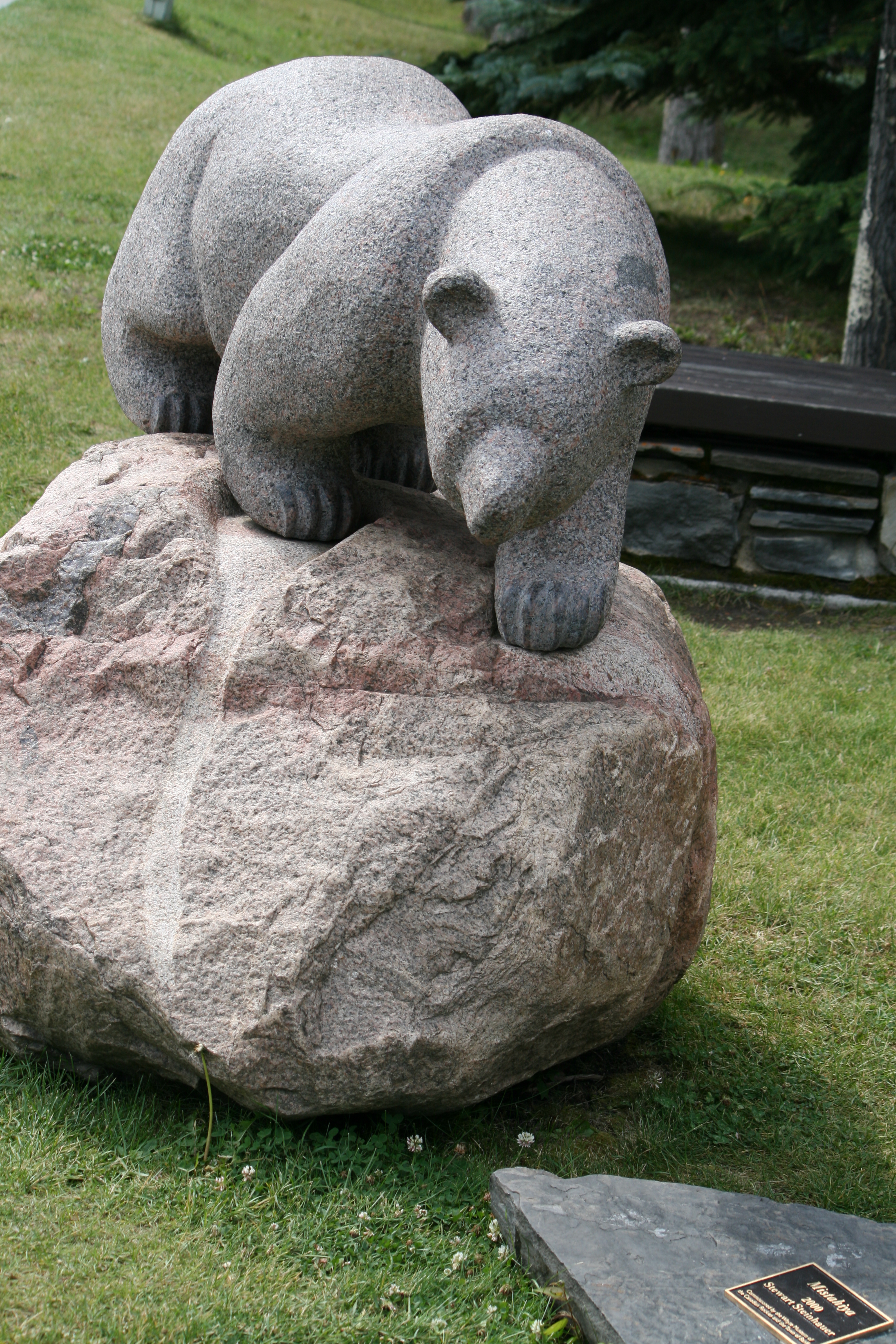
I had a whale of a time in the bear country
Where America bares its soul with peaks volcanic and snowy
It is not a Canada or US of A that the Rockies here divide
If only you know Pacific and Atlantic watersheds are which side?!
Then peering into mesmerizing blue greens of Lake Louise
Apart from the magical interplay of the clouds and sun therein
I thought there also was a grizzly glaring at me!
Back in the Pacific Northwest, this time away from the world of cetaceans, I was land locked having landed in the prairie land of Calgary, Alberta. The bear signs and bear proof garbage bins, across left behind Washington, with no sightings, only heighten the anticipation of spotting a grizzly as one commences the ascent into the Canadian Rockies. Once in sylvan Banff, the street signs and place names just about suggest a Hollywood enactment of the Grizzly, any minute.
There are fewer than 700 grizzlies in all of Alberta, which led the province to declare the species threatened and develop a recovery plan in 2008. Going through the newspaper life story of Charlie Russell, an Alberta naturalist who has been dubbed the Jane Goodall of Canada, one realizes how conservationists have been resisting reconsidering a hunt.
The Calgary Herald quotes Russell saying “We aren’t doing very well at getting along with them. The idea is to get them off (the threatened species list) so they can justify a hunt”. He suggests there are options to control problem bears. “It should be done by professionals”. “To zero in on that bear that is creating the problem is tricky thing to do and it has to be done by someone with a lot of skill.” Russell says it’s time for people – particularly hunters – to stop depicting bears as dangerous animals.
“Grizzly bears want to get along with us,” he says. “We need to understand them. We can’t keep telling lies. The lies that we tell about them are that they are ferocious animals. These are lies. I say so profoundly because I spent my life exploring these ideas.”
“It makes it very hard to live in bear country if you are all afraid of bears and bears are afraid of us.”
It’s a sentiment supported by Kevin Van Tighem, who just released a book called Bears: Without Fear. “He’s got a really important body of insights into bears that need to inform how we coexist with them in future,” says the former superintendent of Banff National Park. “It’s just such a crowded world”.
“We can’t simply keep on trying to keep bears and humans separate, because the bears are the ones that are going to lose. So we need to live closer to them, and that’s really what Charlie’s experiences have given us some clues about.”
As one begins the exploration within the Banff and Yoho National Parks, the erudite and exceptionally articulate guide Murray Wilson prepares for the first sighting. And lo, just before he can finish his list of do’s and dont’s there is something which is not a burnt tree stump but a baby bear prancing its way through the alpine thicket. The mother bear is not too far and the astute guide picks up her ear tag number ‘64’ and alerts us for two more cubs. There they are. Busy picking berries from the shrubs, delicately, without damaging a single leaf and no wastage. In the spring season they must eat vociferously and build their reserve for the winter hibernation. An adult can consume as much as 20K calories a day! While they stay focused on the task at hand we shoot wildly with the cameras, they carry on blissfully, ignoring the human presence – unthreatened.
With no large cats or the likes of elephants, the grizzly is indeed the rightful king of North American forests. Unlike the cetaceans it is not even in contention to be counted a human. All it needs is a human treatment. Perhaps we have a lot to learn from the respectful coexistence practiced by the First Nations people. The Grizzly will be fine and so would we, living in each other’s backyard.
“the earth is a living thing”
is a black shambling bear
ruffling its wild back and tossing
mountains into the sea…
LUCILLE CLIFTON
Glancing through the editorial page of Calgary Herald I am face to face with the stark realities of ageing in Canada. Not one but two stories bring out the challenges, that ‘healthcare’ segment ought to address in India and China, sooner than later.
“Standoff with dementia – Montreal case foreshadows baby-boomer crisis”: is about Havis, 71, the owner of estimated 180 guns, fired a handgun at police during the tense, 20 hour confrontation. It started with Havis mistaking workers from a utility company for intruders. There’s just one catch, reports the paper, Havis has dementia. It goes on to highlight that there is grave cause for alarm when one factors in the prediction that, with baby boomers’ demographic bulge moving through its senior years like a gopher through a snake’s stomach, cases of dementia are expected to double by 2030 and triple by 2050.
The Alzheimer Society of Canada has been quoted saying that by 2038, there will be 238,000 new cases of Alzheimer’s and other types of dementia diagnosed in the country, a rate of one every two minutes.
“Rx: No to assisted suicide”
This is a stark reminder of the fact that doctors are the forgotton ones in the heated debate over assisted suicide. A new Canadian Medical Association survey shows only about one-quarter of doctors would be willing to participate in an assisted suicide. The edit points out doctors do not want to help kill people.
They likely feel it violates the Hippocratic Oath; they may also personally not want to be responsible for killing anyone. Perhaps they simply cannot stomach the idea of going through the procedure that would lead to someone’s death. Regardless, it says, the results of this survey need to loom large in any parliamentary debate about whether assisted suicide should become legal in Canada.
A likely ‘popular’ debating theme-to-be in times to come, closer home?
After attending a recent event on insurance and risk management, in China, I wish to highlight an interesting facet on freedom of expression. The papers presented were in both Mandarin and English but eventually most of them narrowed down to actuarial arithmetic. What was most fascinating was not just the sheer diversity of papers presented but the open treatment of pain points in an evolving society.
- A Dynamic Function Regarding the Economic Benefits for Land-loss Farmers
- Research on the Financial Support Capability of China’s New-type Rural Social Pension Insurance
- Simulation Evaluation of Basic Medical Insurance Fund under the Global Prepayment System in Yunnan Province
- The Analysis of the Demographic Dividend in Life Insurance Market under the Background of Aging
- A Study on Pricing of Reverse Mortgage with an Embedded Redeemable Option – An Analysis based on China market
- Questioning Moral Hazard in Agricultural Insurance : Non-Evidence from a Quasi Natural Experiment on Livestock Insurance in China
- Impact of Accidental Expenditure on Inter-Temporal Uncertainty Decision of Household Consumption and Saving in Life-Cycle
- Protect Institution or Protect Elderly? A Discussion about the Choice of Risk Transfer Technology for Endowment Service Institution
- Welfare effects of compulsory liability insurance: system design, market and public opinion; analysis of compulsory insurance data based on generalized linear models
- A Countermeasure Research on Doctor-Patient Disputes and Medical Malpractice Insurance – Aspects of Local Policies and Regulations
- On Farmers’ Risk Avoidance Mechanism Construction in the process of the Farmland Transfer in China
- Agricultural Insurance and the Urban-Rural Income Gap-Based on a Dynamic Panel Mode of the GMM Estimation
- The Empirical Study on the Effect of Urbanization to Farmers’ Demand for Agricultural Insurance
Very rarely would one find such a plethora of socio-economic issues discussed at a forum. The beauty was that most of these issues, presented by academics and actuaries, had a long math tail. An actuary friend was quick to remind me that math is the most pure form of truth. Going by the analytics on diverse issues we can only but credit the hosts for the candidness, howsoever, esoteric for a non-actuary!

