Published in I.VW-HSG Trendmonitor: Delighted to explore and co-author this facet of Climate Change with two eminent scholars!
Old & New: Walking past; looking up and occasionally down…


Hong Kong has been in the news of late for the ongoing civil unrest. One of the woes that unsettles many wishing to retain it as a long-term abode – is the price of property. The tall and sleek skyscrapers are not all that this erstwhile English colony is about. Hidden in pockets is the stark and growing poverty that too could be plotted on a graph like the tall towers which keep getting taller. The ‘One country, two systems’ expounded by Chairman Deng Xiao Ping and agreed to by Margaret Thatcher was certainly not about the socio-economic contrast that its population has today polarised into.
When I first arrived to work in Hong Kong during the early 1990s, I was told how easy it was to buy a car there but very expensive to rent or acquire a parking place. I was shocked by the rentals of what were known as ‘shoe box’ apartments. Most Hong Kongers lived in them as they continue to live now, if only they can afford them. Hong Kong’s average house size is 484 square feet and considering average household size of 2.9, an average Hong Konger lives in 161 square feet.
And an insight from Associated Press makes even this sound like a luxury. What it refers to as a dark side to the property boom in wealthy Hong Kong, where an estimated 200,000 people priced out of the market must live in ‘coffin homes’. They can be so small that a person cannot even fully stretch his or her legs!
“A dark side to the property boom in wealthy Hong Kong, where an estimated 200,000 people priced out of the market must live in ‘coffin homes’.
The rents of commercial properties at Central in Hong Kong island then were only second to the Ginza district of Tokyo. Newspaper reports would allude to the atrocious per square inch cost of keeping a waste-paper basket in some of the top marquee buildings in the location. The wares sold from fancy designer shops – were duly marked up on account of the prohibitive rents. The prices were good enough to shock visitors from the US. On the flip side, but on a positive note were stories of aspiring migrants from the Territory trading their tiny overpriced homes for large mansions in Canada or Australia, ahead of the 1997 handover.
Not surprisingly at the very root of the current discontent is the high cost of Hong Kong’s housing inequality. Many of those who have joined the protest movement seem to believe that democracy will address this! Ironically, not much has changed on this front since then – notwithstanding the change in the masters. Let’s unpeel further.
Hong Kong is largely dependent on traditional industries such as finance and real estate. These two sectors account for 70 percent of the economy. Much of its manufacturing steadily started moving to Shenzhen and beyond in the Guangdong province – to leverage the labour costs which once upon a time were a tenth of Hong Kong. In just a little over two decades Shenzhen has risen from a farming community and in 2018 raced ahead of Hong Kong’s GDP. 70 percent of its economy is derived from manufacturing and technology. The rapid rise of Shenzhen too is a cause of grief in Hong Kong. The insecurity amongst the residents is bound to get further heightened with the emergence of the Greater Bay Area with Macau SAR, Zhuhai and HK SAR into its fold.
Land sales account for 93% of the Hong Kong government’s capital revenues. It is aligned closely with the elite and vested interests – inherited from the colonial past.
Land sales account for 93% of the Hong Kong government’s capital revenues. It is aligned closely with the elite and vested interests – inherited from the colonial past. High housing prices is already causing serious limitations on the sustainability of Hong Kong’s growth. Unless the supply side is freed from clutches of the handful of builders the solution does not seem in sight.
Talking to cabbies during travels between Hong Kong and Singapore in my time – when these city states were ferocious tiger economies – two common ‘feedbacks’ on either side were – ‘Singapore is like a hospital’ and ‘Your Hong Kong people are very rude’! Thanks to a well-managed nursing of public housing the Lion City has thwarted a housing crisis, as of now. However, Hong Kong unfortunately remains in the eye of a rude storm.
The shifting of the airport from the Kai Tak in Kowloon to Chek Lap Kok in the Lantau island – was supposed to boost Hong Kong’s fengshui in terms of a westward property development of the Special Administrative Region. What will eventually calm the frayed nerves of the residents – a dose of freedom alone or a nudge from the big brother to make housing more affordable and plentiful to the common man, or both? Surely some learning for a rapidly urbanising India where housing must remain affordable.
Peter Bosshard is a Swiss native who resides in California and works for The Sunrise Project – an Australian non-profit with significant global impact. Their mission is to support social movements in scaling up the transition beyond fossil fuels as fast as possible. They are a team of experienced advocates, analysts and communicators who are driven by a passion to solve the climate crisis. As part of their work they coordinate international campaigns to convince the insurance industry, asset managers and other actors to accelerate the low-carbon transition.
Praveen Gupta: How does one transition the insurance industry and other investors from fossil fuel to clean energy? Particularly as it entails lifestyle change for every individual.
As a first step, insurers should stop covering and investing in the coal sector and should expand their services for renewable energy projects instead.
Peter Bosshard: Acting for a safer and healthier society is nothing new for the insurance industry. Insurance companies have established fire departments, prepared building codes, and created incentives for people to quit smoking. The climate crisis is the greatest threat which humanity has ever faced, and the insurance industry needs to play a leading role in addressing it. As a first step, insurers should stop covering and investing in the coal sector and should expand their services for renewable energy projects instead.
PG: The insurance industry is conditioned as a handmaiden of a larger industry which is deeply steeped into fossil fuels. How do you extricate it from this industrial age mindset?
PB: The renewable energy sector is rapidly out-competing the coal industry, with the latest solar tariffs in India for example 20-30% lower than average coal-fired power tariffs. Even so, old habits die hard and intellectual inertia as well as political patronage – the “power of incumbency” – are still extending the coal industry’s lease of life. Forward-looking insurance leaders need to understand that climate change will bring massive disruptions to our economies and societies, and they need to position their companies for a low-carbon future. Outside pressures can help with this process: In Europe, Australia and the US, protesters are blockading the offices of coal insurers, insurance clients are asking for coal-free carriers, and risk management students are making it clear that they don’t want to work for employers which underwrite climate destruction.
Forward-looking insurance leaders need to understand that climate change will bring massive disruptions to our economies and societies, and they need to position their companies for a low-carbon future.
PG: Is there a risk of some insurers and investors taking a pro-climate posture only as a matter of positioning? In the process running with the hares and hunting with the hounds?
PB: This risk always exists, particularly in an industry that is not transparent about who is underwriting what. However, a lot of insurance professionals agree with the need to accelerate the low-carbon transition and have started sharing information about climate-destroying deals with campaign groups. Saying one thing and doing another is a risky proposition for companies with well-established public brands today.
PG: Transitioning calls for proselytising each stakeholder. Insurers generally do not seem to have a good track record of saying a ‘No’ and taking a principled stand. Where and how do you begin?
PB: Like most other businesses insurance companies indeed don’t like to take a principled stance. Yet as the climate crisis turns into an emergency. Insurers have had to learn that all actors in society are expected to act in line with international climate goals today. In the last two and a half years, 17 international insurance companies – including the world’s biggest primary insurers and reinsurers – have stopped or limited insuring coal, and more than 30 have divested their assets from the coal industry. Close to 60 insurers and other financial institutions have for example ruled out getting involved in the Adani Group’s giant Carmichael coal mine in Australia – a project which has become a global test case for responsible insurance.
In the last two and a half years, 17 international insurance companies – including the world’s biggest primary insurers and reinsurers – have stopped or limited insuring coal, and more than 30 have divested their assets from the coal industry.
PG: To what extent do you believe does the fixation with quarterly performance and short-termism come in the way?
PB: Short-termism is a big challenge for insurers as well as other business sectors. Pension funds and other big institutional shareholders need to take a longer-term view. They need to realise that it isn’t in the interest of their members and investors to maximise quarterly returns by sacrificing a livable future.
PG: Car sales in India have seriously slumped after several years of a dream run. On the flip side should this not be a blessing for our environment given the alarming state of air pollution. Moreover, an opportunity to kickstart a sustainable mobility solution?
PB: The internal combustion engine originally brought convenience but nowadays is choking our cities, our air and our climate. The future of the car is the electric vehicle, and this revolution will happen more quickly than most people expect. Yet city planners also need to realise that everyone’s quality of life improves if you don’t need cars to get around.
PG: My best wishes – to you Peter – in all your endeavours towards decarbonising our industry.
My Op-Ed in The Economic Times of September 28, 2019. Insurers must act responsibly to ensure #sustainability: https://economictimes.indiatimes.com/blogs/et-commentary/ensure-insurers-know-the-climate/
Every spring cleaning has its rewards. One of the rewards this time around – while emptying some boxes after a hiatus of almost 22 years – was this sepia piece:

A reaction to my transitioning from Bangkok to Hong Kong 26 years ago! After all the ‘jarajorn maak maak’ (too much traffic, as the Thais would say) – commuting in the then English colony was a welcome relief. Mainland Chinese city roads were still dominated by the bicycles. Flying in and out of Hong Kong meant Kai Tak airport. LukMaChow, across the border into neighbouring Guangdong province, was dominated by duck farms. Shenzhen was coming out of a slumber. Time does zip past…
Walter Murphy (WM) is a courageous man determined to follow his calling. The pull of Climate Change & ESG made him recently give up a very promising and successful career in the insurance industry. His solid insights into what will and will not work in the Climate Change agenda come from his first hand understanding of the levers of US politics. As a young man he worked at the Capitol Hill for both – the House of Representatives and the Senate. Here he unravels the wheels within wheels of the American Climate Change dynamics, as it unfolds.

PG: Jay Inslee truly set the tone for fixing the Climate Crisis but regrettably decided to stay out of the Presidential race. Thankfully, he will contest for another term as the Governor of Washington. Do you see this as a set back to the Climate Change movement?
WM: I don’t see it as a set back at all. Rather, I believe that Governor Inslee’s mere presence in this campaign pushed the climate change agenda to the forefront sooner than it eventually would have. Some would say the governor’s decision to run entirely on the platform of climate change was quixotic, but I find it fascinating and heartwarming that after his recent decision to drop out of the race, the recognition and plaudits he received from all of the remaining Democratic candidates and from many of his peers such as former Secretary of State John Kerry is a testament to the man and the convictions he has stood for all of his political life.
Governor Inslee was, I believe, the first candidate to release detailed and extensive proposals on what he felt the country needed to actively be doing to stem the ravages of climate change and to reduce this country’s carbon emissions of which the United States has been a major contributor since the early 20th century. All of the Democratic candidates have since introduced their own proposals on how they propose to tackle climate change, almost one upping each other in the process in a climate change arms race, culminating with Senator Sanders’ $16 trillion proposal to fight climate change. Governor Inslee moved the needle on this. Suffice it to say that any future candidate, regardless of whether they are Democrat, Republican or independent, running for national or statewide office will have to include a climate change plank in their platform. I believe it will become the norm and not the exception.
Governor Inslee’s moment in the 2020 presidential campaign may have been ephemeral but it was impressionable. He should be proud of his contribution.
PG: Do you see the Green New Deal as a bipartisan proposition? Does it enjoy much following in the US? Does it mean there is hope if only Democrats were to come in power?
WM: I believe any momentum in implementing any of the proposals outlined in the Green New Deal or for that matter any proposed climate change legislation will advance and succeed long term only if there is some bipartisan consensus in Congress. The American people’s regard and attitude towards the effectiveness of the United States Congress and its ability to compromise and evolve meaningful legislation is at a nadir. It will take a significant amount of work and consensus building for any proposals of the Green New Deal to achieve bipartisan support, but I am somewhat optimistic that it can be done.
First of all, the Green New Deal resolution as proposed by Rep. Alexandria Ocasio-Cortez (D-NY) and Senator Edward Markey (D-MA) is a fourteen-page resolution which calls for a “ten year national mobilization” to address climate change and economic inequality. Both Democrats and Republicans critiqued the Deal when it was announced, and it is highly unlikely that all of the proposals and initiatives laid out in the resolution has any chance of passing as a whole. However, I think that incremental changes can be made and that there could be enough support building amongst the ranks of Republicans that some of the proposals outlined in the Deal could come to fruition at some point.
Although there remain some Republicans who outright reject the existence of climate change and many who continue to deny the basic science presented to them, there are those who not only have accepted that climate change exists but that is anthropogenic in nature. These Republicans realize the future costs involved in not addressing the climate crisis and are more receptive to finding solutions now than they were ten years ago.
The other factor I believe will generate more support amongst Republicans is that the constituencies that traditionally support the GOP more and more are pushing its rank and file to further address the economic ramifications that not addressing climate change will have if left ignored. Climate change has permeated the board rooms of all the major corporations. Shareholders and customers are demanding more environmental, social and governance from the companies they do business with and whose money they entrust to invest. The financial sector recognizes the global implications that climate change is having on the bottom line and is requesting Congress to a greater extent to be more proactive in finding solutions at the federal and state levels.
There long has been an adage that Americans vote with their pocketbook. This is what I believe will drive the narrative going forward and will force both parties to act on significant legislation…
Climate change always has been a “green” issue in terms of the effects it has on our planet’s ecosystems. Ironically, the reason why we eventually will tackle this conundrum at the scale that is needed is due to another “green” issue – money and economics. There long has been an adage that Americans vote with their pocketbook. This is what I believe will drive the narrative going forward and will force both parties to act on significant legislation – whether that is increasing funding for research and development, eliminating subsidies to the fossil fuel industry or expanding electric vehicle charging infrastructure.
I also would like to present one more factor that I deem necessary in order for any Green New Deal climate change legislation to advance on a bipartisan level. Since Americans do have this cynical and mistrusting attitude toward their federal government, I think it is imperative how our legislators present any climate change legislation to the public realm. How legislators spin the climate change debate is as important as what ultimately ends up in any bill that addresses climate change.
The word “spin” is used a lot in Washington mostly with negative connotation. But I think climate change needs to be put forth as an opportunity to make positive change in our world. So much of the narrative when it comes to climate change is so pessimistic, so doom and gloom and rightfully so. Negative sells in the media and climate change is no different. By accentuating the positives that can be gained by fighting climate change, I believe the more the American people will be receptive to the ideas and proposals put forth by any legislator regardless if they are Democrat or Republican. There is a burgeoning offshore wind industry on the precipice of taking off in this country.
By spinning the benefits of what this industry would bring in terms of economics (the other “green”) – thousands of long term, sustainable new jobs, lower electricity rates, cleaner air which leads to lower healthcare rates – I think Americans would get behind legislation faster than telling them how much carbon dioxide emissions are bad for you and that this MUST be done to meet the standards set in an international treaty many know nothing about. Keeping climate change tonally positive will resonate more and hopefully persuade the American people to push its legislators to work together in the spirit of bipartisanship to enact meaningful climate change legislation.
PG: California has been historically well ahead of all states when it comes to environment. What is it that California is doing to make insurance less dysfunctional if not fully functional while actively promoting sustainability? Does the California Insurance Commissioner have an action plan in sync with the state policies?
WM: There’s a saying that “everything is bigger in Texas”. While that still may hold true, it may one day be amended to say, “everything is bigger in Texas – until you move to California”.
The economy of California is the largest in the United States, boasting a $3.018 trillion gross state product as of 2018. As a sovereign nation (2018), California would rank as the world’s fifth largest economy, ahead of the United Kingdom but behind Germany. The state is almost 164,000 square miles with diverse physical topography such as its 840 miles of coastline, to the snowcapped Sierra Nevada Mountains running through her central spine, to the economic bounty of its Imperial Valley and all the way down to the semi-arid steppe climate of southern California. As of 2018, 39.56 million people called the Golden State their home, making it the most populous state in the union and the state with the most electoral votes (55) in the electoral college. All of this makes California the “Big Enchilada”.
Because of California’s sheer size and diversity, California insurers have diverse underwriting vulnerabilities to climate change.
While summer wildfires have dominated the attention, the state also has had to deal with severe drought. One-third of California’s water supply comes from the melting snowpack of the Sierra Nevada Mountains. Meteorologists and hydrologists already are seeing fluctuating weather patterns that will adversely affect the snow levels in the future. Long term drought also has affected the state’s aquifers due to over pumping for agricultural purposes.
California Insurance Commissioner Ricardo Lara has teamed up with the United Nations to develop “sustainable insurance” guidelines that would help address climate-change-related disasters such as coastal flooding and larger wildfires – the first such partnership of its kind between the international organization and a U.S. state.
“We have a historic opportunity to utilize insurance markets to protect Californians from the threat of climate change, including rising sea levels, extreme heat and wildfires,” Lara said in a statement. “Working with the United Nations, we can keep California at the forefront of reducing risks while promoting sustainable investments.”
Commissioner Lara recently has appointed the nation’s first Deputy Insurance Commissioner of Climate and Sustainability in the United States. The Department’s new Climate and Sustainability Office will address the threat of climate change by working with the insurance industry, climate experts, California and international leaders. Commissioner Lara also is currently the vice-chair of the NAIC’s Climate Change and Global Warming Working Group. This Working Group reviews climate change risk to insurance companies, receives information regarding the use of modeling by carriers and their reinsurers concerning climate change and its impact on insurers through presentations by various experts and interested parties. The Working Group also investigates sustainability issues and solutions related to the insurance industry, and reviews innovative solutions, including new insurance products.
For more information on what the California Department of Insurance is doing to manage the risks associated with climate change, check out this comprehensive report as provided by the Department.
PG: Likewise, are you seeing any positive action flowing into the insurance policies at the Washington state thanks to the urgency and gravity of Mr. Inslee’s vision for addressing Climate Crisis?
WM: Washington Insurance Commissioner Michael Kreidler definitely has been a leader when it comes to addressing the threat of climate change to the insurance industry and the consumers that he is trying to protect. The commissioner chairs the National Association of Insurance Commissioners’ (NAIC) Climate Risk and Resilience Working Group (www.naic.org). The group’s goals include:
- Engaging with industry and stakeholders in the U.S. and abroad on climate related risk and resiliency issues;
- Investigate and recommend measures to reduce risks of climate change related to catastrophic events; and
- Identify insurance and other financial mechanisms to protect infrastructure and reduce exposure to the public.
Governor Inslee, Commissioner Kreidler and Washington Commissioner of Public Lands Hilary Franz recently authored an op-ed in The Seattle Times extolling the threats that climate change poses to the state’s communities. This kind of synergy is welcomed and needed in the uphill battle we face against climate change. Changing weather patterns and drier summers in California and the Pacific Northwest will continue to result in more prevalent and intense wildfires. As wildfires get worse, Insurers are quietly reducing their exposure to fire-prone regions across the Western United States, putting new pressure on homeowners and raising concerns that climate change could eventually make insurance unaffordable in some areas.
PG: What in your view ought to be the fundamental shift in the way insurance products and processes are designed so as to facilitate the decarbonization process?
WM: The insurance industry as a whole needs to do a better job coordinating with stakeholders such as regulators, governments and insurance standard setting organizations as how best to broaden their initiatives in mitigating the effects of climate change and increasing their investment in climate change infrastructure. According to Lloyd’s of London, damages from weather-related losses around the world have increased from an annual average of $50 billion in the 1980s to close to $200 billion in the past 10 years. At this rate, the economic costs to the industry will severely hamper its ability to invest in assets as would have in the past. Pro-action rather than reaction on the part of the industry is imperative for its future survival.
The insurance industry should continue to institutionalize climate change as a core business issue, expand its contributions towards building financial resilience to climate risks and supporting the transition to a low-carbon economy by collaborating with governments and other key stakeholders. Governments and the insurance industry should explore ways to support climate resilient and decarbonized critical infrastructure through the industry’s risk management, underwriting and investment functions. The industry needs to continue supporting the transition to a low-carbon economy through its underwriting business, investment strategies and active reduction of its carbon footprint.
PG: From your time at the Hill, is there any learning addressing Climate Change may have from Healthcare (Clinton/ Obama initiatives)?
WM: I think one of the key elements in passing successful climate change legislation will be who are the particular members of Congress driving the legislation and leading the efforts to include all factions in the debate. For me, the message bearer will be just as important as to what eventually is included in any legislation.
The decision to appoint First Lady Hilary Clinton as the point person on reforming Healthcare in 1994 had great ramifications and ended up being one of the biggest obstacles to passing any meaningful legislation. Even though Democrats controlled both houses of Congress, Mrs. Clinton was such a lightning rod for the opposition, even back then, that many Republicans bristled to work across the aisle to pass any tangible legislation resulting in a failed attempt to reform Healthcare and, in a sense, helped to spur on the Newt Gingrich led Republican Revolution which led to the Republican takeover of the House of Representatives and Senate in the 1994 midterm election.
Conversely, when I was working on The Hill in the late 1990’s, Congress was able to pass the Bipartisan Campaign Reform Act. The effort was spurred by the alliance of Senator John McCain (R-AZ) and Senator Russ Feingold (D-WI) – two respected members of the Senate who had a reputation and history of building coalitions. Their cachet as being more moderate members of their respective parties and their ability to compromise and work well with most members of the Senate ultimately resulted in passage of a campaign finance bill. It was not a perfect bill, but it did make significant changes to campaign finance laws.
Therefore, whoever is “driving the train” will be an integral component if any meaningful climate change legislation is going to make it through the legislative sausage grinder that is the United States Congress. If the charge is being made by someone such as Rep. Alexandria Ocasio-Cortez (D-NY) and Senator Bernie Sanders (D-VT), I really don’t see significant progress being made. Any meaningful legislation will need the leadership of moderates in both parties joining together to have any chance of producing significant climate change action.
The other issue I see is that there are many activists out there who want to see radical and sweeping climate change to battle the mounting threat of climate disruption. Senator Sanders, in fact, is calling for a “revolution” against climate change. Unfortunately, passing “revolutions” in Congress at any time in our nation’s history is not the norm, especially during this era of bitter and rancorous partisanship. Seismic change is not going to happen at the scale that we really need to happen in order to meet the threshold levels laid out in the Paris Agreement. Any gargantuan legislative proposal is going to turn members off, as they will think it impossible to navigate through both chambers of Congress.
Although many climate change activists might not be willing to accept tackling climate change via smaller increments, I believe it’s the only way to make any headway at all. Small victories will lead to more victories. Stringing together victories would build confidence and possibly snowball into larger proposals and greater attempts to make effective change.
PG: Is the average American serious about Climate Change? Does he/ she believe in the virtues of the Paris Agreement?
WM: In a recent Washington Post-ABC News Poll, 62% of Americans disapproved of the Trump administration’s handling of climate change compared to only 29% who approved. Year after year, Americans not only have become more accepting that climate change is a real threat to their existence and way of life, but the issue slowly has risen to become one of the top political issues of the 2020 presidential campaign.
As has the rest of the world, the United States increasingly is seeing more adverse weather conditions than ever before. From flooding in the Midwest, to oppressive heat waves in the Northeast, to longer and more intense hurricane seasons in the South, to epic wildfires in the West, Mother Nature has gotten American’s attention. There certainly are those who still debate and, in some cases, totally dismiss the science put forth in defense of climate change. But those numbers are diminishing year after year.
The more people are faced with a natural disaster event, the more people will call for action. Whether they believe in the virtues of the Paris Agreement is difficult to say.
The more people are faced with a natural disaster event, the more people will call for action. Whether they believe in the virtues of the Paris Agreement is difficult to say. The Paris Agreement was not legally binding, and countries are on their honor to adhere to the proposals to reduce the greenhouse gas emissions. President Trump’s decision to withdraw from the Agreement, I believe, galvanized many governors, mayors and state officials to carry on the efforts outlined in the Agreement. Most of the climate change action in the United States is being driven at this level.
I think what is more important is how Americans feel climate change is affecting them economically and their quality of life rather than whether they support the Paris Agreement. Support for renewable energy and a reduction of carbon emissions, in my opinion, only is going to increase and will continue to remain one of the top issues in the political arena for decades to come.
PG: Many thanks, Walter! May your passion and drive bring about the desired change to make our Planet truly sustainable.
Mrs Anjani Naravane’s (AN) journey as an author is truly inspiring. Starting from cookery books in Marathi – her versatile explorations continue – as she endeavours to delight readers of Marathi with the gems of her discovery in English and Gujarati literature. Now in her late eighties, she already has 35 books to her credit. These came about with familial responsibilities over the years.

PG: You have had spectacularly long writing
innings. When and how did it all begin?
AN: It happened like this: My sister-in-law (brother’s wife) used to
contribute to one Marathi magazine. Once she requested me to write there about
the dinner parties that we used to give because (a) we had a cosmopolitan group
of friends, (b) we used to have overseas guests staying with us for some days –
being members of a group called International Friendship League run by Shri
Mahendrabhai Meghani, and (c) I was fond of cooking, learning new recipes from
different countries! So I wrote about a party we had recently hosted when a
Swedish architect was staying with us. It included the menu and recipes.
The Editor and she liked the article and I was asked to write more often. This is how it all began. I started writing on various other topics too. I wrote three cookery books on different topics for three different publishers. So that is how I became a writer in Marathi! I also started translating good books (those that I liked) from English and Gujarati into Marathi.
PG: How many books in all, till date?
AN: Thirty five. These include five of my own, some from English into Marathi and the rest from Gujarati into Marathi.
PG: How have you evolved as an author? What are the most preferred themes you like to write about? Any specific likes for translations that you undertake?
AN: I like to talk to or find out about the younger generation’s problems. I wrote two books on this subject which are my own. The third one was given to me by my publisher to translate from English to Marathi, which I did. I also like to translate biographies of which I have done three.

PG: Would you like to mention what these problems tend to be and how are they any different from those faced by the earlier generations?
Each new generation seeks more independence. In India, we often see two or three generations living together… But generally in Western countries, I think when a couple decides to get married, they will look for an accommodation first!
AN: Each new generation seeks more independence. In India, we often see two or three generations living together. I read that in Japan too, this custom prevails; maybe in Germany as well. But generally in Western countries, I think when a couple decides to get married, they will look for an accommodation first! This did not happen in India atleast, when the new bride was expected to take over much of the physical work from the mother-in-law. So the problems are essentially different.
When people get old in the West, they are put in old-age homes; here they are (willy-nilly perhaps) looked after by their children, for lack of really good homes for the aged and also the concept is yet to take root.
PG: Which were the three biographies that you translated?
AN: 1. It’s Not About the Bike – My Journey Back to Life, by Lance Armstrong. Translation in Marathi, first published in March 2009, went into four editions.
2. Russi Mody, The Man Who Also Made Steel – published in June 2010.
3. Turning Points: A Journey Through Challenges, by Dr. A P J Abdul Kalam – published in Marathi in November 2012. It went into six editions.
I realised that two of these are actually speaking autobiographies.
PG: Which is the most favourite book written by you, till date?
AN: I am not writing much myself these days. The most favourite book is a Gujarati novel written by the well-known Gujarati author Shri Dhruv Bhatt – Tattvamasi (literally, That Thou Art). It received the Sahitya Academy Award for the best Gujarati book that year. My Marathi translation of this book went into four editions or reprints. I translated the same in English too, on assignment by the Academy.

PG: Who do you write for – yourself or the fan following?
AN: No fan following! I translate into Marathi from English and Gujarati if I like the book and I think Marathi readers will like it.
PG: What next and when?
AN: Another novel on Mahabharat’s Bheeshma, titled Pratishruti (Remembering the Past), by Dhruv Bhatt has been translated by me into Marathi and will be out soon. Also, I have been translating good Gujarati short stories into Marathi, a collection of these should be in the market the next year or so. I think I will be calling it a day then!
PG: How in your view can more women be drawn into writing?
AN: I feel, by nature, women here are more reticent to put their ideas in writing. I had no problem because the family I married into was progressive. My Mother-in-law (born in 1894) was one of the first lady graduates in India! The situation is changing very fast and improving, giving women a wider perspective on life. The next generation is already different.
PG: Grateful thanks for the wonderful insights!
Any visit to China, wherever it is, your encounters never cease to amaze. This time the CICIRM took me to Chengdu, Sichuan. It wasn’t just the ancient past but elements of the present and the future, as well, that presented themselves in the home of Taoism, Szechwan or Szechuan cuisine, Pandas and what have you!


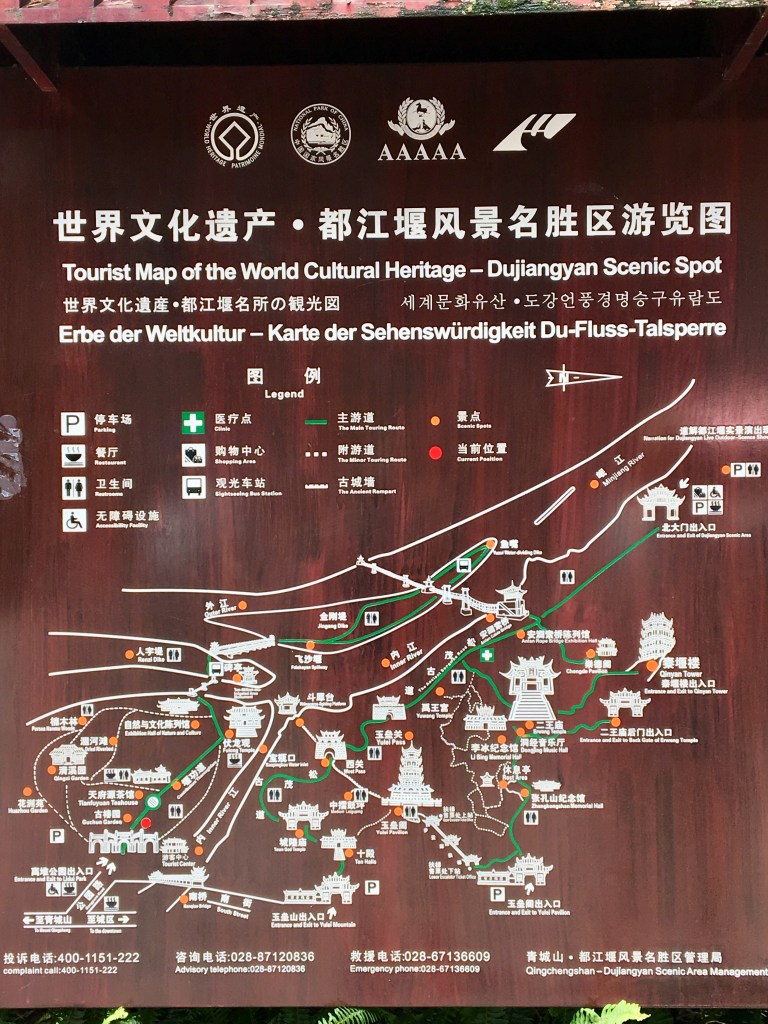
Dujiangyan is a pretty town on the banks of the Min River, the longest tributary of Yangtze. Its world heritage site draws immense crowds. What it is best known for is an ancient irrigation system. It was originally constructed around 256 BC by the State of Qin as an irrigation and flood control project. The water management scheme is still in use today.

Li Bing, the then governor of Shu for the State and his son – harnessed the river using a new method of channeling and dividing water rather than simply damming it. Till date it protects the Chengdu Plain from flooding.










The Panda Valley is home to Chengdu Field Research Centre. Here the Giant Pandas bred in captivity are readied to be released in the wild. An endangered past – in good safe hands of the present – ensures a secure future! The bonus comes in the form of also sighting the Red Pandas – no relatives of the black and white ones.


The Tami robot installed next to the Hotel front desk will very soon provide multiple assistance to the guests. Be these local attractions, details of the hotel or register guests for events. Customers will be able to interact with Tami using voice or touch screen commands. You no longer need to struggle with a Google translator to figure out what the hotel staff wishes to say or know! Tami is also expected to break into song and dance during coffee breaks.


 The Diversity Blog